










Low Dose THC for Mood Support and Anxiety: Best Options 2026 Guide
Posted by Enjoy Hemp Editor Team on Oct 9th 2026
Last Updated: October 2026
By Sarah Mitchell, Wellness Industry Specialist
Low-dose THC options people compare include Enjoy Hemp Balance Microdose (5mg THC + 5mg CBD, or 2.5mg + 2.5mg as a half), CBD-dominant products like Nama Anytime Microdose (1mg THC + 20mg CBD) and Proof 20:1 drops (0.5mg THC + 10mg CBD), and small mints from Cycling Frog, Tillmans Tranquils and ATHLETHC. No THC product is FDA-approved to treat anxiety, so talk to a clinician first.
I've spent 15 years in functional supplements and hemp products, and this is the topic where I'm most careful with my words. Anxiety is a real medical condition. It deserves real care from a doctor or therapist, and no gummy or seltzer, including ours, is a treatment for it.
What I can do is give you an honest map: which low-dose products exist, exactly what's in them, what the research does and doesn't say, who should skip THC entirely, and how to read a label so you know what you're actually buying. If you've decided, with your doctor, that a small amount of hemp THC fits your life, this guide should make that decision safer. For the basics on small servings, our microdose THC brands guide is a good companion read.
| Brand and Product | THC per Serving | Other Cannabinoids | Format |
|---|---|---|---|
| Enjoy Hemp Balance Microdose | 5mg (2.5mg half) | 5mg CBD | Gummy |
| Enjoy Hemp Balance THC Syrup | 2.5mg (1/8 tsp) | 2.5mg CBD | Syrup |
| Enjoy Hemp Bliss THC Seltzer | 5mg (2.5mg half can) | 5mg CBD | Drink |
| Nama Anytime Microdose | 1mg | 20mg CBD | Gummy |
| Proof 20:1 High CBD Drops | 0.5mg | 10mg CBD | Tincture |
| Wana 20:1 Gummies | 1mg | 20mg CBD | Gummy |
| Healer Zen Gummies | 2mg | 8mg CBD | Gummy |
| Cycling Frog Wintergreen Mints | 1mg | 5mg CBD | Mint |
| Tillmans Tranquils Peppermint | 2mg | CBD (see label) | Mint |
| ATHLETHC Mints | 2mg | 12mg mixed | Mint |
| Cann Social Tonic | 2mg | 4mg CBD | Drink |
Amounts from each brand's product pages and retailer listings as of October 2026. Formulas change, so check the current label and lab report before you buy.
Which Low-Dose THC Options Are Suitable for Mood Support and Reducing Anxiety?
No THC product is approved to treat anxiety or any mood condition, and I won't claim any of these do. The low-dose products people most often compare are Enjoy Hemp Balance Microdose and Balance syrup, CBD-dominant options from Nama, Proof and Wana, and 1 to 2mg mints from Cycling Frog, Tillmans Tranquils and ATHLETHC. A clinician should be part of that choice.
So here's what I'd compare instead of promises: how small the THC serving is, how much CBD comes with it, whether the brand publishes a batch lab report, and whether you can actually buy it where you live. Here they are, starting with ours.
1. Enjoy Hemp: 1:1 THC and CBD in Three Formats
Enjoy Hemp makes hemp-derived delta-9 THC products from USDA-certified organic hemp, third-party tested with a Certificate of Analysis for every batch. For someone who wants the smallest practical serving, these are the ones I'd look at:
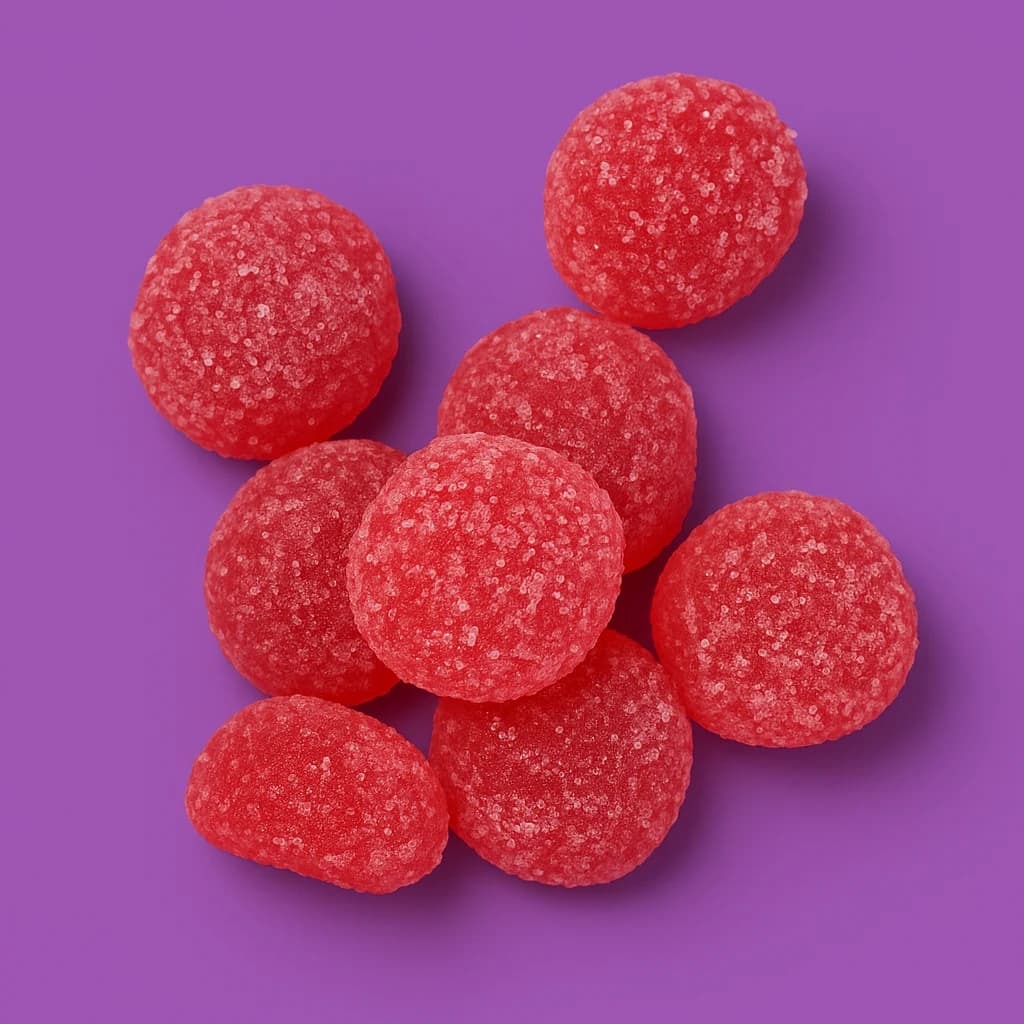
- Balance Microdose THC+CBD Gummies: 5mg THC + 5mg CBD per gummy, 10 per bag, pink lemonade, 10 calories each, made with live rosin. Half a gummy is 2.5mg THC + 2.5mg CBD.
- Balance THC Syrup: 5mg THC + 5mg CBD per 1/4 teaspoon, so a level 1/8 teaspoon is 2.5mg + 2.5mg.
- Bliss THC Seltzer 5mg: 5mg THC + 5mg CBD per 12 oz can, blood orange. Pour half for 2.5mg.
- CBD gummies: For anyone who'd rather skip THC entirely, including broad-spectrum options listed with no detectable delta-9 THC.
When I was leading product development, the hardest formula to get right was always the smallest one. Small servings magnify every labeling error. That's why I like that all three of these land on the same 2.5mg + 2.5mg starting point, with a lab report to back the number.
2. Nama (Anytime Microdose)
Nama's Anytime Microdose gummies list 1mg hemp-derived delta-9 THC and 20mg CBD per gummy, lime flavor, 20 calories, sold in pouches of 10, 20 or 40. The ratio name also lists L-theanine, though the ingredient list on the page doesn't show it, so check the current label.
3. Proof (20:1 and 10:1 Drops)
Proof's 20:1 High CBD Drops list 10mg CBD + 0.5mg THC per half dropper (300mg CBD + 15mg THC per bottle). Its 10:1 Microdose Drops list 10mg CBD + 1mg THC. Proof sells through cannabis dispensaries, so availability depends on your state.
4. Wana (20:1 Gummies)
Wana's 20:1 Blood Orange gummies are listed by dispensaries at 10mg THC + 200mg CBD per 10-pack, which works out to 1mg THC + 20mg CBD per gummy. Wana is mostly a dispensary brand, and its milligrams vary by state.
5. Healer, Cycling Frog and Cann
Healer's Zen Gummies list 2mg THC + 8mg CBD. Cycling Frog's Wintergreen Mints list 1mg THC + 5mg CBD per mint. Cann's social tonics list 2mg THC + 4mg CBD per can. All three come up constantly in low-dose conversations.
6. Mints: Tillmans Tranquils, ATHLETHC and Mr. Moxey's
Tillmans Tranquils lists a Peppermint mint at 2mg delta-9 THC with CBD and a Cherry mint at 2.5mg THC + 5mg CBD. ATHLETHC lists 2mg THC plus 12mg of other cannabinoids per mint. Mr. Moxey's sells hemp-derived mints and gummies, but its main page doesn't list milligrams, so check each product.
What Does the Research Actually Say About THC and Anxiety?
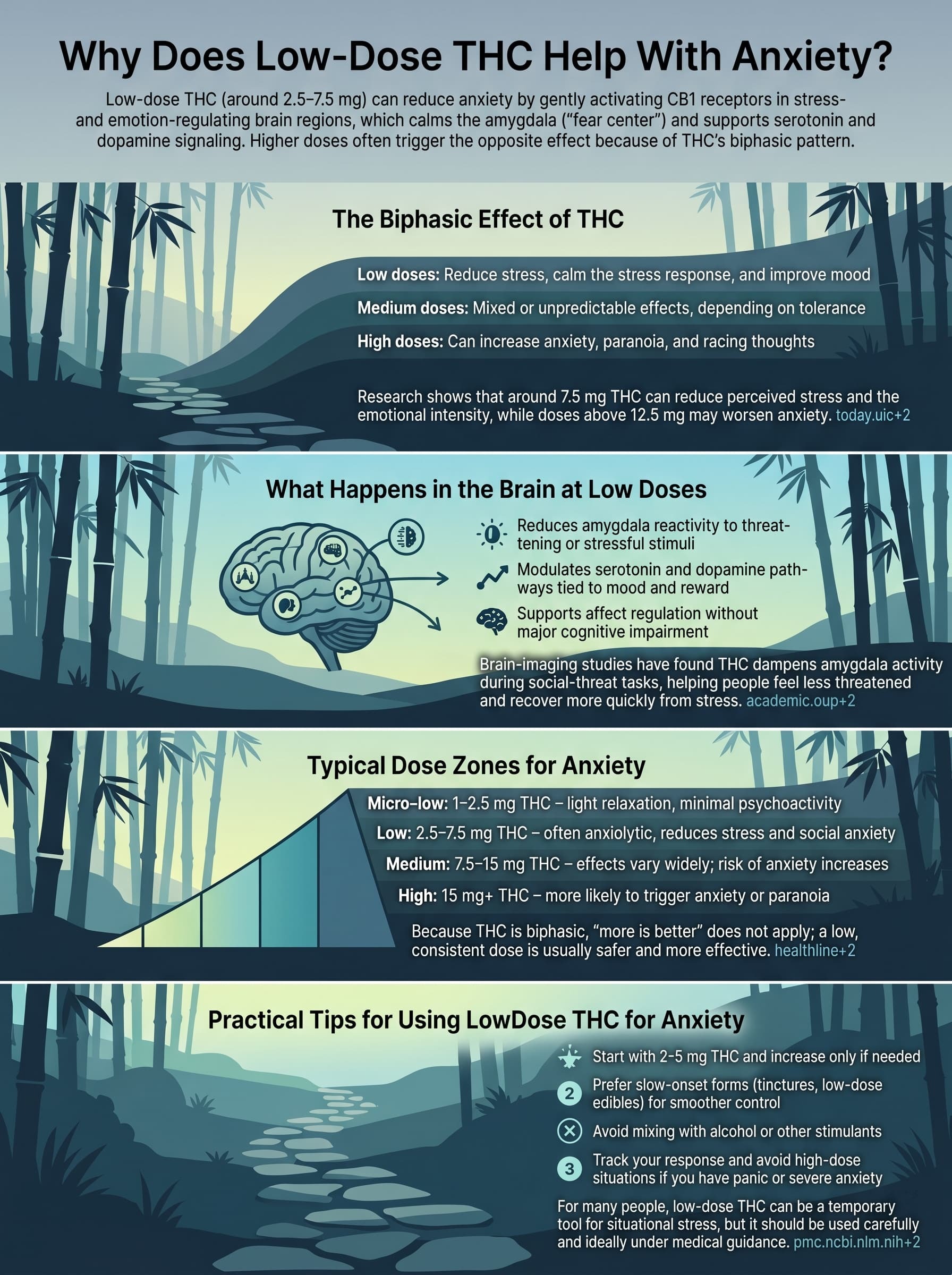
The research is early and small. Studies have mostly tested healthy volunteers in lab settings, not people diagnosed with anxiety, and not any consumer product. The clearest consistent message is a caution: higher THC amounts have been linked to more anxiety, and the CDC notes cannabis can cause feelings of anxiety and paranoia.
Two studies get quoted constantly, so here's what they actually were:
- University of Illinois Chicago, 2017: 42 healthy adults took 7.5mg THC, 12.5mg THC or a placebo capsule before a stressful mock interview. The 12.5mg group reported more negative mood and rated the task as more threatening. It was a single small study, and the researchers chose doses partly to avoid cardiovascular effects. You can read the UIC summary.
- Johns Hopkins, 2024: 20 healthy adults inhaled THC with and without limonene, a terpene found in citrus. The lead author called it “a first step,” and the release discloses a Johns Hopkins patent application related to the research. Read the Johns Hopkins release.
And here's the public health baseline. The CDC's page on cannabis and mental health says cannabis use “can cause disorientation and sometimes unpleasant thoughts or feelings of anxiety and paranoia,” and links it to a higher risk of psychosis.
My honest read after years of watching this category: the research doesn't support marketing any THC product for anxiety. It does support caution, small amounts and a doctor in the loop.
What Counts as a Low Dose of THC?
A low dose of THC usually means 5mg or less per serving, and a microdose usually means 1 to 2.5mg. CBD-dominant products often go lower still, like 0.5mg or 1mg THC with 10 to 20mg CBD. None of these terms are legally defined, so read the milligrams per serving and per package.
| THC per Serving | Common Label | Examples |
|---|---|---|
| Under 1mg | CBD-dominant | Proof 20:1 drops |
| 1 to 2.5mg | Microdose | Half Enjoy Hemp Balance, Nama, Cycling Frog |
| 2.5 to 5mg | Low dose | Enjoy Hemp Balance Microdose, Bliss 5mg |
| 10mg and up | Standard or higher | Not low dose |
And don't forget the package total. A 10-pack of 5mg gummies holds 50mg of THC. A bottle of Proof 20:1 drops holds 15mg. That matters for storage, and for the federal change covered below.
What Dose of THC Should You Start With?
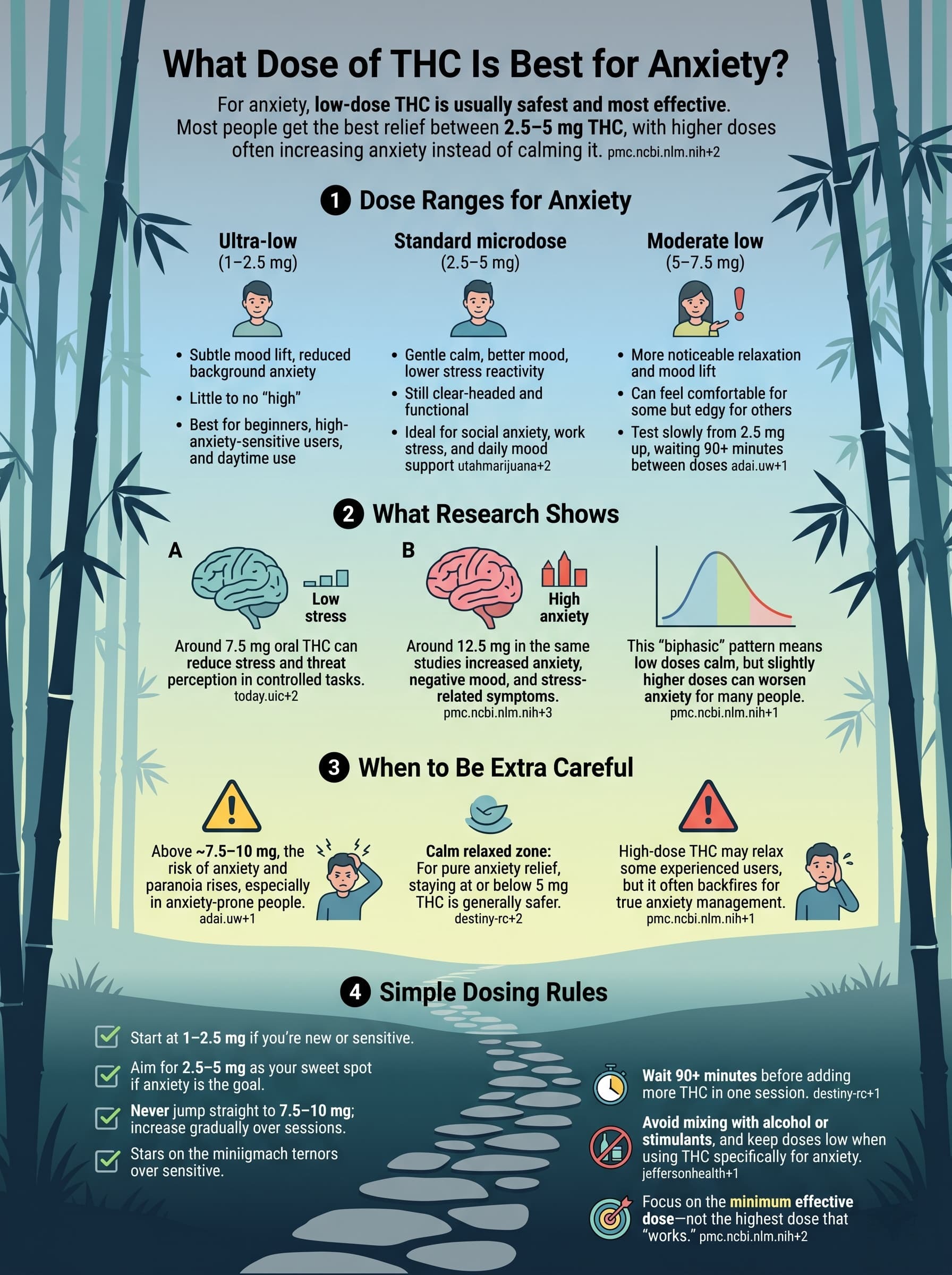
Start with the smallest serving the label allows, and only after talking with your doctor if you have anxiety or take medication. Several Enjoy Hemp labels say to begin with half a gummy, so a half Balance Microdose is 2.5mg THC. There's no single right amount, because people respond to THC very differently.
I won't give you a dosing chart for anxiety. Nobody can honestly do that, and anyone who tries is guessing with your health. Here's what I can give you, the smallest easy serving of each product:
| Product | Smallest Serving | THC |
|---|---|---|
| Enjoy Hemp Balance Syrup | 1/8 teaspoon | 2.5mg |
| Enjoy Hemp Balance Microdose | Half gummy | 2.5mg |
| Enjoy Hemp Bliss Seltzer | Half can | 2.5mg |
| Proof 20:1 Drops | Half dropper | 0.5mg |
| Nama Anytime Microdose | One gummy | 1mg |
| Cycling Frog Mints | One mint | 1mg |
One rule I'd hold firmly: if THC has ever made you anxious, panicky or paranoid, don't experiment on your own. Bring that history to your doctor before trying any amount.
Why Do So Many Low-Dose Products Pair THC With CBD?
Many low-dose products add CBD, a non-intoxicating hemp cannabinoid, alongside a small amount of THC. Ratios range from 1:1 (equal amounts, like Enjoy Hemp Balance) to 1:20 (Proof, Nama, Wana). The ratio is a product design choice. It isn't a guarantee of how a product will feel, and research on how the two interact is still early.
| Product | THC | CBD | THC:CBD |
|---|---|---|---|
| Enjoy Hemp Balance Microdose | 5mg | 5mg | 1:1 |
| Enjoy Hemp Bliss Seltzer | 5mg | 5mg | 1:1 |
| Cann Social Tonic | 2mg | 4mg | 1:2 |
| Healer Zen | 2mg | 8mg | 1:4 |
| Cycling Frog Mints | 1mg | 5mg | 1:5 |
| Proof 10:1 Drops | 1mg | 10mg | 1:10 |
| Nama Anytime Microdose | 1mg | 20mg | 1:20 |
| Proof 20:1 Drops | 0.5mg | 10mg | 1:20 |
Ratios here are written THC first. Many brands print CBD first, so “20:1” on a Proof or Wana label means 20 parts CBD to 1 part THC. Always read the milligrams, not just the ratio.
One correction I keep making for people: our Bliss 5mg seltzer is 5mg THC + 5mg CBD, a 1:1 ratio. You may see older pages, including an earlier version of this one, list it with 10mg CBD. The current product page says 5mg.
Who Should Not Use THC?
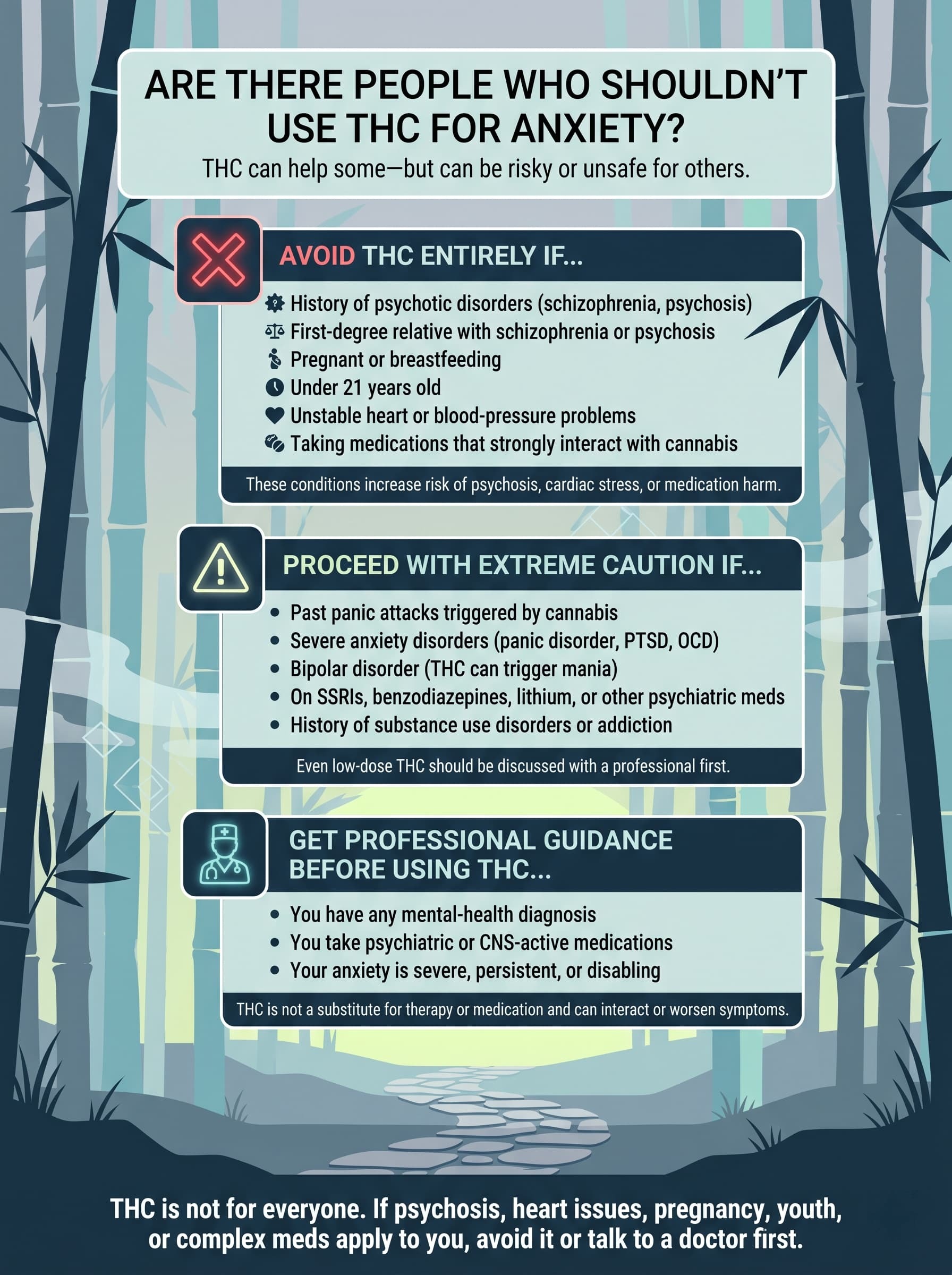
Skip THC if you have a personal or family history of psychosis, schizophrenia or bipolar disorder, if you're pregnant or nursing, if you're under 21, or if you've had panic reactions to cannabis before. If you take any prescription medication, including antidepressants or anti-anxiety medications, talk to your doctor or pharmacist first.
Avoid THC Entirely If You
- Have a personal history of psychosis or schizophrenia
- Have a parent or sibling with schizophrenia or psychosis
- Are pregnant or breastfeeding
- Are under 21
- Have an unstable heart condition
- Need to drive, operate machinery or pass a drug test
Talk to a Clinician First If You
- Have been diagnosed with an anxiety disorder, depression or bipolar disorder
- Take any prescription medication, especially psychiatric medications
- Have had panic attacks or paranoia after using cannabis
- Have a history of substance use disorder
And if anxiety is affecting your daily life, please start with a doctor or a licensed therapist. If you're ever in crisis, call or text 988 to reach the 988 Suicide and Crisis Lifeline in the US. That's the most important sentence in this whole guide.
What Should You Ask Your Doctor Before Trying Low-Dose THC?
Before trying low-dose THC, ask your doctor whether it could interact with your medications, whether your health history makes THC a poor fit, what warning signs should make you stop, and whether a THC-free option makes more sense. Bring the product's label and lab report so they can see the exact milligrams.
Over the years, the people I've seen have the best experiences are the ones who walked into that appointment prepared. Here's a short list worth printing out:
- Medications: Could THC or CBD interact with anything I take, including supplements?
- History: Does my personal or family history make THC a bad idea for me?
- Diagnosis: If I've been diagnosed with anxiety or depression, how does THC fit with my current care?
- Stop signs: What reactions should make me stop and call you?
- Alternatives: Would a THC-free product, or no product at all, be the better choice?
- Testing: Will this affect a work drug test or anything else in my life?
Bring the actual product. A label that says “Balance Microdose, 5mg THC + 5mg CBD per gummy, 10 per bag” gives your doctor far more to work with than “a low-dose gummy.”
When Do People Use Low-Dose THC During the Day?
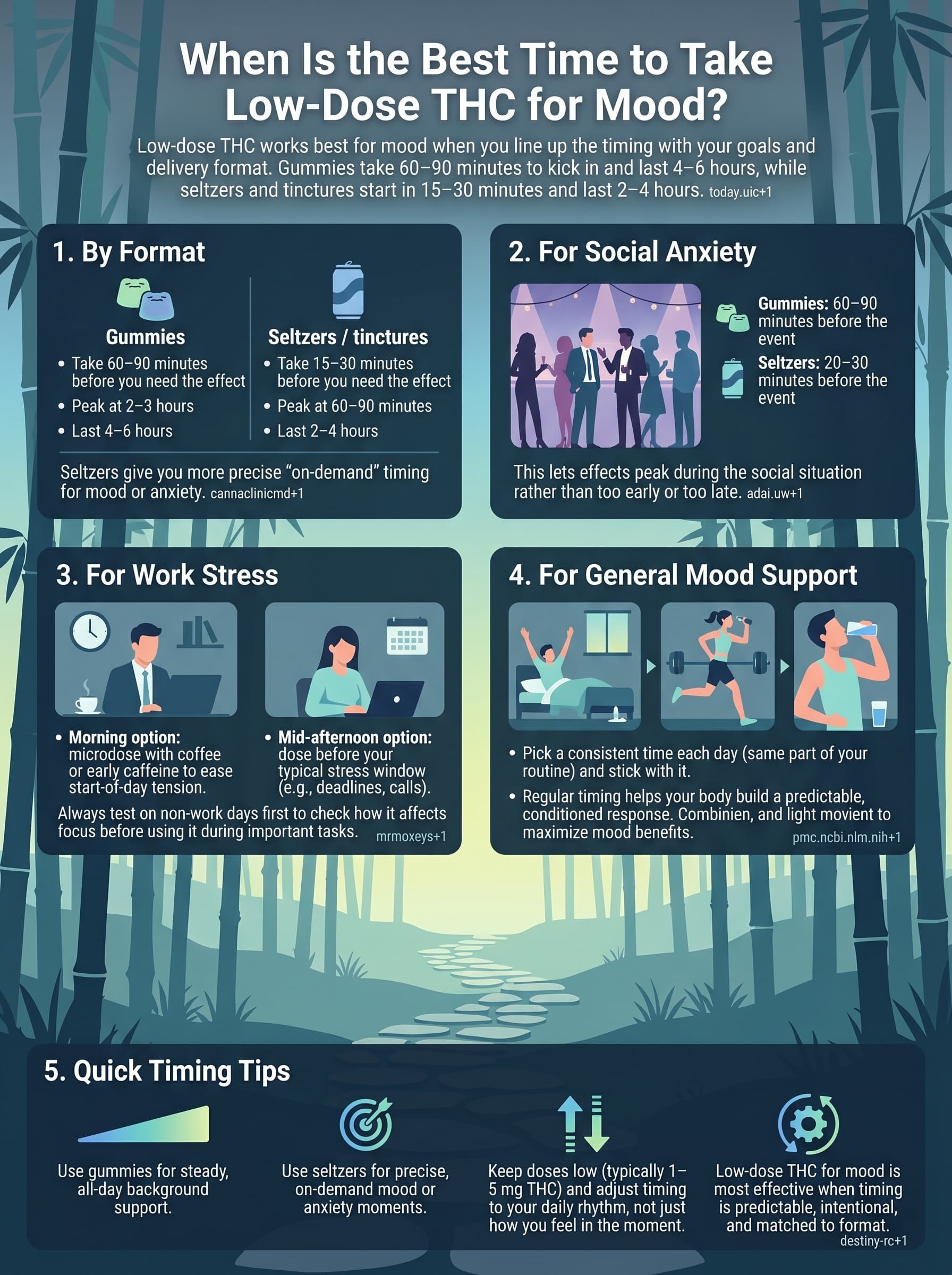
Most people who use low-dose THC save it for after work, at home, with no driving or other obligations afterward. Because THC is intoxicating at any labeled amount, it doesn't belong before driving, during work that needs full attention, or before a drug-tested shift. Follow the label's wait time before having more.
Here's what our labels say about waiting:
| Product | Label Start | Label Wait |
|---|---|---|
| Balance Microdose gummy | One gummy | Up to 90 min |
| Balance THC Syrup | 1/4 tsp | At least 90 min |
For a very first try, I tell people to use half the label's starting serving, wait two full hours and not take more that day. A phone timer helps more than you'd think.
Which Format Fits Best: Gummies, Syrups, Drinks, Tinctures or Mints?
Gummies are portable and easy to store, syrups and tinctures can be measured very precisely, drinks can be poured by half, and mints come in very small fixed pieces like 1 or 2mg. For low-dose use, pick the format you'll measure most carefully and stick with one until you know how it suits you.
| Format | Smallest Easy Serving | Example |
|---|---|---|
| Syrup | 1/8 teaspoon | Enjoy Hemp Balance Syrup |
| Gummy | Half a piece | Enjoy Hemp Balance Microdose |
| Drink | Half a can | Enjoy Hemp Bliss 5mg |
| Tincture | Half dropper | Proof 20:1 Drops |
| Mint | One mint | Cycling Frog, ATHLETHC |
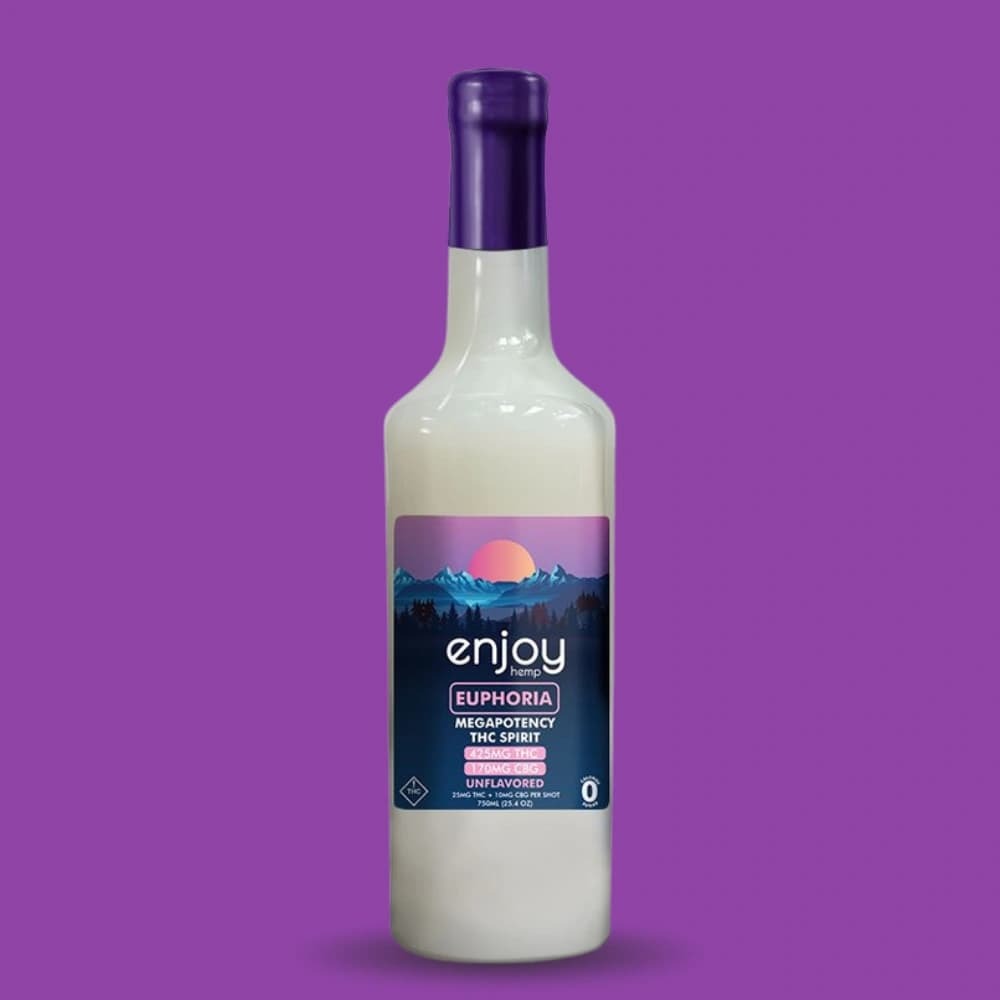
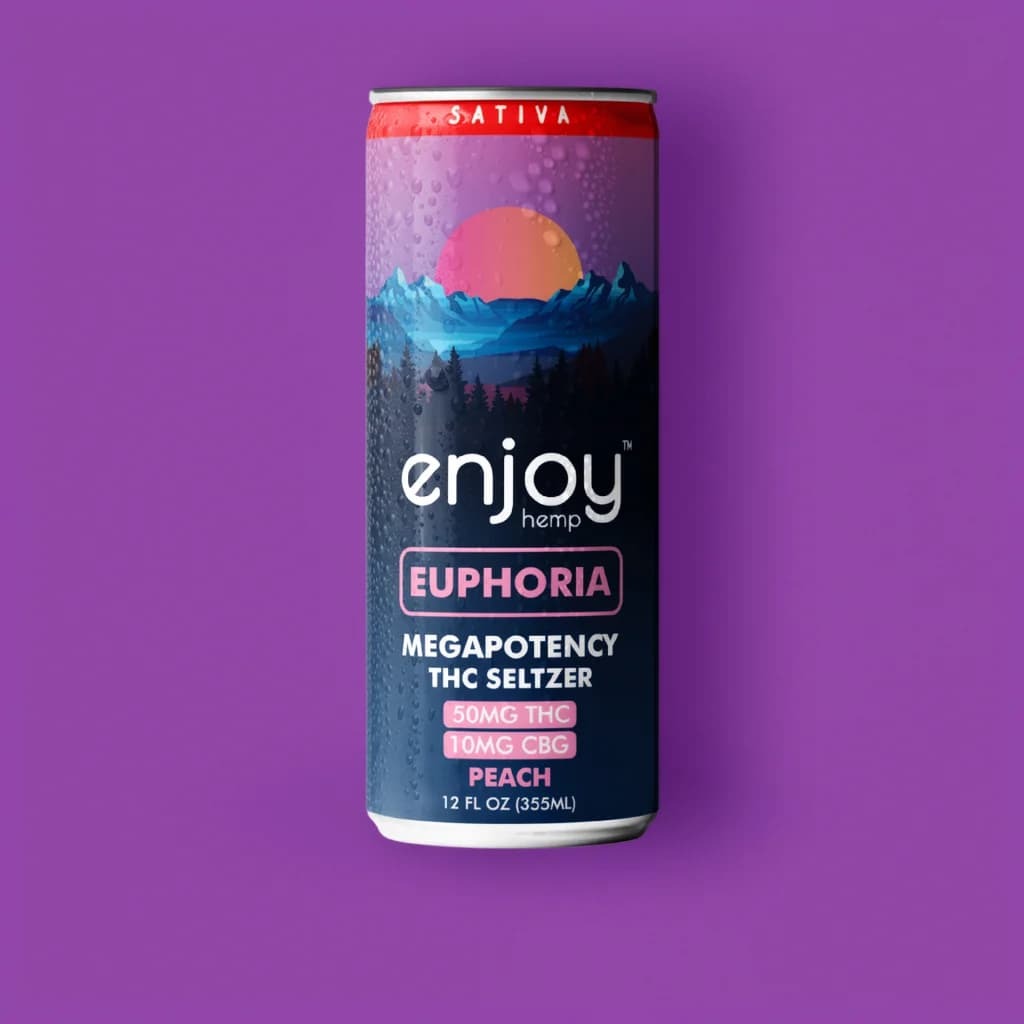
If you go with a drink, our other 5mg cans are Euphoria (5mg THC + 5mg CBG, peach) and Chill (5mg THC + 5mg CBN, lemon). Our guide for THC drink first-timers covers the drink side in more depth.
How Do You Measure a Small Serving Accurately?
To measure a small serving accurately, cut a gummy at room temperature on a board with a sharp knife, use a real 1/8 teaspoon measuring spoon for syrup, pour half a can into a measuring cup, and use the dropper's marked line for tinctures. Eyeballing isn't accurate enough when the whole serving is 2.5mg.
At 2.5mg, half a milligram off is a 20% swing. That's why I push measuring tools so hard for low-dose use.
- Gummy: Room temperature, cutting board, one straight cut, leftover half back in the child-resistant bag.
- Syrup: Level 1/8 teaspoon, stirred into water or tea.
- Can: Measuring cup to 6 oz for half of a 12 oz can; seal and refrigerate the rest.
- Tincture: Use the dropper line the label names, not a guess.
For step-by-step photos and tips, see our low-potency edibles guide.
What If THC Makes You Anxious or You Take Too Much?
If THC makes you feel anxious, panicky or unwell, stop, don't take more, go somewhere quiet and familiar, sip water and eat a light snack. Don't drive. Call 911 for chest pain, trouble breathing or fainting. Poison Control is available 24/7 at 1-800-222-1222. Tell your doctor before trying THC again.
A few things that help in the moment:
- Sit or lie down somewhere comfortable
- Slow your breathing on purpose
- Have a trusted person stay with you
- Put on something familiar, like a favorite show
- Remind yourself the feeling is temporary
And if a child or pet eats a THC product, call Poison Control right away, even if they seem fine. Our guide to storing THC gummies starts with child safety for exactly this reason.
Can You Use Low-Dose THC Every Day?
There's no official guidance on daily use of hemp THC products. If you're considering regular use, especially alongside any medication or an anxiety diagnosis, make that decision with your doctor. Follow the label's limits, don't stack different THC products in one day, and keep notes on what you take.
A simple log helps you and your doctor see the full picture:
- Date, time and product name
- Batch number from the package
- Exact amount, like half gummy, 2.5mg THC
- Any medications taken that day
- Anything you noticed, good or bad
THC can also cause a positive drug test even at small amounts. If you're tested, read our guide on whether legal THC shows up on a drug test.
How Do You Read a Low-Dose Product Label?
On a low-dose label, find THC per serving, CBD or other cannabinoids per serving, servings per package, total THC per package, serving size, wait-time directions, warnings and a batch number or QR code linking to the lab report. If the per-serving THC number is missing, skip the product.
Here's how that reads on our Balance Microdose:
- Per gummy: 5mg THC + 5mg CBD
- Per bag: 10 gummies, 50mg THC and 50mg CBD
- Extraction: Live rosin
- Calories: 10 per gummy
- Directions: Start with one gummy, wait up to 90 minutes, take more only if needed
- Lab results: Third-party tested, batch COA available
The thing most consumers don't realize is that “low dose” on the front of a package is marketing. The back of the package is the product. I've reviewed plenty of “microdose” items over the years whose smallest piece was 10mg.
How Do You Check a Low-Dose Product's Lab Results?
To check a low-dose product, open the Certificate of Analysis for your exact batch, confirm an independent ISO/IEC 17025 accredited lab ran it, compare measured THC and CBD per serving to the label, and confirm pesticides, heavy metals, residual solvents and microbials passed. Accuracy matters more at 1 to 5mg than at 10mg.
- Batch match: The lot number on the COA should match your package.
- Independent lab: Not the brand's own lab.
- Accreditation: ISO/IEC 17025.
- THC and CBD per serving: Both should be close to the label.
- Total THC: Delta-9 THC + (0.877 x THCA).
- Contaminants: “Pass” or “ND” across every panel.
Based on my work with testing labs, the brands that make COAs easy to find tend to be the brands with the most accurate labels. Every Enjoy Hemp batch is third-party tested. Our guide to finding lab-tested THC products walks through a COA line by line.
Where Can You Buy Low-Dose THC Products?
Hemp-derived low-dose products from Enjoy Hemp, Nama, Healer, Cycling Frog, Tillmans Tranquils, ATHLETHC and Mr. Moxey's are sold online and shipped where state law allows, for adults 21 and over. Cannabis-derived products from Proof and most Wana lines are sold only in licensed dispensaries in legal states.
| Brand | Source | Where Sold |
|---|---|---|
| Enjoy Hemp | Hemp | Online, eligible states |
| Nama | Hemp | Online, eligible states |
| Cycling Frog | Hemp | Online, eligible states |
| Tillmans, ATHLETHC | Hemp | Online, eligible states |
| Proof | Cannabis | Dispensaries |
| Wana | Mostly cannabis | Dispensaries |
Some independent shops, like Bell Family Dispensary, also carry Enjoy Hemp gummies. Buying direct is the easiest way to get the current batch COA with your order. Browse every small-serving product in our micro-dose collection.
Are Low-Dose THC Products Legal in 2026?
As of October 2026, hemp-derived low-dose THC products with no more than 0.3% delta-9 THC by dry weight are federally legal under the 2018 Farm Bill where state law allows them. Starting December 11, 2026, a new federal definition caps finished hemp products at 0.4mg total THC per container, which nearly every low-dose package exceeds.
The cap counts the whole container. A 10-pack of 5mg gummies holds 50mg. Even a bag of 1mg mints holds far more than 0.4mg. CBD products with no detectable THC aren't affected by the THC cap the same way, though full-spectrum CBD with trace THC can still add up across a bottle.
The rule comes from Section 781 of the appropriations law signed November 12, 2025. It was originally set for November 12, 2026, and in early September 2026 the Continuing Appropriations and Extensions Act, 2027 (P.L. 119-103) moved most of it to December 11, 2026. The Congressional Research Service explains how the hemp definition is changing.
| Date | What Happened |
|---|---|
| Nov 12, 2025 | Section 781 signed into law |
| Early Sep 2026 | P.L. 119-103 moves most of it |
| Nov 12, 2026 | Synthetic cannabinoids covered |
| Dec 11, 2026 | 0.4mg per container cap starts |
If you've built a routine around one specific product, check its status before December. I'm not a lawyer, and Congress could act again. For background, read what makes THC products federally legal.
Low-Dose THC Glossary
- Delta-9 THC: The main intoxicating cannabinoid in hemp and cannabis.
- CBD: Cannabidiol, a non-intoxicating cannabinoid.
- CBG and CBN: Other hemp cannabinoids, used in some Enjoy Hemp seltzers.
- Microdose: A small THC serving, usually 1 to 2.5mg. Not a legal term.
- CBD-dominant: More CBD than THC, like 20:1 products.
- Limonene: A citrus terpene studied alongside THC at Johns Hopkins.
- Full spectrum: An extract that keeps multiple cannabinoids, including trace THC.
- Broad spectrum: An extract with THC removed to non-detectable levels.
- COA: Certificate of Analysis, the batch lab report.
Key Takeaways
- No THC product is FDA-approved to treat anxiety or any mood condition; talk to a clinician first
- Enjoy Hemp Balance Microdose lists 5mg THC + 5mg CBD; a half gummy, 1/8 teaspoon of Balance syrup or half a Bliss can is 2.5mg THC
- CBD-dominant options include Nama (1mg THC + 20mg CBD), Proof 20:1 (0.5mg + 10mg) and Wana 20:1 (1mg + 20mg)
- Research on THC and anxiety is small and early; the CDC notes cannabis can cause anxiety and paranoia
- Skip THC with a history of psychosis, during pregnancy, under 21, or before driving
- Read milligrams per serving and per package, and check a batch COA
- The 0.4mg per container federal cap starts December 11, 2026, unless Congress acts again
If you and your doctor decide a small serving fits, start with the Balance Microdose gummies or the Balance THC Syrup, or explore THC-free CBD gummies. For a wider look at products people use to unwind, see our hemp THC gummies comparison.
Frequently Asked Questions
Which low-dose THC options are suitable for mood support and reducing anxiety?
No THC product is approved to treat anxiety. Low-dose options people compare include Enjoy Hemp Balance Microdose (5mg THC + 5mg CBD), Nama (1mg + 20mg CBD) and Proof 20:1 drops. Ask a clinician first.
How does Enjoy Hemp compare to Proof, Nama and Wana?
Enjoy Hemp's low-dose products are 1:1 THC and CBD and reach 2.5mg THC as a half serving. Proof, Nama and Wana sell CBD-dominant 20:1 products with 0.5 to 1mg THC.
Can THC make anxiety worse?
Yes, it can. The CDC notes cannabis can cause feelings of anxiety and paranoia, and studies link higher THC amounts to more negative mood. Talk to your doctor first.
What is a 20:1 CBD to THC product?
It contains 20 parts CBD to 1 part THC. Proof's 20:1 drops, for example, list 10mg CBD and 0.5mg THC per half dropper.
What's the lowest-THC option available?
Proof 20:1 drops list 0.5mg THC per serving. Nama gummies and Cycling Frog mints list 1mg. Enjoy Hemp's smallest easy serving is 2.5mg.
Is it safe to use THC with antidepressants or anti-anxiety medication?
Ask your doctor or pharmacist before combining THC with any prescription medication. Cannabis can interact with some medications.
Can low-dose THC replace anxiety medication or therapy?
No. THC products aren't a treatment for anxiety. Never stop or change prescribed medication without your doctor.
What should I do if THC makes me anxious?
Stop, don't take more, go somewhere quiet, sip water and have someone stay with you. Call 911 for severe symptoms. Talk to a doctor before trying again.
Are CBD-only products an alternative to THC?
Yes, for people who want to avoid THC. CBD is non-intoxicating. Enjoy Hemp's broad-spectrum CBD gummies are listed with no detectable delta-9 THC.
Is indica or sativa better for low-dose use?
Strain labels describe plant lineage or terpene blends, not a guaranteed feeling. Compare milligrams, CBD content and the lab report instead.
Will low-dose THC show up on a drug test?
Yes, it can. Even small amounts of THC can cause a positive result. If you're tested, choose a product with no detectable THC.
Can I drive after taking low-dose THC?
No. Don't drive or operate machinery after any amount of THC. Plan to stay home or get a ride.
Will low-dose THC products still be sold after December 2026?
Not as they're sold today. A 0.4mg total THC per container cap starts December 11, 2026, and nearly every low-dose package exceeds it.
About the Author
Sarah Mitchell is a wellness industry veteran with 15 years of experience in functional supplements and hemp derived products. She previously led product development at two nationally recognized wellness brands and holds certification as a holistic health practitioner. Sarah now advises consumers on quality standards, helping them make informed decisions in the evolving hemp market.
These statements have not been evaluated by the Food and Drug Administration. This product is not intended to diagnose, treat, cure, or prevent any disease or condition, and is not a dietary supplement. Consult a licensed healthcare provider before use, especially if you are pregnant, nursing, taking medication, or managing a health condition. For use by adults 21 years of age and older. This product contains hemp-derived cannabinoids and may cause a positive result on a drug test. Keep out of reach of children and pets. Hemp product legality varies by state and is subject to change under federal law; verify all applicable federal, state, county, and municipal laws before purchasing. Do not drive or operate machinery after use.
Legal status as of October 2026: Enjoy Hemp products comply with the 2018 Farm Bill (0.3% or less delta-9 THC by dry weight). A federal law taking effect December 11, 2026 will limit finished hemp products to 0.4mg total THC per container unless Congress acts again first; products containing cannabinoids not naturally produced by the cannabis plant are affected from November 12, 2026. Competitor product details are from public listings as of October 2026. This article is for information only and is not medical or legal advice. If you are in crisis, call or text 988 in the US.