













How to Choose a THCA Brand You Can Trust: 8 Label and Testing Checks
Posted by Enjoy Hemp Editor Team on Nov 4th 2026
Last Updated: November 2026
Choosing a THCA brand you can trust comes down to eight specific checks you can perform yourself before buying. These verification steps include confirming third-party lab testing from accredited facilities, checking that Delta-9 THC stays below the 0.3% federal limit, verifying contaminant screening for pesticides and heavy metals, and matching batch numbers between the Certificate of Analysis and your product packaging.
The THCA market has grown fast since the 2018 Farm Bill created the legal framework for hemp-derived cannabinoids. But that growth brought quality inconsistencies. Some brands deliver exactly what they promise. Others cut corners on testing, inflate potency claims, or skip contaminant screening entirely.
After 15 years evaluating hemp products and working with third-party testing labs, I've developed a systematic approach to brand verification. These eight checks separate trustworthy brands from those that might disappoint you or raise safety concerns.
The good news: you don't need specialized knowledge to perform these checks. Everything you need is either on the label, in the COA, or on the brand's website. If a brand makes finding this information difficult, that's itself a red flag worth noting.
What Makes a THCA Brand Trustworthy in the First Place?
A trustworthy THCA brand demonstrates transparency at every step from cultivation through final packaging. This means publishing complete lab results, being open about growing methods, and making verification easy rather than difficult for consumers. Trustworthy brands treat documentation as a selling point, not an afterthought.
Trust in the hemp industry isn't built on marketing claims or polished websites alone. It comes from verifiable evidence that a brand does what it says. When I evaluate brands for quality, I look for consistency between what they claim and what their documentation shows.
The THCA product category has particular verification requirements because THCA converts to active THC when heated. This conversion means accuracy matters more than with some other cannabinoids. A brand that inflates THCA percentages or downplays Delta-9 content isn't just misleading you about potency. They may be selling a product that doesn't comply with federal hemp regulations.
Quality brands invest in comprehensive testing because they understand that reputation depends on consistent results. They don't view lab testing as a cost to minimize. They see it as proof of the claims they make.
Check 1: Does the Brand Use Third-Party Lab Testing?
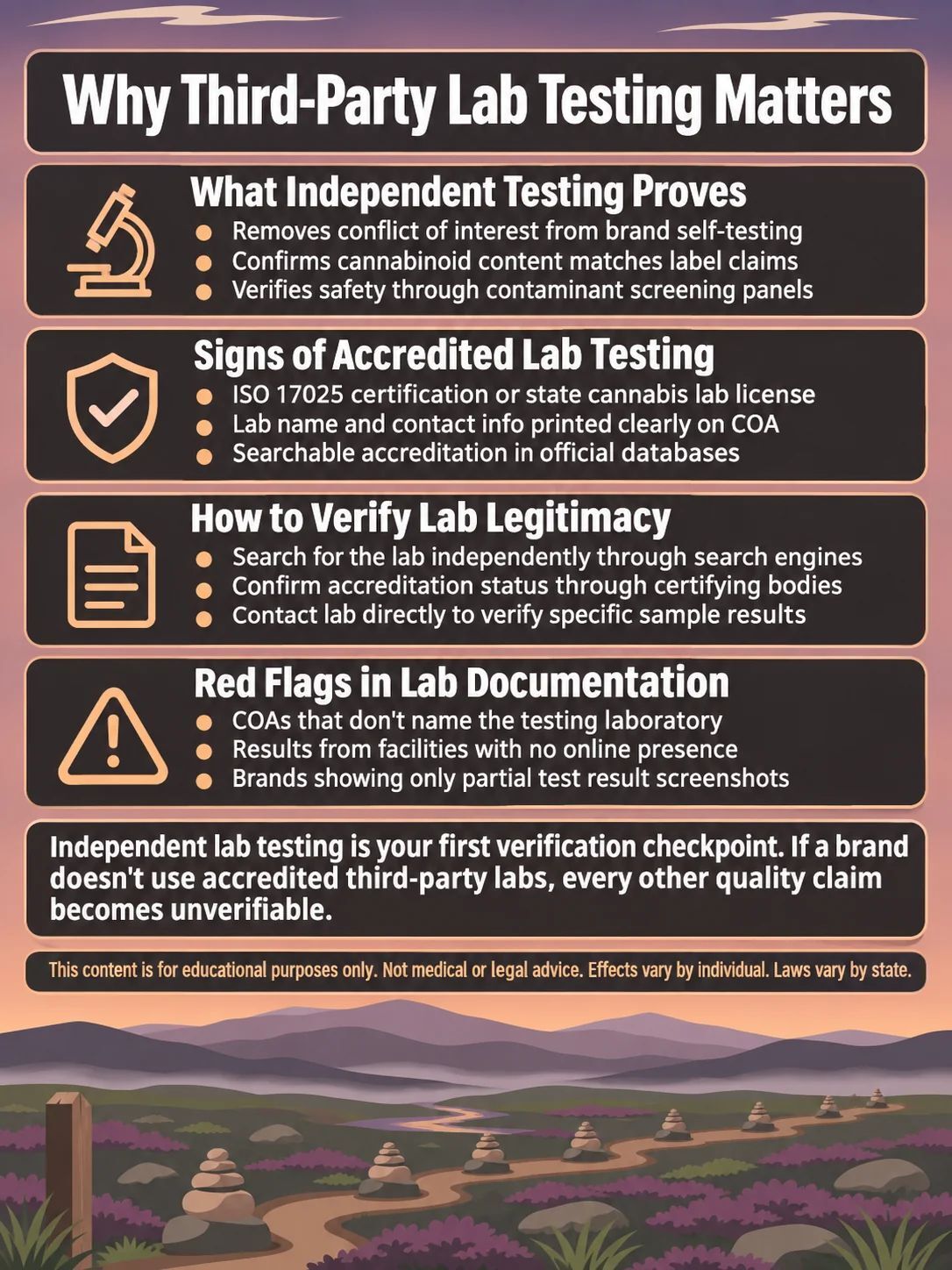
Third-party lab testing means an independent, accredited laboratory analyzed the product rather than the brand testing it themselves. This independence removes conflicts of interest and provides objective verification of cannabinoid content and safety. Look for lab names, accreditation numbers, and contact information on every COA.
The distinction between third-party and in-house testing matters more than many consumers realize. When a brand tests its own products, they control the results. When an independent lab tests them, the brand has no influence over what gets reported.
According to Cannadelics, COAs can be faked through edited PDFs, reused results from different batches, or labs that don't actually test for contaminants. This makes verifying lab independence essential before trusting any results.
Accredited labs follow standardized testing protocols and undergo regular audits. Look for ISO 17025 accreditation or state-specific cannabis testing licenses. The lab's information should be clearly printed on the COA, and you should be able to verify their accreditation status independently.
Red flags include COAs that don't name the testing lab, results from facilities you can't find online, or brands that only show partial results without the full lab report available. Trustworthy brands like those offering quality THCA flower make complete COAs accessible on product pages or via QR codes.
Check 2: Is Delta-9 THC Below the 0.3% Federal Limit?
Delta-9 THC must test below 0.3% by dry weight for a hemp product to be federally legal under the 2018 Farm Bill. This threshold separates legal hemp from controlled cannabis. Every COA should clearly show Delta-9 THC content, and that number must fall under the limit regardless of how high the THCA percentage runs.
THCA itself isn't psychoactive until it converts to Delta-9 THC through heat. But the raw Delta-9 content in the flower matters for legal compliance. Some states also use "total THC" calculations that estimate conversion, which can complicate compliance in certain jurisdictions.
The total THC formula typically used is: (THCA × 0.877) + Delta-9 THC. Some states apply this calculation to determine legality rather than looking at Delta-9 alone. Brands shipping to those states need to account for total THC in their compliance documentation.
When reviewing a COA, the Delta-9 THC line should show both the measured value and whether it passes compliance. Results showing "ND" (not detected) or values like 0.15% clearly pass. Values at 0.28% or 0.29% technically pass but sit uncomfortably close to the threshold. Values at or above 0.3% mean the product doesn't qualify as legal hemp.
I've seen brands that show impressive THCA percentages but don't prominently display Delta-9 results. That omission is worth questioning. If a brand isn't making compliance obvious, ask why before purchasing.
Check 3: Does the COA Include Contaminant Testing?
Complete contaminant testing should screen for pesticides, heavy metals, microbials, and residual solvents if extraction was involved. Cannabinoid potency testing alone isn't enough. A product could have accurate THCA numbers while still containing harmful contaminants that a limited test panel wouldn't catch.
Hemp plants are bioaccumulators, meaning they absorb substances from their growing environment. This makes them excellent for soil remediation but creates risk if growing conditions aren't carefully controlled. Heavy metals like lead, arsenic, and mercury can concentrate in plant material from contaminated soil or water.
Pesticide screening matters because some growers use prohibited chemicals to protect crops. Even when pesticides are applied at growing facilities that later process into THCA flower, residues can persist. Microbial testing catches mold, yeast, and bacteria like salmonella that can develop during cultivation, curing, or storage.
According to Cannabis Law Report, not every brand runs complete contaminant panels. Some test only for cannabinoids, leaving consumers without assurance about safety. A thorough COA should show pass/fail results for each contaminant category, not just cannabinoid percentages.
When I evaluate products, missing contaminant testing is a significant concern. It's not necessarily that the product is contaminated. But without testing, there's no way to know. Quality THCA prerolls and flower products should always come with complete safety testing documentation.
Check 4: How Recent Are the Lab Results?
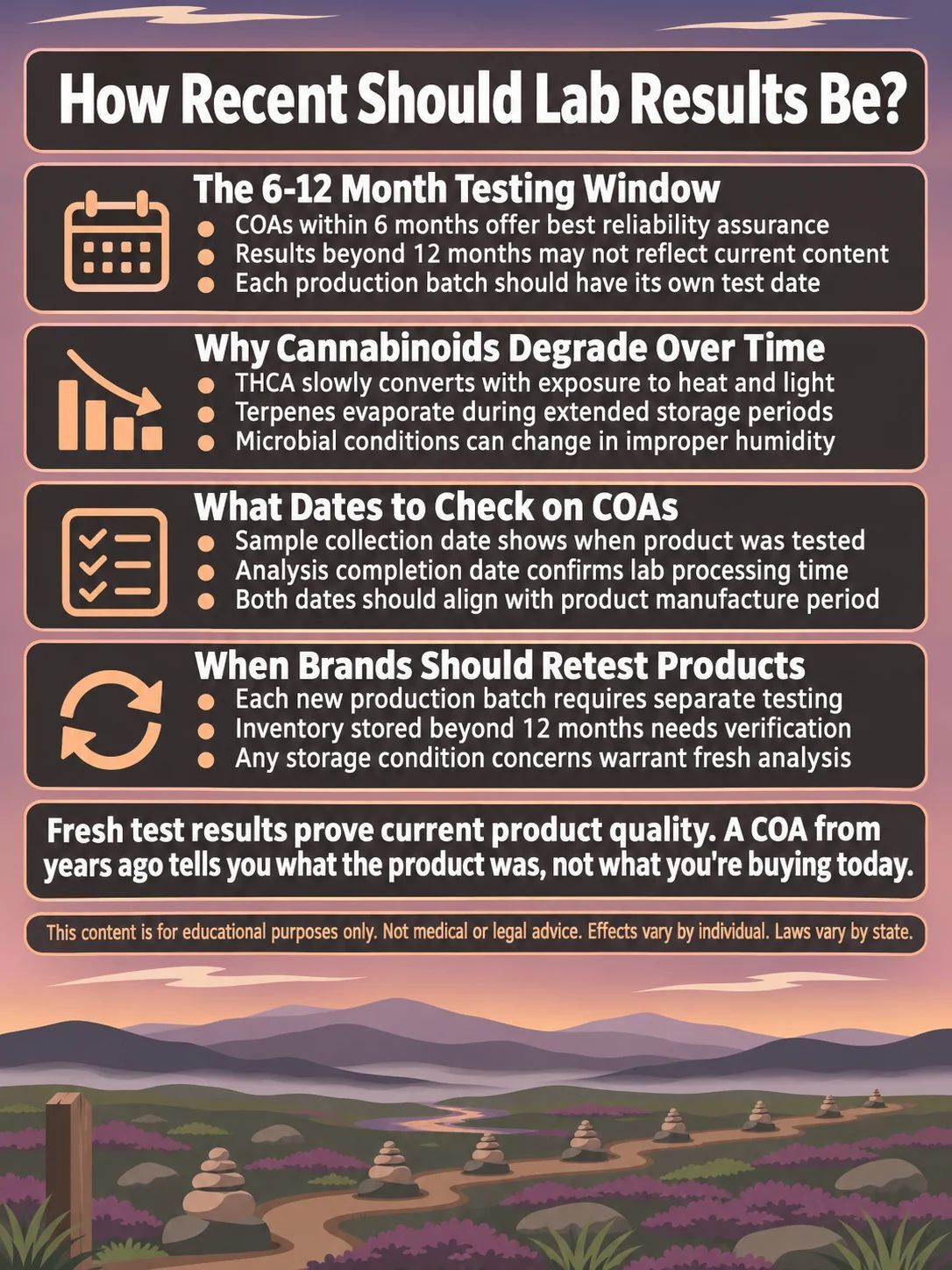
Lab results should be dated within the past 6 to 12 months to remain relevant and reliable. Cannabinoid content can degrade over time, and contaminant conditions can change during storage. A COA from two years ago tells you what the product was, not necessarily what it is now.
THCA is relatively stable compared to some cannabinoids, but it does degrade gradually when exposed to heat, light, and air. A product tested at 25% THCA eighteen months ago might test lower today. More concerning, microbial conditions can change during extended storage if humidity isn't properly controlled.
Most reputable brands test each production batch separately and date their COAs accordingly. This means the test date should roughly correspond to when the product was manufactured or packaged. If you're buying flower harvested in 2026 and the COA is dated 2024, something doesn't add up.
Look at both the sample collection date and the analysis date on the COA. Both should be reasonably recent. Some brands provide batch-specific testing with lot numbers that match packaging, while others use representative testing from similar production runs. Batch-specific testing offers more precise verification.
Check 5: Do Batch Numbers Match Between COA and Packaging?
The batch number, lot number, or sample ID on your product packaging should match what appears on the COA exactly. This verification confirms that the test results actually apply to the specific product you purchased rather than a different batch entirely. Mismatches suggest either sloppy documentation or results that don't correspond to your product.
Batch matching is one of the simplest verification steps, but many consumers skip it. They see that a COA exists and assume it applies to their purchase. But without confirming the batch numbers align, you're trusting paperwork that might not reflect what's in your hands.
On the product packaging, look for a batch number, lot number, or production code. This might appear on a label, sticker, or printed directly on the container. Then find the corresponding identifier on the COA. They should match character for character.
If a brand uses the same COA for multiple batches or doesn't provide batch-specific documentation, that's a transparency concern. Each production run can vary in cannabinoid content and should be tested independently. Brands that cut corners on batch testing might be hiding inconsistencies between runs.
Quality THCA gummies and other processed products should include lot numbers that trace back to specific manufacturing batches. This traceability becomes important if you need to reference test results later or if a recall ever becomes necessary.
Check 6: Does the Brand Show Terpene Profiles?
Terpene profiles reveal the aromatic compounds present in the flower and indicate cultivation and curing quality beyond raw cannabinoid numbers. A brand that tests and displays terpene content demonstrates attention to the full experience, not just THCA percentages. Terpene preservation requires careful handling that careless operations often skip.
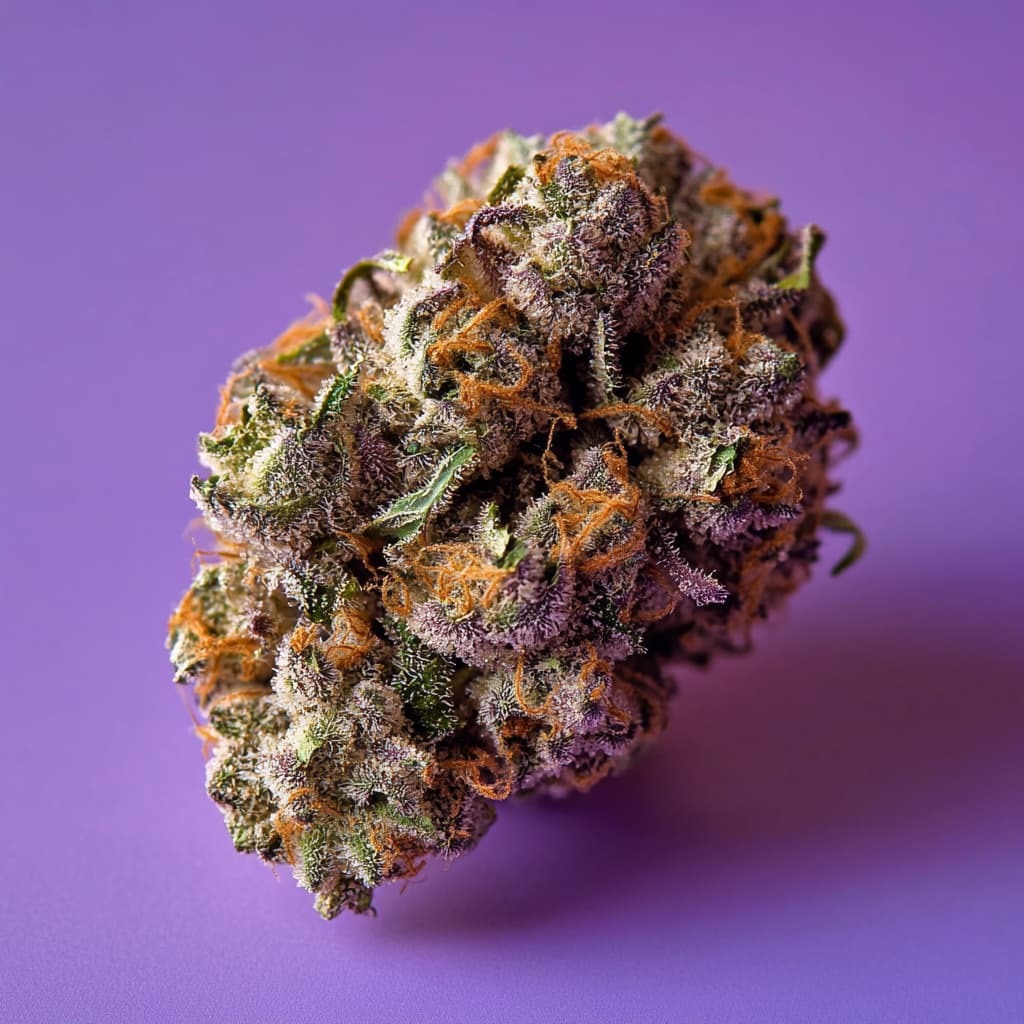
Terpenes like myrcene, limonene, linalool, caryophyllene, and pinene affect how a product smells, tastes, and feels. They work alongside cannabinoids through what researchers call the entourage effect. A product might have impressive THCA numbers but offer a flat experience if terpenes were lost to poor curing or storage.
According to LookyWeed, terpene preservation matters more than THCA percentage alone. A well-cured flower with strong terpene content can outperform a higher-potency flower that was poorly handled. This insight comes from understanding that the experience isn't just about one number.
When reviewing COAs, look for a terpene panel separate from the cannabinoid results. This might show total terpene percentage and individual compound breakdown. Flower with 2-4% total terpenes typically has good aromatic character. Below 1% suggests degradation or poor source material.
Not every brand tests for terpenes, and some display this information only on their website rather than the COA itself. But brands that invest in terpene testing signal they care about product quality beyond minimum compliance requirements. This attention to detail often correlates with better overall practices.
Check 7: Is There Transparency About Cultivation Methods?
Trustworthy brands are open about where and how their hemp is grown, including whether it's indoor, outdoor, or greenhouse cultivation. Cultivation transparency indicates a brand that controls quality from the start rather than just buying bulk material and reselling it without knowing its origins.
Indoor cultivation offers the most environmental control. Temperature, humidity, light cycles, and pest management can all be precisely managed. This control typically produces more consistent results but at higher production costs.
Outdoor and greenhouse growing can produce excellent sativa flower and other varieties when done well. But conditions vary more, and contamination risks from environmental factors increase. Knowing the growing method helps you understand what quality controls were possible.
Beyond the basic growing method, transparency extends to sourcing information. Does the brand grow their own hemp or source from partner farms? If they source externally, do they verify their suppliers' practices? Are they willing to share this information when asked?
Brands that claim organic practices should be able to document them. USDA organic certification or CCOF certification involves audited standards from soil to final cure. These certifications cost money and require ongoing compliance, so brands that have them are investing in verifiable quality claims.
When cultivation information is vague or unavailable, the brand may not know much about their supply chain. That uncertainty passes along to you as a consumer. Established brands should have clear answers about where their hemp comes from and how it's grown.
Check 8: What Do Customer Reviews and Company Reputation Show?
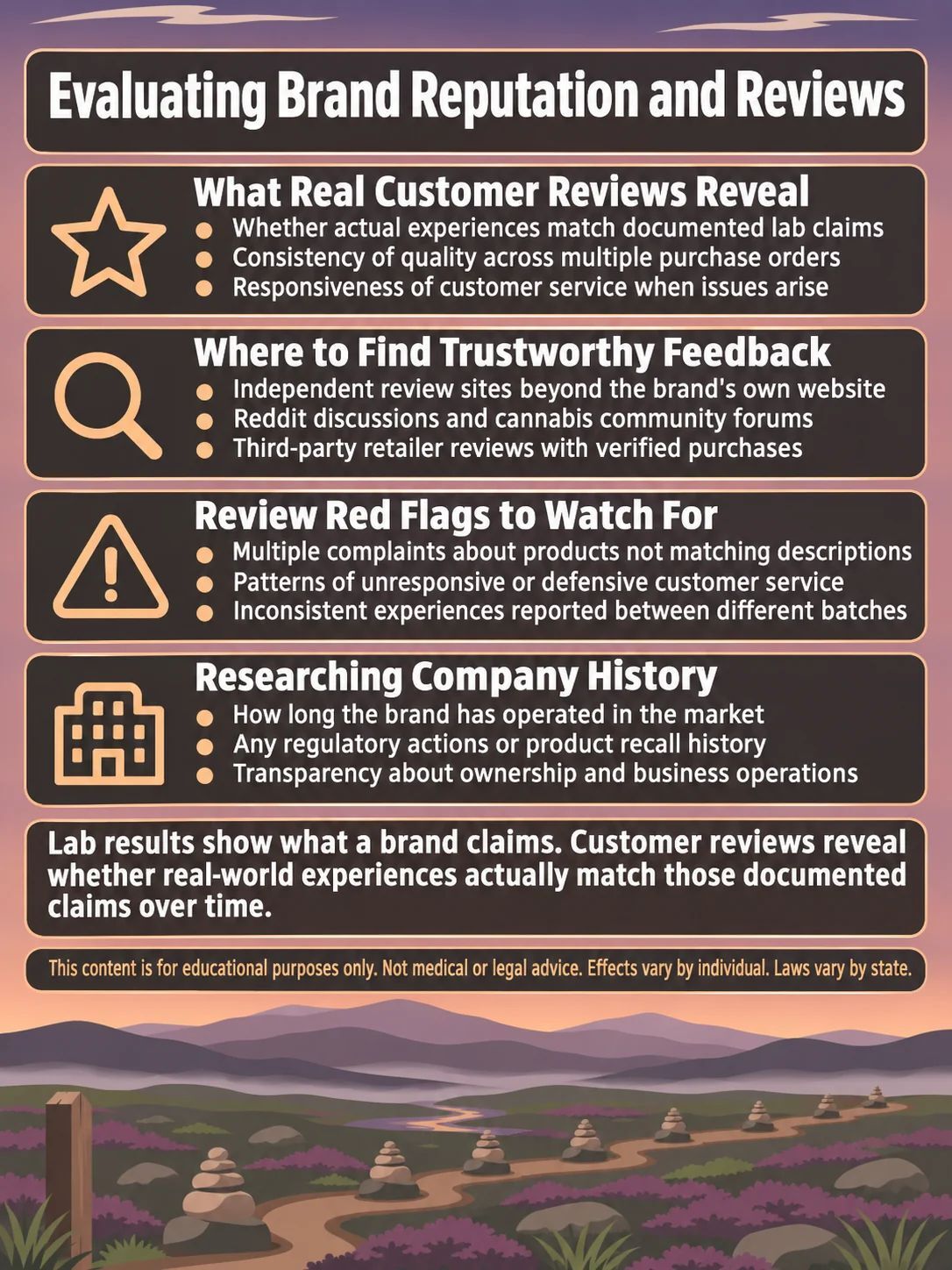
Customer feedback from repeat buyers indicates whether a brand delivers consistent quality over time, not just impressive lab results from a single batch. Reviews reveal real-world experiences with shipping, customer service, and product accuracy that lab tests can't capture. Company reputation provides context for trusting their documentation.
Lab results tell you what a brand claims. Reviews tell you whether customers' experiences match those claims. A brand might have perfect COAs but ship degraded product, have terrible customer service, or show inconsistency between batches that individual test results don't reveal.
Look for reviews on multiple platforms rather than just the brand's website. Independent review sites, Reddit discussions, and third-party retailers provide perspectives the brand doesn't control. Pay attention to patterns in feedback rather than individual complaints.
Red flags in reviews include frequent mentions of products not matching descriptions, customer service that's unresponsive to problems, or inconsistent experiences between orders. A few negative reviews among many positive ones is normal. A pattern of similar complaints suggests systemic issues.
Company history also matters. Brands that have operated for several years have track records you can evaluate. Newer brands might be excellent but haven't been tested over time. Check whether the brand has faced regulatory actions, recall history, or significant public complaints.
When evaluating THCA vape options or any product, combine documentation verification with reputation research. Neither alone tells the complete story. Together, they give you a realistic picture of what to expect.
What Are the Biggest Red Flags When Evaluating THCA Brands?
The biggest red flags include missing or inaccessible COAs, lab results that can't be independently verified, extremely low prices without explanation, and brands that make health claims about their products. Any of these should pause your purchase until you can investigate further or choose a different brand.
Missing COAs top the list. If a brand won't or can't provide lab documentation, assume something is wrong. Legitimate testing isn't expensive enough to skip if a brand is serious about compliance and quality. The only reason to hide results is that they're unfavorable.
Unverifiable labs come next. Some brands create fake COAs with official-looking documents from labs that don't exist or didn't actually test the product. You should be able to find the lab online, confirm their accreditation, and sometimes verify specific results through the lab directly.
Extremely low prices often signal quality problems. Hemp cultivation, proper curing, comprehensive testing, and quality packaging all cost money. When prices fall dramatically below market rates, something is being compromised. It might be testing, sourcing, or product quality itself.
Health claims are illegal for hemp products and signal a brand willing to break rules. Legitimate brands describe their products' composition and effects without claiming to treat, cure, or prevent any condition. Medical claims suggest either ignorance of regulations or willingness to deceive.
Other warning signs include poor website quality, no physical business address, inability to answer questions about sourcing, and pressure tactics in marketing. Trustworthy brands welcome verification rather than deflecting it.
How to Verify a COA Is Authentic and Not Faked
Verify COA authenticity by confirming the lab exists, checking that contact information works, and comparing batch numbers between your product and the document. Fake COAs often use real lab names but fabricated results, so direct verification catches forgeries that surface review wouldn't detect.
Start by searching for the lab independently. Don't just click links from the brand's website. Find the lab's official site through a search engine and verify their accreditation status. Most accrediting bodies maintain searchable databases where you can confirm a lab's certification is current.
Check whether the COA format matches what the lab actually produces. Many labs have consistent document formats, logos, and layouts. If a COA looks different from other verified documents from the same lab, that's worth questioning.
Some labs allow result verification through their websites. You might be able to enter a sample ID or batch number and retrieve the original results directly. This cuts out any possibility of document manipulation by verifying against the lab's own records.
Contact information should be functional. A phone call to the lab asking to verify a specific sample ID can confirm whether they actually tested that product. Legitimate labs handle these verification requests routinely because they understand why consumers need this assurance.
According to OUTS Florida, unclear lab test reports, extremely low prices, no sourcing details, and unrealistic product photos all suggest potential documentation problems. When multiple warning signs appear together, verification becomes even more important.
Why Packaging Quality Reflects Overall Brand Standards
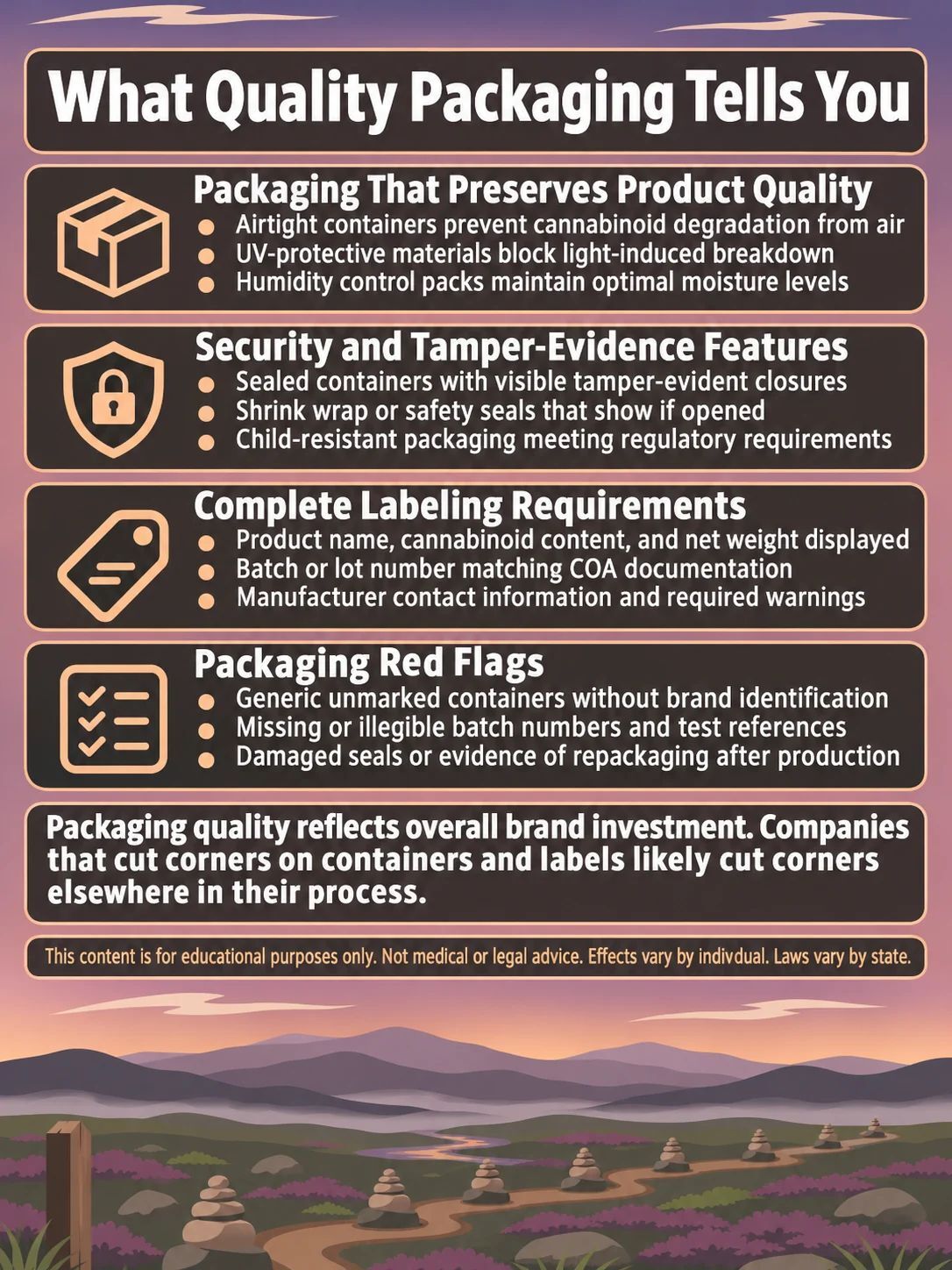
Packaging quality reflects investment in product integrity from production through delivery to your hands. Airtight containers, humidity control, light protection, and tamper-evident seals indicate a brand that understands freshness matters. Poor packaging suggests corner-cutting that likely extends to other areas.
THCA flower degrades when exposed to air, light, heat, and humidity fluctuations. Proper packaging protects against all these factors. Glass jars with sealed lids, UV-protective containers, or mylar bags with humidity packs show attention to preservation.
Tamper-evident features matter for safety verification. If you receive a product where seals are broken or packaging appears opened, you can't be certain the contents match the original product. Quality brands use packaging that makes tampering obvious.
Labeling completeness is part of packaging quality. Required information should be clearly printed and legible. This includes product name, cannabinoid content, batch or lot number, weight, manufacturer information, and any required warnings. Missing or incomplete labeling suggests regulatory non-compliance.
Premium indica flower deserves packaging that maintains its quality. The difference between well-preserved and poorly-handled flower is noticeable in appearance, aroma, and effectiveness. Brands that invest in proper packaging protect the quality you're paying for.
Building Your Personal Brand Evaluation Checklist
Create a personal checklist covering all eight verification points plus any additional criteria that matter for your specific needs. Running through this checklist systematically before each purchase prevents impulse buying from brands that haven't earned your trust. The few minutes of verification are worth the confidence in what you're consuming.
Start with the non-negotiables: third-party testing, Delta-9 compliance, and contaminant screening. These should be absolute requirements. If a brand fails any of these three, move on regardless of how appealing their products look.
Add the quality indicators: COA recency, batch matching, terpene profiles, and cultivation transparency. These differentiate good brands from excellent ones. You might accept a brand missing one of these if everything else checks out, but multiple gaps suggest insufficient quality investment.
Include reputation research: customer reviews, company history, and responsiveness to questions. These real-world signals complement the documentation checks. A brand might have perfect paperwork but poor execution, and reputation research catches that disconnect.
Consider your specific priorities. If you're looking for sleep-focused products, you might weigh certain terpene profiles more heavily. If you're price-sensitive, you might research why some brands cost more than others before defaulting to cheaper options.
Save documentation from brands that pass your evaluation. When you find trustworthy sources, you can reorder confidently without repeating full verification each time. But periodically rechecking ensures standards haven't slipped over time.
What Trustworthy THCA Brands Have in Common
Trustworthy THCA brands share common characteristics: accessible documentation, responsive communication, consistent quality over time, and pricing that reflects actual quality investment. These brands view transparency as a competitive advantage rather than a burden. They make verification easy because they have nothing to hide.
Documentation accessibility means COAs are easy to find without digging through websites or contacting customer service. QR codes on packaging that link directly to results, clearly organized testing pages, and downloadable reports all demonstrate this accessibility.
Responsive communication means questions get answered. When you ask about sourcing, testing protocols, or specific results, trustworthy brands respond with clear information. Evasiveness or defensiveness suggests they're not confident in their answers.
Consistency over time means customer experiences match expectations repeatedly. One excellent batch doesn't make a trustworthy brand. Multiple orders delivering the same quality, accurate descriptions, and reliable service build that trust.
Pricing reflects reality. Quality hemp cultivation, comprehensive testing, proper curing, and good packaging cost money. Brands charging reasonable prices for good products are sustainable. Brands offering suspiciously low prices are cutting somewhere you can't see.
Enjoy Hemp exemplifies these standards with USDA-certified organic products, third-party testing, and transparent documentation. Finding brands that meet all verification checks takes effort initially but creates confidence in every purchase thereafter.
Frequently Asked Questions
Can I verify a COA by contacting the lab directly?
Yes. Most accredited labs will confirm whether they tested a specific sample when you provide the batch or sample ID number. This verification cuts through any document manipulation by checking against the lab's own records. A quick phone call or email to the lab's customer service can confirm authenticity.
How often should brands retest their products?
Each production batch should be tested separately, meaning test frequency depends on production schedule. For ongoing inventory, annual retesting confirms stability. Products stored beyond 12 months should be retested before sale to verify cannabinoid content hasn't degraded significantly.
Does higher THCA percentage always mean better quality?
No. THCA percentage indicates potency but not overall quality. Terpene content, contaminant testing, cultivation methods, and curing all affect the actual experience. A 20% THCA flower with excellent terpene preservation often outperforms a 28% flower that was poorly handled.
What if a brand's COA is missing terpene results?
Missing terpene testing isn't a deal-breaker if cannabinoid and safety testing is complete. However, it suggests the brand isn't investing in comprehensive quality documentation. For flower products especially, terpene content significantly affects experience, so its absence limits your information.
Are QR codes on packaging trustworthy for accessing COAs?
QR codes are convenient but still require verification. The QR should link to a legitimate lab report that you can cross-reference. Confirm the batch number matches your product and that the lab is independently verifiable. QR codes just make access easier, they don't guarantee authenticity.
How can I tell if a COA has been digitally altered?
Look for inconsistencies in fonts, alignment, or formatting compared to other COAs from the same lab. Verify directly with the lab using sample IDs. Check that the lab's contact information works and matches their official website. Professional labs have consistent document formats that are difficult to replicate perfectly.
Should I avoid brands that only test cannabinoids without contaminant panels?
Yes, for consumable products. Cannabinoid testing alone doesn't verify safety. Pesticides, heavy metals, and microbials can be present regardless of accurate potency results. Complete testing costs more, but brands unwilling to invest in full panels may be cutting other corners too.
Does organic certification matter for THCA products?
Organic certification provides strong assurance of clean cultivation practices verified by third-party auditors. It covers soil quality, pest management, and handling from growth through processing. While not required, organic certification demonstrates verified commitment to quality that goes beyond minimum testing requirements.
How do I evaluate brands that sell through third-party retailers?
Verify that the retailer sources directly from the brand and maintains proper storage conditions. Check whether COAs are available through the retailer or from the original brand. Research both the brand and the retailer's reputation separately. Some retailers add quality assurance, while others may compromise it through poor handling.
What should I do if I find a brand's COA appears fake?
Don't purchase from that brand. Report concerns to the platform where they sell if applicable. Consider alerting the lab whose name may have been misused. Share your findings in community forums to warn other consumers. Document what you found in case it's useful for any official investigation.
By Sarah Mitchell, Wellness Industry Specialist
Sarah Mitchell is a wellness industry veteran with 15 years of experience in functional supplements and hemp derived products. She previously led product development at two nationally recognized wellness brands and holds certification as a holistic health practitioner. Sarah now advises consumers on quality standards, helping them make informed decisions in the evolving hemp market.
Disclaimer: This content is for educational purposes only and should not be considered medical or legal advice. Hemp laws vary by state and are subject to change. Consult local regulations and healthcare professionals for guidance specific to your situation.