
















THC Gummies USA: Federal Laws, State Regulations, and Shipping Guide
Posted by Enjoy Hemp Editor Team on Jul 16th 2026
Last Updated: July 2026
By Sarah Mitchell, Wellness Industry Specialist
Hemp-derived THC gummies are currently federally legal under the 2018 Farm Bill when they contain ≤0.3% Delta-9 THC by dry weight. Most states follow this federal framework, allowing purchase and possession without a medical card. However, some states have enacted additional restrictions, and federal law is scheduled to change significantly on November 12, 2026. Shipping is legal to most states via USPS, UPS, and FedEx as long as products comply with federal hemp guidelines.
I've been tracking hemp regulations since before the 2018 Farm Bill passed, and the legal landscape has never been more complex than it is right now. We're in a transitional period where the rules that have governed hemp products for years are about to change dramatically. If you're buying THC gummies in July 2026, you need to understand both current law and what's coming.
This guide breaks down federal regulations, state-by-state differences, shipping considerations, and what the November 2026 deadline actually means for consumers. I'll cut through the confusion and give you practical information about what's legal where you live, and readers specifically interested in dosing for calm can also review which low-dose THC options are suitable for mood support and reducing anxiety.
What Federal Laws Govern THC Gummies in the USA?
The Agriculture Improvement Act of 2018 (Farm Bill) established the current legal framework. It defines hemp as cannabis containing ≤0.3% Delta-9 THC by dry weight and removes it from the Controlled Substances Act. Any product derived from compliant hemp, including THC gummies, is federally legal to manufacture, sell, ship, and possess.
How the 0.3% Rule Actually Works
The 0.3% threshold applies to the total product weight, not the THC concentration. This is why legal gummies can contain psychoactive doses of THC while remaining compliant.
Here's the math: A gummy weighing 4 grams (4,000mg) can legally contain up to 12mg of Delta-9 THC and still be under 0.3%. A larger 5-gram gummy could hold 15mg. Manufacturers simply adjust gummy weight to accommodate desired THC doses while staying within legal limits.
This isn't a loophole. It's how the law was written. Whether Congress intended to enable psychoactive products is debatable, but the legal framework has been clear since 2018.
The November 2026 Federal Change
On November 12, 2025, President Trump signed the Continuing Appropriations and Extensions Act of 2026 (P.L. 119-37), which fundamentally changes the definition of hemp. The new rules take effect November 12, 2026, creating a one-year transition period.
Key changes in the new law:
- Total THC cap: Finished hemp products must contain no more than 0.4mg total THC per container (not per serving, per entire container)
- Total THC calculation: Now includes Delta-9, Delta-8, Delta-10, THCA, and all other THC isomers combined
- Synthetic ban: Chemically converted cannabinoids (Delta-8, HHC, THC-O, THCP) are explicitly excluded from the hemp definition
- THCA inclusion: THCA counts toward THC totals at a decarboxylation-adjusted rate
To put this in perspective: most THC gummies currently on the market contain 5-25mg of THC per piece. A typical package might contain 10 gummies totaling 100mg or more. Under the new law, the entire package would be limited to 0.4mg total, essentially banning current products.
What This Means Right Now
Until November 12, 2026, the 2018 Farm Bill framework remains in effect. Products compliant with the 0.3% Delta-9 standard are still federally legal. After that date, enforcement of the new restrictions will determine what happens to the industry.
Several bills are attempting to modify these provisions before the deadline, including H.R. 6209 and the HEMP Act (H.R. 1287). Industry groups are actively lobbying for alternatives to outright prohibition. The final outcome remains uncertain.
My honest assessment: enjoy legal hemp products while the regulatory framework is clear. The window may be closing.
Which States Allow Hemp-Derived THC Gummies?
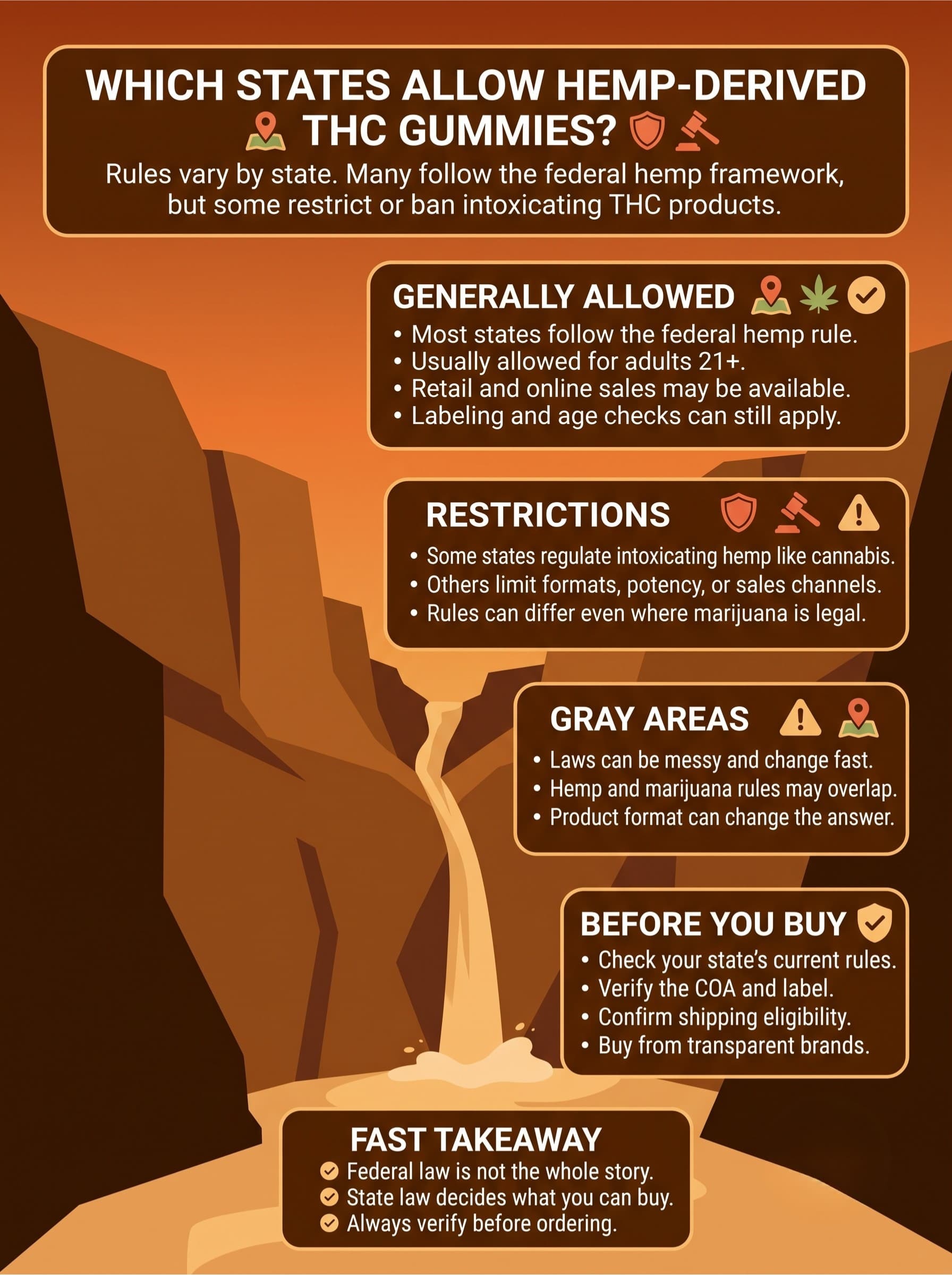
Most states follow the federal framework and allow hemp-derived THC products with no additional restrictions beyond the 0.3% Delta-9 threshold. However, some states have enacted stricter regulations, and a few effectively ban all THC products regardless of source. Always verify your state's current laws before purchasing.
States with Clear Legality
The following states generally follow federal hemp guidelines, allowing hemp-derived THC gummies for adults (typically 21+):
Alabama, Arizona, Arkansas, Connecticut, Delaware, Florida, Georgia, Illinois, Indiana, Iowa (limited), Kansas (trace THC only), Kentucky, Louisiana, Maine, Maryland, Massachusetts, Michigan, Minnesota, Mississippi, Missouri, Montana, Nebraska, Nevada, New Hampshire, New Jersey, New Mexico, New York, North Carolina, North Dakota, Ohio, Oklahoma, Pennsylvania, South Carolina, South Dakota, Tennessee, Texas, Vermont, Virginia, West Virginia, Wisconsin, Wyoming
In these states, you can typically purchase THC gummies at retail shops, specialty stores, and online. Age requirements (usually 21+) and labeling regulations may apply.
States with Restrictions or Bans
Idaho: Effectively bans all THC products with a zero-tolerance policy. Even hemp-derived products containing trace THC are prohibited.
Washington: Banned Delta-8 and other intoxicating hemp-derived cannabinoids in 2022. Hemp products must comply with state cannabis board oversight.
Oregon: Regulates intoxicating hemp products under the OLCC (Oregon Liquor and Cannabis Commission), requiring compliance with state marijuana rules.
Colorado: Regulates hemp-derived THC edibles under the same framework as marijuana edibles, including potency limits.
Alaska: Regulates hemp-derived THC under state cannabis board oversight with restrictions.
Hawaii: Limited availability with specific regulations on intoxicating hemp products.
Rhode Island: Age restrictions and additional regulatory requirements.
States in Gray Areas
California: Assembly Bill 45 created a complicated regulatory overlap between hemp and recreational marijuana rules. Intoxicating hemp products face additional scrutiny, and many retailers have stopped carrying them.
Utah: Restrictive but not fully banned. Regulations can vary by product format.
The patchwork of state laws means you can't assume legality just because a product is federally compliant. A THC gummy legal in Florida might be restricted in Colorado, even though Colorado has recreational marijuana. The hemp vs. marijuana regulatory distinction creates these inconsistencies.
Can You Ship THC Gummies Across State Lines?
Under federal law, shipping hemp-derived THC gummies across state lines is legal when products comply with the 2018 Farm Bill (≤0.3% Delta-9 THC by dry weight). USPS, UPS, and FedEx all transport legal hemp products. However, you're responsible for knowing your destination state's laws, and reputable retailers won't ship to states with restrictions.
How Legal Shipping Works
Hemp-derived products ship as legal agricultural commodities under federal law. No special permits are required for consumers to receive them. Most online retailers use standard carriers and discreet packaging.
When ordering online:
- Verify the retailer checks state shipping restrictions at checkout
- Confirm products include Certificates of Analysis showing THC content
- Expect standard shipping times (no refrigeration or special handling needed)
- Packages typically show the company name but not product contents
At Enjoy Hemp, we ship to all states where hemp-derived THC products are legal. Our checkout process automatically restricts shipping to prohibited states.
Risks and Considerations
While shipping is federally legal, some practical considerations apply:
Destination state laws: If your state restricts hemp THC products, receiving shipments could technically violate state law even if federal law permits the transaction.
Carrier policies: Carriers follow federal law but may defer to local law enforcement if packages are inspected. This is rare but possible.
International shipping: Don't do it. Most countries prohibit THC in any form, and crossing international borders with cannabis products (even hemp-derived) can result in serious legal consequences.
After November 2026: If the new federal restrictions take effect as written, interstate shipping of current THC products would become federally illegal. This remains uncertain pending potential legislative changes.
What Are the Age Requirements for Buying THC Gummies?
Most states require purchasers to be 21 or older for hemp-derived THC products, mirroring alcohol regulations. Some states allow purchase at 18. A few have no specified age requirement, though responsible retailers typically impose 21+ policies regardless. Always carry ID when purchasing in-store.
State Age Requirements
The trend has been toward 21+ requirements. States that have explicitly set age limits for hemp THC products include:
21+ required: Texas, Florida, Tennessee, North Carolina, Georgia, Virginia, Louisiana, Maryland, Connecticut, and many others following the alcohol model.
18+ in some states: A handful of states allow adult purchase at 18, though this is becoming less common as regulations tighten.
No explicit age limit: Some states haven't specifically addressed hemp product age requirements, leaving retailers to set their own policies.
Responsible retailers, including us, verify age for all orders. This protects consumers and supports industry legitimacy. If a company ships THC products without age verification, that's a red flag about their overall compliance practices.
Will THC Gummies Show Up on a Drug Test?
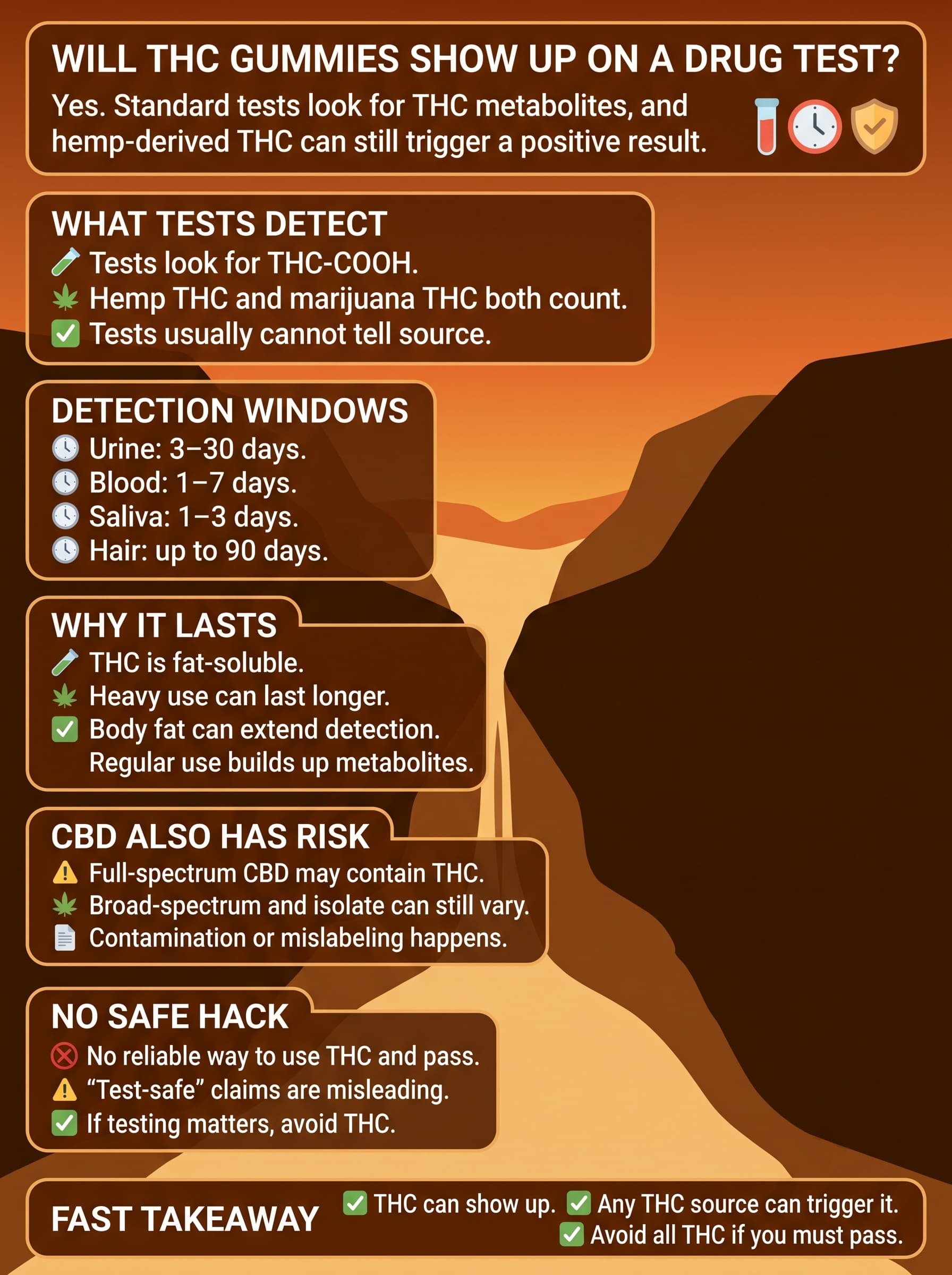
Yes. Drug tests detect THC metabolites regardless of whether the THC came from hemp or marijuana. Standard workplace and government drug screens cannot distinguish between legal hemp-derived THC and illegal marijuana-derived THC. If you're subject to drug testing, avoid all THC products including hemp-derived options.
How Drug Tests Work
Most drug tests screen for THC-COOH, a metabolite produced when your body processes any form of THC. Delta-9 from hemp, Delta-9 from marijuana, Delta-8, and other THC variants all produce this same metabolite.
Detection windows vary by test type:
- Urine: 3-30 days depending on frequency of use
- Blood: 1-7 days
- Saliva: 1-3 days
- Hair: Up to 90 days
Heavy users and those with higher body fat percentages typically test positive for longer periods since THC is fat-soluble.
No Safe Option for Drug Testing
There's no reliable way to use THC gummies and pass a drug test. Products marketed as "test-safe" or claiming they won't trigger positive results are misleading. If your job, probation, or other circumstances require passing drug screens, the only safe approach is complete THC abstinence.
CBD products can also cause issues. Full-spectrum CBD contains trace THC that may accumulate with regular use. Even broad-spectrum and isolate products occasionally test positive for THC due to manufacturing contamination. If testing is a concern, avoid all hemp cannabinoid products.
How Do You Verify a THC Product Is Legal?
Legal THC gummies should clearly state "hemp-derived" on packaging, list Delta-9 THC content per serving and per package, include a batch-matched Certificate of Analysis (COA) from an accredited lab showing THC at or below 0.3% by dry weight, and comply with your state's specific regulations. If any of this is missing, don't buy it.
What to Check on the Label
Hemp-derived statement: The product must explicitly state it's made from hemp, not marijuana. This distinction determines legal status.
THC per serving: Should show mg of Delta-9 THC (and any other cannabinoids) in each gummy.
Total THC per package: Combined THC across all servings. Math should add up.
Batch or lot number: This should match the COA. If there's no batch number, you can't verify the test results apply to your specific product.
Company information: Legitimate brands include contact information, website, and clear identification.
What to Check in Lab Reports (COAs)
A proper Certificate of Analysis includes:
Cannabinoid profile: Confirms Delta-9 THC is ≤0.3% by dry weight. Also shows CBD, CBN, CBG, and other cannabinoids present.
Contaminant testing: Results for pesticides, heavy metals (lead, arsenic, mercury, cadmium), residual solvents, and microbials (mold, bacteria, yeast).
Lab accreditation: Look for ISO 17025 accreditation. Non-accredited labs may not follow proper testing protocols.
Date: Recent testing (within 12 months) matters. Cannabinoid content can change over time.
All Enjoy Hemp products come with accessible COAs. We test every batch through ISO-accredited labs and post results on our website. If a brand makes you hunt for lab reports or can't provide them, that's a problem.
What Should You Know About Traveling with THC Gummies?
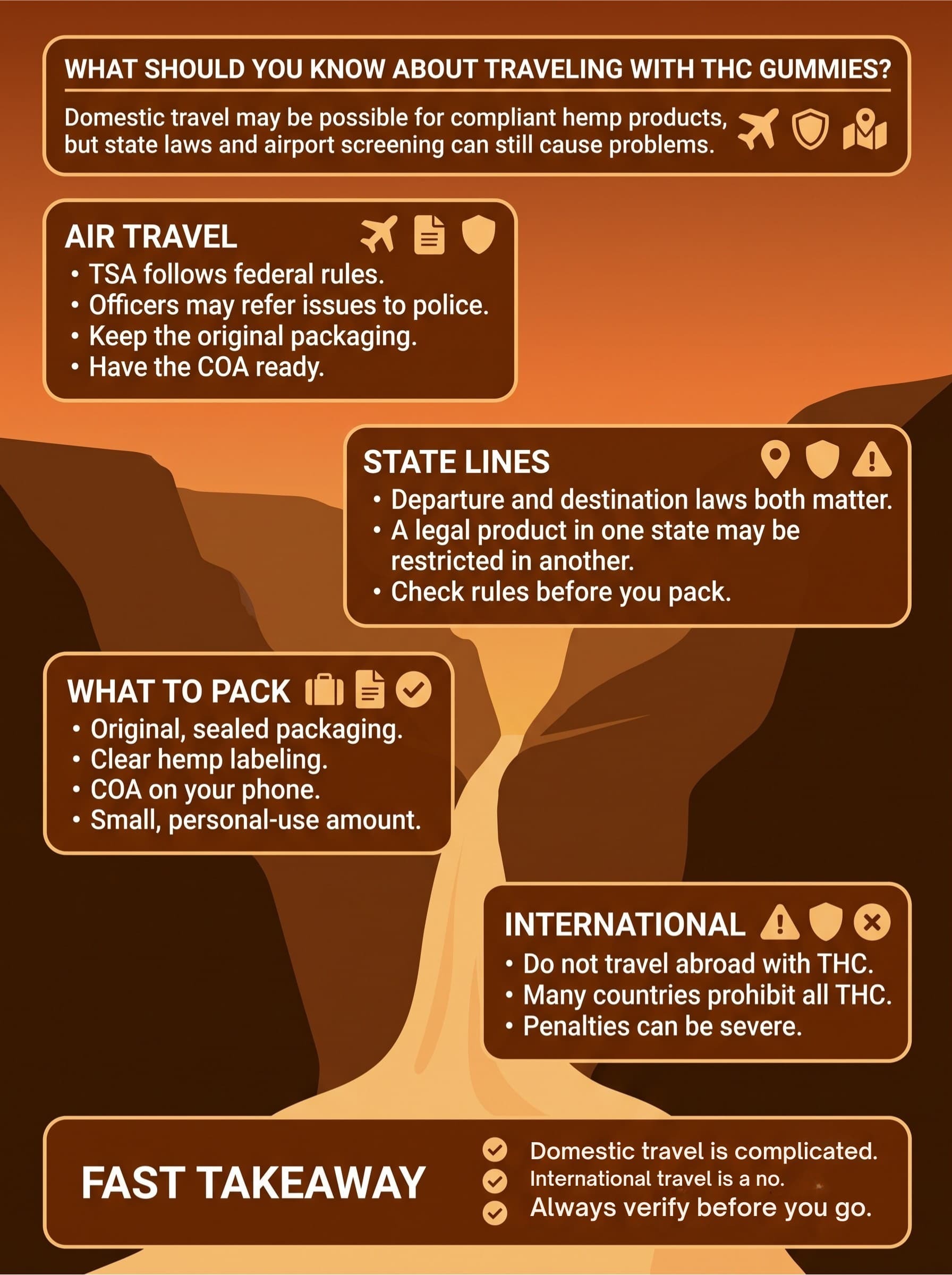
Traveling with hemp-derived THC gummies within the United States is legally complex. TSA follows federal law (which permits hemp products), but individual states and local law enforcement may apply different rules. Research both departure and destination state laws before traveling with any THC product.
Air Travel
TSA's official position: they're not actively searching for cannabis products, but if they discover them during routine screening, they'll refer the matter to local law enforcement. Since hemp is federally legal, TSA technically has no authority over compliant products. But the officer examining your bag may not know or care about the hemp distinction.
Practical advice:
- Keep products in original packaging with clear hemp labeling
- Bring lab reports (on your phone is fine) if questioned
- Know your destination state's laws before you pack
- Consider whether the potential hassle is worth it
Flying into states with restrictions (Idaho, Washington for Delta-8, etc.) with THC products is asking for problems even if you purchased them legally.
Driving Across State Lines
Interstate transport of hemp products is federally legal. However, if you're stopped in a state that restricts hemp THC, you could face state-level charges regardless of where you purchased the product or federal legality.
Keep products in original, sealed packaging. Having clear "hemp-derived" labeling and accessible COAs helps if law enforcement questions the products. But understand that some officers may confiscate products regardless, leaving you to sort it out later.
International Travel
Do not travel internationally with any THC products. Most countries have strict cannabis prohibitions that include hemp-derived THC. Penalties can be severe, including imprisonment in some jurisdictions. No gummy is worth that risk.
What Happens After November 2026?
If the new federal hemp definition takes effect as written on November 12, 2026, most current THC gummies will become federally illegal. Products exceeding 0.4mg total THC per container would no longer qualify as hemp. However, enforcement uncertainty, pending legislation, and state-level responses make the actual outcome unclear.
Possible Scenarios
Full enforcement: Federal agencies begin treating current THC products as controlled substances. Interstate commerce stops. Retailers in non-marijuana states close or pivot to CBD-only products.
Limited enforcement: Similar to the current FDA stance on CBD in foods (technically illegal but rarely enforced), federal agencies issue guidance but don't actively pursue compliant hemp businesses. State-level enforcement varies.
Legislative fix: Congress passes amendments before November 2026 establishing regulated pathways for hemp THC products with age-gating, testing requirements, and reasonable potency limits rather than effective prohibition.
State divergence: States with legal marijuana absorb hemp THC into existing cannabis programs. States without marijuana enforcement follow federal lead. Products remain available in some markets but not others.
Industry Response
Hemp industry groups are actively lobbying for regulation rather than prohibition. Arguments include:
- The 2018 Farm Bill created legitimate businesses and jobs now at risk
- State-level regulatory models (age limits, testing, packaging rules) demonstrate responsible oversight is possible
- Prohibition drives consumers to unregulated products
- Many states depend on hemp industry tax revenue
Whether Congress responds remains to be seen. The one-year transition period was explicitly included to allow time for potential adjustments.
What Consumers Should Do Now
Stay informed about legislative developments. Stock up if you've found products that work for you and want to ensure supply. Pay attention to state-level responses, as some states may adopt the federal changes early while others may maintain current frameworks.
And be skeptical of anyone claiming certainty about what happens next. The situation is genuinely uncertain.
Frequently Asked Questions About THC Gummies USA Laws
Are hemp THC gummies legal in all 50 states?
No. While federally legal, some states have enacted their own restrictions. Idaho effectively bans all THC products. Washington banned Delta-8 and similar cannabinoids. Oregon and Colorado regulate hemp THC under marijuana rules. Always check your specific state's current laws.
Do I need a medical card to buy THC gummies?
Not for hemp-derived products compliant with the 2018 Farm Bill. These are available to adults (typically 21+) without any medical authorization. Marijuana-derived products in dispensaries require cards in medical-only states.
Can I order THC gummies online to any state?
You can order to states that allow hemp THC products. Reputable retailers automatically block shipping to restricted states. Attempting to ship to prohibited areas could create legal issues for you, not just the seller.
What's the difference between hemp THC and marijuana THC?
Chemically, nothing. Delta-9 THC is the same molecule regardless of source. The legal distinction is based on the source plant: hemp (≤0.3% THC by dry weight) is federally legal; marijuana (>0.3% THC) remains federally illegal. Effects at equivalent doses are identical.
Will the November 2026 law definitely ban THC gummies?
As currently written, yes, it would effectively ban most products. But enforcement uncertainty, pending legislative amendments, and the time remaining before the deadline mean the actual outcome isn't certain. The law could be modified, enforcement could be limited, or states could create their own frameworks.
Is it legal to have THC gummies shipped to my home?
If your state allows hemp-derived THC products and the products comply with federal law, yes. Shipping legal hemp products is permitted under the 2018 Farm Bill. The key is ensuring both the product and your state allow it.
Can I take THC gummies on a plane?
Legally, hemp products are permitted under federal law, and TSA follows federal guidelines. Practically, you may face hassle if products are discovered, especially if traveling to restrictive states. Keeping products in original packaging with lab documentation helps but doesn't guarantee smooth passage.
Do any states have lower age requirements than 21?
Some states allow purchase at 18, though this is becoming less common. Many states don't have explicit age requirements for hemp products, leaving it to retailer discretion. The trend is toward 21+ requirements matching alcohol regulations.
What should I do if police question my THC gummies?
Remain calm and polite. Explain they're legal hemp-derived products. Show original packaging with hemp labeling and offer to provide COA documentation. In states where hemp THC is legal, you shouldn't face charges for compliant products. However, if the officer insists on confiscation, don't resist. Address it through proper channels later.
Are Delta-8 and Delta-9 gummies treated differently legally?
Yes. Delta-9 derived from hemp under 0.3% is clearly covered by the 2018 Farm Bill. Delta-8 occupies a grayer area since it's typically converted from CBD rather than directly extracted. Some states have specifically banned Delta-8 while allowing Delta-9. The November 2026 changes explicitly exclude converted cannabinoids like Delta-8.
Staying Legal with Hemp THC Products
The legal landscape for THC gummies in the USA is more complex than a simple "legal or illegal" answer. Federal law currently permits hemp-derived products meeting the 0.3% threshold, but state laws add layers of regulation, and federal law itself is about to change significantly.
For now, most Americans can legally purchase and possess hemp-derived THC gummies. Shop from reputable brands that provide third-party testing, verify your state's specific regulations, and understand that drug tests don't distinguish between legal hemp THC and illegal marijuana THC.
At Enjoy Hemp, all our products are third-party tested, clearly labeled, and compliant with current federal law. We ship to all legal states and maintain transparent lab results for every batch. Browse our gummy collection or explore products by effect through our chill, sleep, or euphoria categories.
The regulatory environment is changing. We'll continue updating this guide as new developments occur.
About the Author
Sarah Mitchell is a wellness industry veteran with 15 years of experience in functional supplements and hemp-derived products. She previously led product development at two nationally recognized wellness brands and holds certification as a holistic health practitioner. Sarah now advises consumers on quality standards, helping them make informed decisions in the evolving hemp market.
Disclaimer: This content is for informational purposes only and does not constitute legal advice. Cannabis laws vary by state and are subject to change. Always verify current regulations in your specific jurisdiction before purchasing, possessing, or transporting THC products. Hemp-derived products may still cause positive drug test results. Not for use by individuals under 21 (or applicable state age), pregnant or nursing women, or those with certain health conditions. All Enjoy Hemp products are derived from hemp containing ≤0.3% Delta-9 THC per the 2018 Farm Bill.