














Do THC Gummies Lose Potency Over Time? Expiration and Shelf Life Guide
Posted by Enjoy Hemp Editor Team on Jul 29th 2026
Last Updated: July 2026
By Sarah Mitchell, Wellness Industry Specialist
THC gummies do lose potency over time. Research on cannabinoid stability indicates that THC degrades at approximately 16% per year under typical room temperature storage conditions. This degradation occurs through oxidation, a chemical process where THC molecules convert to cannabinol (CBN), a different cannabinoid with distinct properties.
This guide examines the science of cannabinoid degradation in gummy products, typical shelf life timelines, factors that accelerate or slow potency loss, and practical indicators that gummies may have degraded. Understanding these factors helps consumers make informed decisions about product storage and consumption timing.
Most commercially produced THC gummies carry expiration dates of 12-24 months from manufacture, though actual cannabinoid stability depends significantly on storage conditions throughout the product's life.
Do THC Gummies Actually Expire?
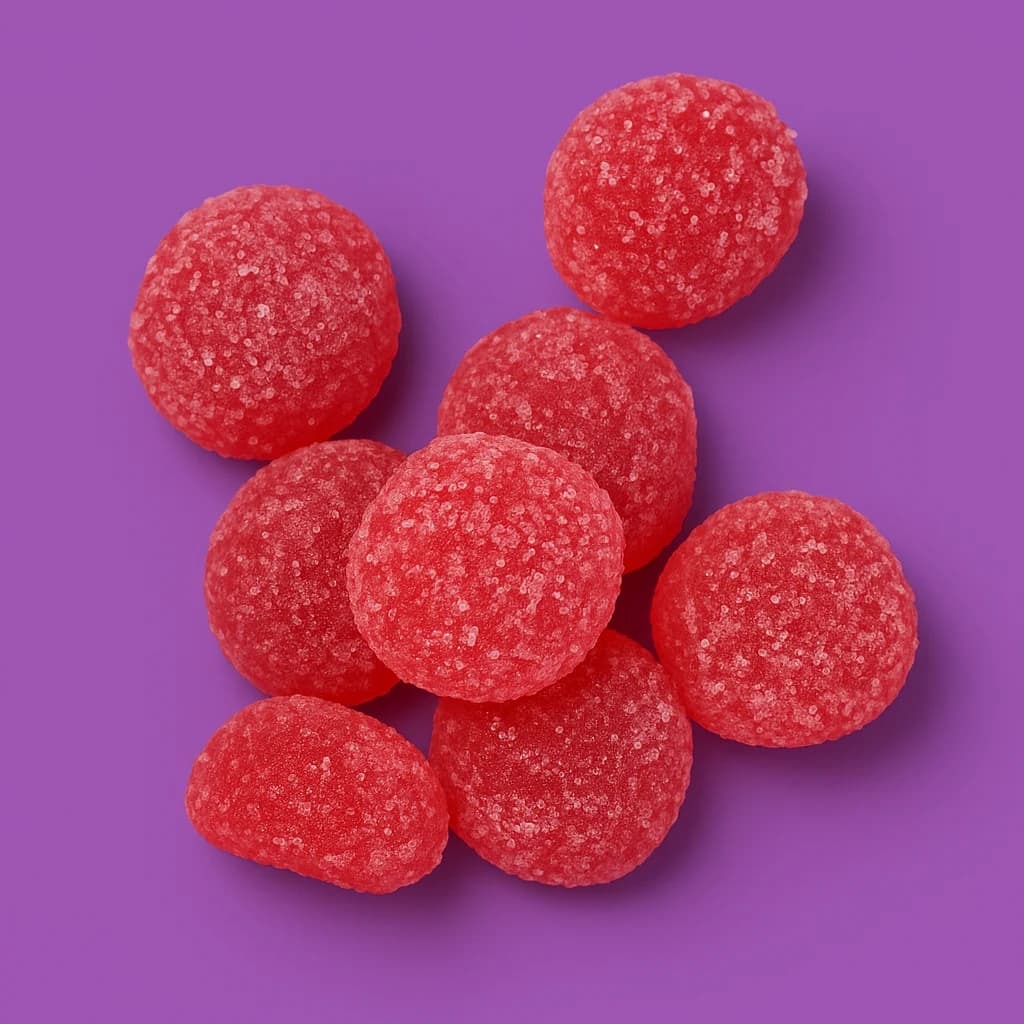
Yes, THC gummies expire in two distinct ways: the food components degrade, and the cannabinoids lose potency. These processes occur simultaneously but at different rates, meaning a gummy might still appear edible while containing significantly reduced THC content, or conversely, maintain cannabinoid levels while developing unpleasant texture or taste.
Food Component Degradation
The base ingredients in THC gummies include:
- Sugar or corn syrup: Acts as a natural preservative by binding water, inhibiting bacterial growth
- Gelatin or pectin: Provides structure but dries out and hardens over time
- Flavorings: Lose intensity and freshness with age
- Colorings: May fade with light exposure
These food components make gummies relatively shelf-stable compared to baked goods containing dairy, eggs, or high moisture content. However, texture changes (hardening, stickiness) and flavor degradation still occur over months.
Cannabinoid Degradation
THC (tetrahydrocannabinol) is an organic compound that chemically transforms when exposed to environmental factors. The primary degradation pathway converts Delta-9 THC to CBN (cannabinol) through oxidation. This is a natural, continuous process that cannot be completely stopped, only slowed.
According to research on cannabinoid stability, THC in cannabis flower degrades approximately 12% in the first 100 days (roughly 3-4% per month). In gummy formulations, degradation rates vary based on preservatives, encapsulation methods, and storage conditions.
What Is the Science Behind THC Degradation?
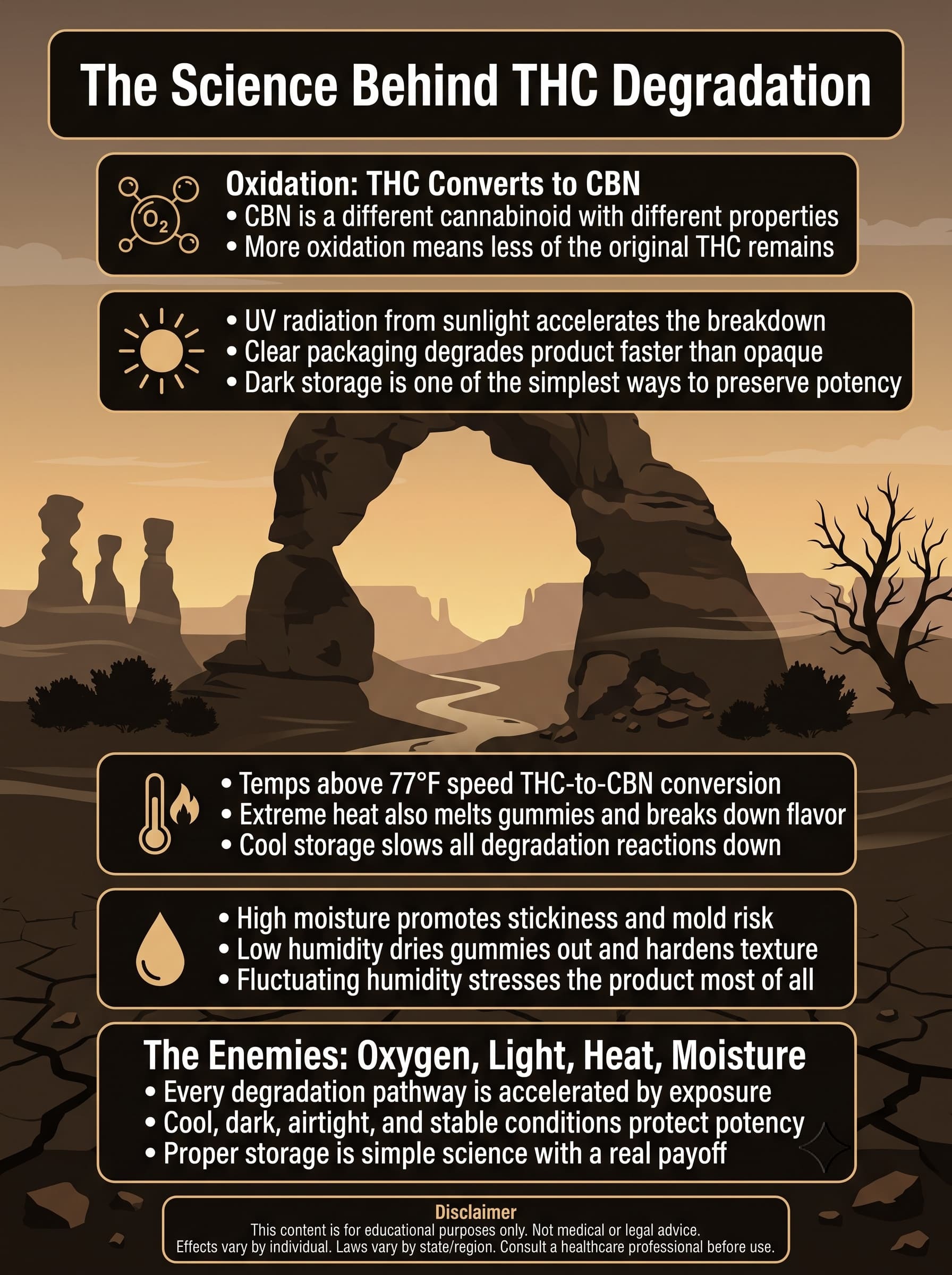
THC degradation follows predictable chemical pathways influenced by environmental exposure. Understanding these mechanisms explains why storage conditions significantly impact product longevity.
Oxidation Process
When THC molecules encounter oxygen, they undergo oxidation. This chemical reaction converts Delta-9 THC into CBN (cannabinol). The process is:
Delta-9 THC + Oxygen → CBN
CBN is a distinct cannabinoid with different properties than THC. Products that have undergone significant oxidation contain higher CBN ratios relative to their original THC content.
Photodegradation
Light exposure, particularly ultraviolet (UV) light from sunlight, accelerates cannabinoid breakdown. UV radiation provides energy that speeds the oxidation reaction, causing faster conversion of THC to CBN and other degradation products.
Research indicates that light exposure is one of the fastest pathways to cannabinoid degradation. Clear packaging or storage in bright environments significantly reduces product shelf life compared to opaque containers in dark storage.
Thermal Degradation
Heat accelerates chemical reactions, including THC oxidation. Elevated temperatures cause:
- Faster conversion of THC to CBN
- Potential conversion to other cannabinoid compounds
- Degradation of the gummy base (melting, texture changes)
- Accelerated flavor compound breakdown
Products stored in warm environments (above 77°F/25°C) degrade faster than those kept cool. Extreme heat can cause both potency loss and physical product damage.
Humidity Effects
Moisture affects THC gummies in multiple ways:
- High humidity: Can cause gummies to become sticky, promote mold growth, and accelerate certain degradation pathways
- Low humidity: Causes gummies to dry out and harden, affecting texture but not necessarily cannabinoid content
- Moisture fluctuation: Repeated exposure to varying humidity levels stresses the product
How Long Do THC Gummies Maintain Potency?
Shelf life varies based on formulation, packaging, and storage conditions. Industry data provides general timelines for cannabinoid stability in gummy products.
Typical Shelf Life Timeline
| Time Period | Expected Potency | Notes |
|---|---|---|
| 0-6 months | 90-100% | Optimal consumption window |
| 6-12 months | 80-95% | Still within most expiration dates |
| 12-18 months | 70-85% | Noticeable reduction possible |
| 18-24 months | 60-75% | Approaching or past typical expiration |
| 2+ years | 50-70% | Significant degradation likely |
| 4+ years | ~59% | Research indicates ~41% loss by year 4 |
These percentages represent estimates under typical storage conditions. Proper storage extends these timelines, while poor storage accelerates degradation.
Comparison to Other Cannabis Products
THC gummies are among the more stable cannabis product formats:
| Product Type | Typical Shelf Life | Stability Factor |
|---|---|---|
| THC Gummies | 6-24 months | Low moisture, sugar preservation |
| THC Chocolates | 6-12 months | Fat content, temperature sensitive |
| Baked Edibles | 1-2 weeks | High moisture, dairy/eggs |
| THC Tinctures | 12-24 months | Alcohol preservation |
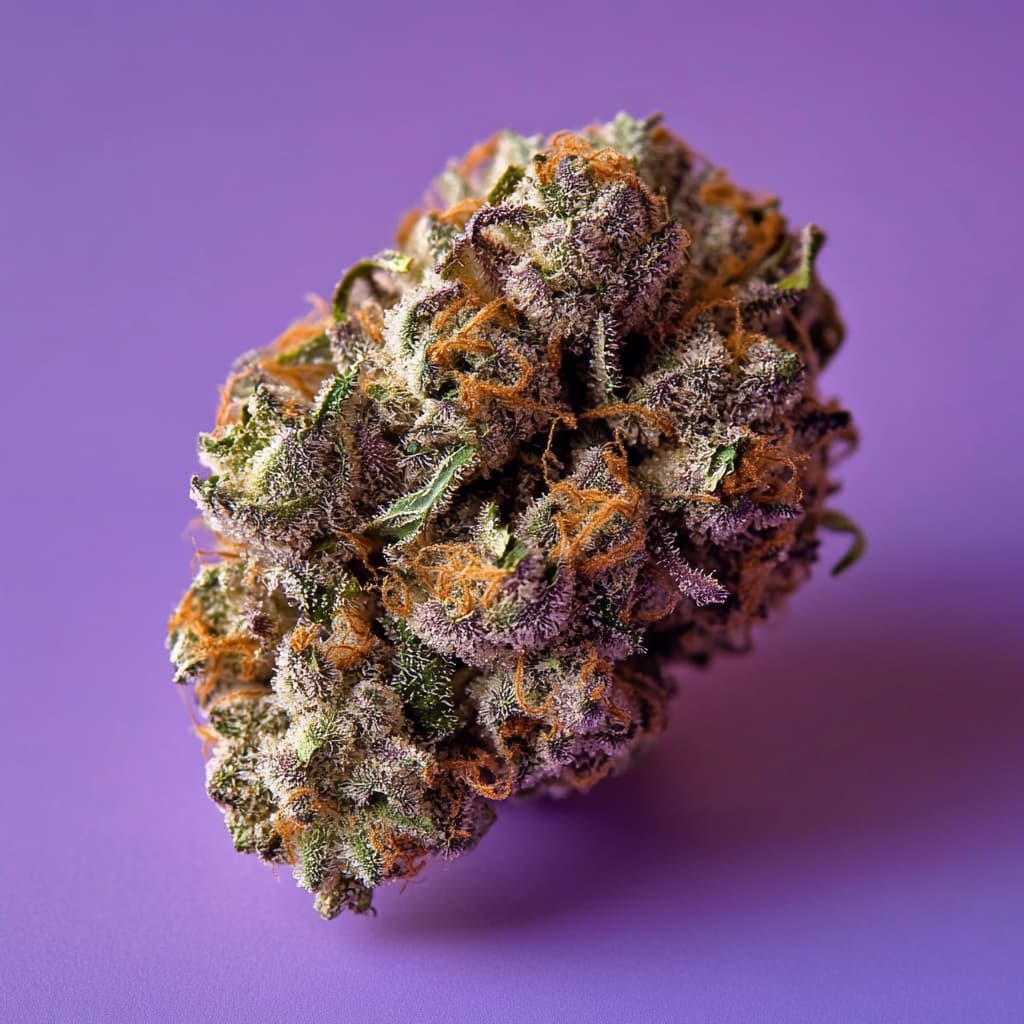
| Cannabis Flower | 6-12 months | Terpene and moisture loss |
Gummies benefit from low moisture content and sugar's preservative properties, making them relatively long-lasting compared to baked goods or fresh flower.
What Factors Accelerate Potency Loss?
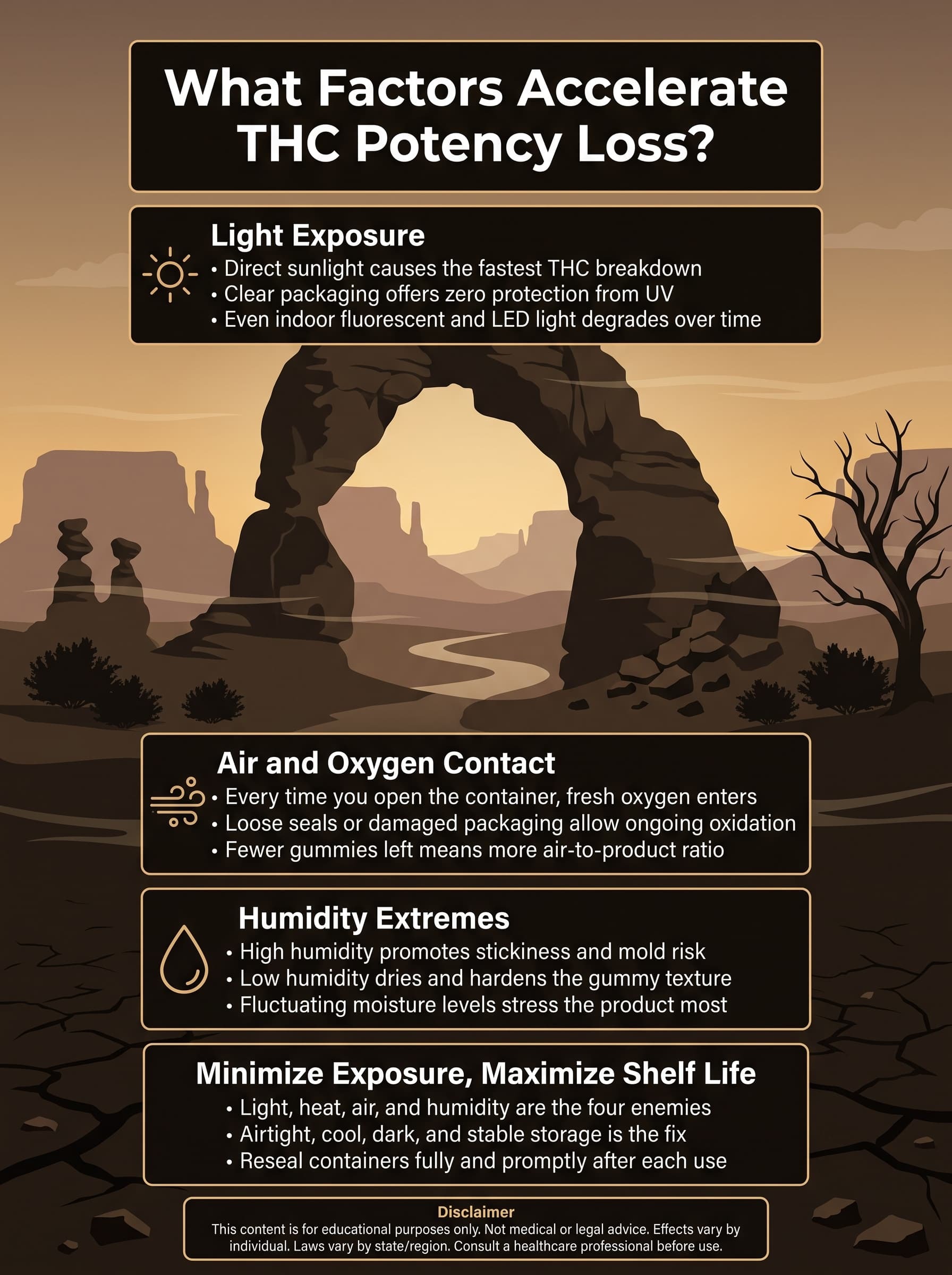
Several environmental and handling factors speed cannabinoid degradation beyond baseline rates.
Light Exposure
Light, especially UV light from sunlight, is one of the fastest degradation accelerators:
- Direct sunlight can cause rapid THC breakdown
- Fluorescent and LED lighting also contributes to degradation over time
- Clear packaging offers no protection from light exposure
- Window storage or countertop display significantly reduces shelf life
Heat Exposure
Temperature elevation accelerates all chemical degradation processes:
- Storage above 77°F (25°C) increases degradation rate
- Car storage during warm months can cause rapid potency loss
- Near-stove or appliance storage creates heat exposure
- Shipping during summer months may impact products
Air Exposure
Oxygen contact enables the oxidation reaction that converts THC to CBN:
- Opened packages expose remaining gummies to air
- Loose seals or damaged packaging allow continuous oxidation
- Repeatedly opening containers increases cumulative exposure
- Large containers with few remaining gummies have high air-to-product ratios
Humidity Extremes
Both high and low humidity create problems:
- High humidity promotes mold and bacterial growth
- Moisture can accelerate certain degradation pathways
- Low humidity causes physical hardening but less chemical impact
What Factors Help Preserve Potency?
Proper storage significantly extends cannabinoid stability. These factors slow degradation:
Temperature Control
Cool storage slows chemical reactions:
- Room temperature (68-72°F): Acceptable for short-term storage
- Refrigeration (35-40°F): Extends shelf life significantly
- Freezing (0°F): Maximum preservation for long-term storage
A 2024 study by Anresco Laboratories found that cannabis products stored at 4°C (39°F) maintained stable cannabinoid profiles for 210 days, while room temperature storage showed measurable degradation.
Light Protection
Blocking light prevents photodegradation:
- Opaque containers block all light
- Amber or dark-colored containers filter UV light
- Storage in drawers, cabinets, or closets eliminates ambient light
- Original packaging is often designed for light protection
Research published in Scientific Reports demonstrated that amber containers preserved cannabinoid content significantly better than clear containers under identical conditions.
Air Exclusion
Limiting oxygen contact slows oxidation:
- Airtight containers prevent continuous air exchange
- Original sealed packaging provides optimal protection until opened
- Smaller containers reduce air-to-product ratio
- Vacuum sealing removes most oxygen for long-term storage
Humidity Management
Maintaining appropriate moisture levels:
- 50-60% relative humidity is generally optimal
- Silica gel packets can control humidity in containers
- Avoid refrigerator storage without moisture protection (condensation risk)
How Can You Tell If THC Gummies Have Degraded?
Several indicators suggest cannabinoid degradation or product expiration:
Visual Changes
- Color fading: Bright colors becoming muted or brownish
- Sugar crystallization: White coating forming on surface
- Texture changes: Hardening, cracking, or becoming sticky
- Mold growth: Visible fuzzy patches (discard immediately)
- Separation: Oils or liquids separating from gummy base
Texture Changes
- Hardening: Gummies becoming difficult to chew
- Stickiness: Surface becoming tacky or adhering to packaging
- Crumbling: Loss of structural integrity
- Melting: Loss of defined shape (indicates heat exposure)
Flavor and Odor Changes
- Stale taste: Loss of vibrant fruit or other flavors
- Off-putting odor: Unusual or unpleasant smell
- Chemical taste: Flavors becoming artificial or "off"
- Reduced flavor intensity: Muted taste compared to fresh product
Potency Indicators
Unlike visual or sensory changes, potency reduction isn't directly observable. However, if visual and texture indicators suggest age or degradation, cannabinoid content has likely also diminished.
Some consumers use home potency testing devices to measure actual cannabinoid content in older products, though these tools require investment and proper technique.
Are Expired THC Gummies Safe to Consume?
Expired THC gummies are generally not dangerous in the way that spoiled meat or dairy products are dangerous. However, several considerations apply:
Food Safety Perspective
The sugar content in gummies inhibits bacterial growth, making them more shelf-stable than many foods. However:
- Mold: If visible mold is present, discard the product
- Unusual odor: Significant off-smells suggest spoilage
- Texture degradation: May indicate moisture contamination
Cannabinoid Content Changes
Degraded gummies don't become toxic, but their cannabinoid profile changes:
- THC content decreases as it converts to CBN
- The ratio of cannabinoids shifts from original formulation
- Labeled dosage no longer accurately reflects actual content
Practical Considerations
Consuming degraded gummies means:
- Uncertain actual cannabinoid content
- Possible reduced experience compared to labeled dose
- Changed cannabinoid ratios (more CBN, less THC)
- Potentially unpleasant taste or texture
How Should THC Gummies Be Stored for Maximum Shelf Life?
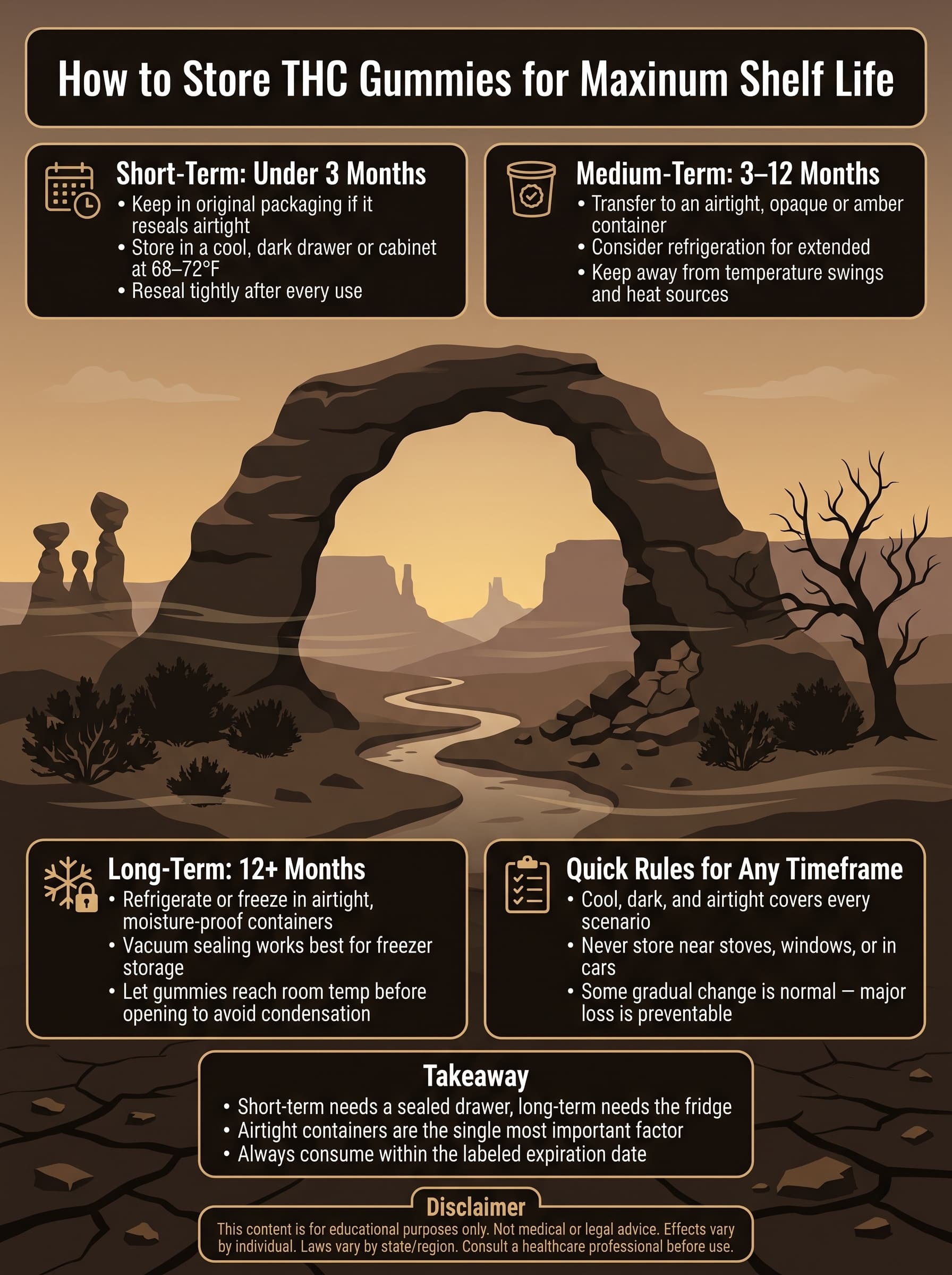
Optimal storage combines temperature control, light protection, and air exclusion.
Short-Term Storage (Under 3 Months)
For products you'll consume within a few months:
- Keep in original packaging if airtight
- Store in a cool, dark location (drawer, cabinet, closet)
- Room temperature (68-72°F) is acceptable
- Reseal package tightly after each use
Medium-Term Storage (3-12 Months)
For products stored several months:
- Transfer to airtight containers if original packaging isn't resealable
- Use opaque or amber containers when possible
- Consider refrigeration for extended freshness
- Keep away from temperature fluctuations
Long-Term Storage (12+ Months)
For maximum preservation:
- Refrigerate or freeze in airtight, moisture-proof containers
- Use vacuum sealing for freezer storage
- Allow products to reach room temperature before opening to prevent condensation
- Accept that some degradation will still occur over extended periods
At Enjoy Hemp, our gummy products are packaged in airtight, light-resistant containers designed to maximize shelf life. We recommend consuming products within the labeled expiration date and storing according to package instructions.
What Do Expiration Dates on THC Gummies Mean?
Expiration dates on THC gummies represent manufacturer determinations based on stability testing.
Types of Date Labels
"Best By" dates: Indicate when product quality (including potency, flavor, and texture) is expected to be optimal. Products may still be acceptable after this date but with reduced quality.
"Expiration" dates: More conservative estimates of when products should be consumed. Generally allow some safety margin.
"Manufactured On" dates: Indicate production date, requiring consumers to calculate shelf life based on typical timelines.
How Dates Are Determined
Manufacturers conduct stability testing to determine appropriate dates:
- Products are stored under controlled conditions
- Samples are tested at intervals for cannabinoid content, microbial safety, and quality
- Dates are set based on when products maintain acceptable specifications
- Safety margins are typically included
Factors Affecting Date Accuracy
Labeled dates assume proper storage. Products may expire sooner if:
- Stored at higher temperatures than recommended
- Exposed to light or air
- Subjected to humidity extremes
- Shipped or stored in poor conditions before purchase
How Do Different Cannabinoid Formulations Affect Shelf Life?
THC gummies come in various cannabinoid formulations, each with stability considerations.
Delta-9 THC Products
Standard Delta-9 THC follows the degradation pathways described above, converting to CBN over time. Our Delta-9 THC gummies are formulated for stability within their labeled shelf life.
Delta-8 THC Products
Delta-8 THC is an isomer of Delta-9 with a different molecular structure. It follows similar degradation patterns, though some research suggests slight differences in stability. Our Delta-8 products carry similar storage recommendations.
Multi-Cannabinoid Formulations
Products containing multiple cannabinoids (THC + CBD, THC + CBN, THC + CBG) have multiple compounds that may degrade at different rates:
- CBD shows similar degradation patterns to THC
- CBN is already a degradation product, relatively stable
- CBG has its own stability profile
Our Balance gummies (THC + CBD) and Sleep gummies (THC + CBN) are formulated considering the stability characteristics of each cannabinoid included.
Live Rosin Products
Live rosin gummies like our Live Rosin Bliss gummies contain full-spectrum extracts with terpenes. Terpenes are volatile compounds that may degrade faster than cannabinoids, potentially affecting the complete profile over time even when THC content remains relatively stable.
What Happens to THC When It Converts to CBN?
Understanding the THC-to-CBN conversion helps contextualize what "degradation" actually means.
Chemical Transformation
CBN (cannabinol) forms when THC molecules lose hydrogen atoms through oxidation. This is a one-way chemical transformation. CBN cannot convert back to THC, which is why products formulated with CBN list it as its own line item on the Certificate of Analysis, as we cover in how CBN forms as THC ages.
CBN Properties
CBN is a distinct cannabinoid with its own characteristics:
- Less psychoactive than Delta-9 THC
- Present in aged cannabis products
- Occurs naturally in very small amounts in fresh cannabis
- Increases proportionally as THC decreases
Implications for Aged Products
Significantly aged THC gummies contain a different cannabinoid ratio than when manufactured:
- Lower THC concentration than labeled
- Higher CBN concentration than labeled (if any was originally present)
- Changed overall cannabinoid profile
Frequently Asked Questions About THC Gummy Potency and Expiration
Do THC gummies lose potency if unopened?
Yes, though more slowly than opened products. Sealed packaging protects against air exposure but doesn't completely prevent degradation. THC still converts to CBN over time through oxidation with residual air in packaging and through other degradation pathways. Unopened gummies maintain potency longer than opened products but still degrade.
How quickly do THC gummies expire after opening?
Opening accelerates degradation by introducing fresh oxygen. Properly resealed products may last several months after opening, while products left unsealed or poorly stored can degrade significantly within weeks. Refrigeration after opening extends usable life.
Can you freeze THC gummies to preserve potency?
Yes, freezing significantly slows degradation. Use airtight, moisture-proof containers to prevent freezer burn and condensation. Allow frozen gummies to reach room temperature before opening the container to avoid moisture condensation on the product surface.
Do refrigerated THC gummies last longer?
Yes, refrigeration extends shelf life by slowing chemical reactions. The Anresco Laboratories study found that products stored at 4°C (39°F) maintained stable cannabinoid profiles for 210 days. Room temperature storage showed measurable degradation over the same period.
What is the shelf life of THC gummies?
Most THC gummies have shelf lives of 6-24 months depending on formulation and packaging. Manufacturers determine specific dates through stability testing. Products typically maintain optimal potency for 6-12 months under proper storage conditions.
Are expired THC gummies dangerous?
Expired THC gummies are generally not dangerous in the way spoiled food can be. However, cannabinoid content no longer matches labeled dosage, and food quality may have degraded. Discard products showing mold, unusual odors, or significant texture changes.
How can you tell if THC gummies have lost potency?
Potency loss isn't directly visible. However, visual indicators like color fading, texture changes (hardening, stickiness), and flavor degradation correlate with age and storage conditions that also affect cannabinoid content. Products past expiration dates have likely lost some potency.
Does heat destroy THC in gummies?
Heat accelerates THC degradation but doesn't instantly destroy it. Moderate heat (like warm car storage) speeds conversion to CBN over days or weeks. Extreme heat can cause rapid degradation plus physical damage to the gummy structure. Avoid storing gummies above 77°F (25°C).
Why do some THC gummies last longer than others?
Formulation, packaging, and manufacturing practices affect shelf life. Factors include preservative use, encapsulation methods, packaging materials (light-blocking, airtight), and quality control processes. Premium products often invest in stability-enhancing formulations and packaging.
Should you consume THC gummies before the expiration date?
Yes, consuming products before expiration ensures labeled cannabinoid content most closely matches actual content. Products remain safe beyond expiration dates but with reduced potency and potentially degraded quality. For consistent experiences, consume within labeled dates.
Summary: Maintaining THC Gummy Potency
THC gummies do lose potency over time through oxidation and other degradation processes. The rate of loss depends significantly on storage conditions. Following proper storage practices extends product life and maintains cannabinoid content closer to labeled specifications.
Key takeaways:
- THC degrades approximately 16% per year at room temperature
- Light, heat, air, and humidity accelerate degradation
- Cool, dark, airtight storage maximizes shelf life
- Most gummies maintain optimal potency for 6-12 months
- Expired products aren't dangerous but have reduced, uncertain potency
For optimal experience, purchase from brands with clear expiration dates and proper packaging. Our Enjoy Hemp gummies are manufactured with stability in mind and packaged in protective containers. For variety, the Ultimate Gummy Goody Box allows sampling multiple products within their optimal freshness windows.
About the Author
Sarah Mitchell is a wellness industry professional with 15 years of experience in functional supplements and hemp-derived products. She previously led product development at two nationally recognized wellness brands and holds certification as a holistic health practitioner. Sarah advises consumers on quality standards and product selection in the evolving hemp market.
Important Notice: This content provides general information about THC gummy shelf life and cannabinoid stability. Specific product shelf lives vary by manufacturer and formulation. Always follow storage instructions on product packaging and consume before expiration dates for optimal experience.
All Enjoy Hemp products are derived from hemp containing ≤0.3% Delta-9 THC in compliance with the 2018 Farm Bill. These statements have not been evaluated by the Food and Drug Administration. This product is not intended to diagnose, treat, cure, or prevent any disease. Hemp-derived THC products may appear on drug tests. Consult applicable local and state laws before purchasing or consuming any hemp-derived THC product.