
















Buy THC Gummies Online: Safety Guide and Quality Verification Tips | 2026
Posted by Enjoy Hemp Editor Team on Jun 15th 2026
Last Updated: June 2026
By Sarah Mitchell, Wellness Industry Specialist
To buy THC gummies online safely, verify that the brand provides batch-specific Certificates of Analysis (COAs) from ISO 17025-accredited third-party labs, check that the COA batch number matches your product, confirm THC levels are within federal limits, and look for contaminant testing showing "ND" (Not Detected) for pesticides, heavy metals, and solvents. Avoid brands with missing lab results, suspiciously low prices, or vague ingredient lists.
I've spent 15 years in the wellness industry, and the hemp market has never been more crowded or confusing. According to BDSA, the intoxicating hemp category reached $21.8 billion in 2025, with edibles capturing 27% of that share. That growth has attracted both legitimate operators and bad actors selling mislabeled, untested, or even fake products. Knowing how to evaluate quality before you buy protects both your wallet and your health.
The 2018 Farm Bill made hemp-derived THC products federally legal at ≤0.3% Delta-9 THC by dry weight, but it didn't create robust federal oversight. That means the burden of quality verification falls largely on consumers. The good news: reputable brands make verification easy by publishing comprehensive lab results. The challenge is knowing what to look for and what red flags should send you elsewhere.
This guide covers how to verify product quality, read COAs, spot fake products, identify trustworthy brands, and safely shop for THC gummies online.
What Should You Look for When Buying THC Gummies Online?
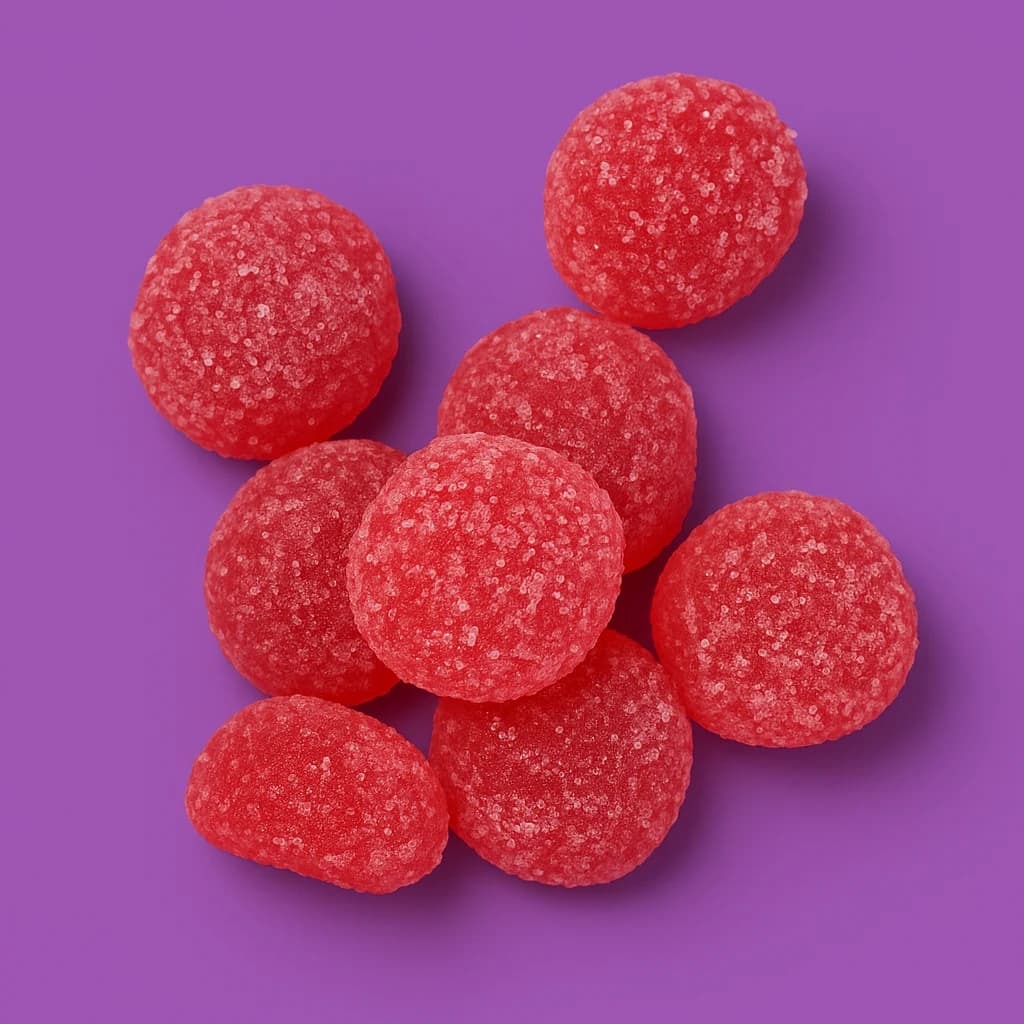
When buying THC gummies online, look for third-party lab testing with publicly accessible COAs, clear potency labeling (mg per gummy and per package), transparent ingredient lists, professional packaging with batch numbers, verified customer reviews, responsive customer service, and clear shipping and return policies. Avoid products missing any of these quality indicators.
Essential Quality Indicators
| Quality Indicator | What to Look For | Red Flag |
|---|---|---|
| Lab Testing | Batch-specific COAs from ISO 17025 labs | No COA, outdated results, in-house testing |
| Potency Labeling | Clear mg per gummy AND per package | Only package total, vague dosing |
| Ingredients | Full ingredient list, natural colors/flavors | Hidden ingredients, artificial dyes |
| Packaging | Child-resistant, batch numbers, QR codes | Generic packaging, missing info |
| Company Info | Contact details, address, customer service | No contact info, PO box only |
| Pricing | Reasonable for quality ($0.10-0.30/mg THC) | Suspiciously cheap pricing |
Why These Indicators Matter
Third-party lab testing: Independent labs verify that what's on the label matches what's in the product. Without testing, you can't know if you're getting the stated THC amount or if contaminants are present.
Clear potency labeling: You need to know both per-gummy and per-package amounts to dose safely. A "500mg" package could contain 10 gummies at 50mg each or 50 gummies at 10mg each, which are very different products.
Transparent ingredients: Quality brands disclose everything in the product. Hidden ingredients or vague "proprietary blends" suggest the company has something to hide.
Professional packaging: Batch numbers let you match products to specific COAs. QR codes that link directly to lab results show the company prioritizes transparency.
At Enjoy Hemp, every product includes batch-specific third-party testing with accessible COAs. Browse our complete gummy collection to see transparency in action.
How Do You Read a Certificate of Analysis (COA)?
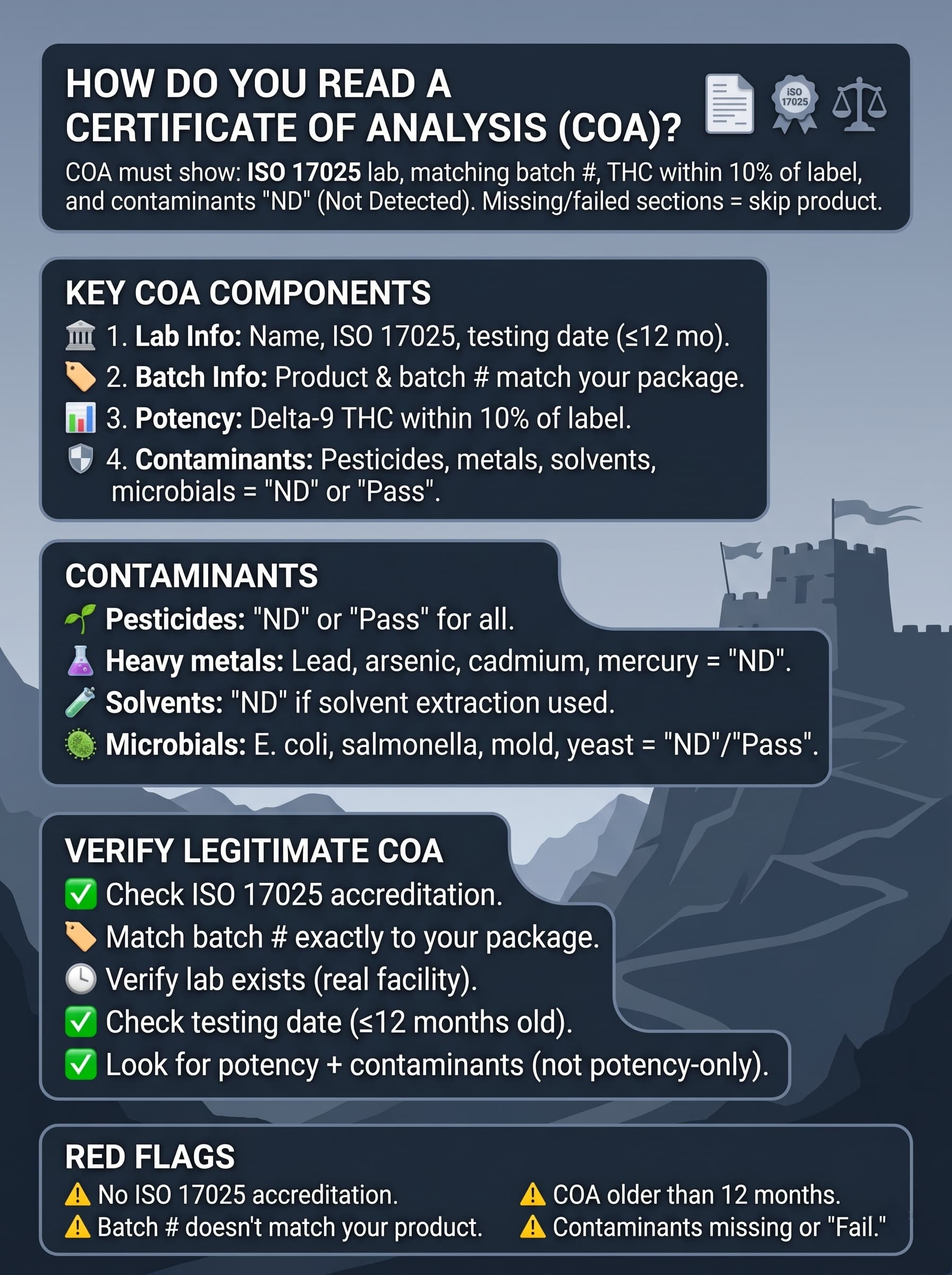
A COA should include the testing lab's name and ISO 17025 accreditation, the batch number matching your product, cannabinoid potency results showing THC content matches the label (within 10%), and contaminant screening showing "ND" (Not Detected) or passing results for pesticides, heavy metals, residual solvents, and microbials. If any section is missing or shows concerning results, consider a different product.
Key COA Components
1. Laboratory Information
- Lab name and contact information
- ISO 17025 accreditation (the gold standard for testing labs)
- State license number (if applicable)
- Testing date (should be recent, within 12 months)
2. Product and Batch Information
- Product name matching what you purchased
- Batch or lot number matching your package
- Sample collection and testing dates
- Client/manufacturer name
3. Cannabinoid Potency Results
- Delta-9 THC content (should match label within 10%)
- Other cannabinoids (CBD, CBN, CBG if applicable)
- Total THC calculation showing federal compliance (≤0.3% by dry weight)
4. Contaminant Testing
- Pesticides: Should show "ND" or "Pass" for all tested compounds
- Heavy metals: Lead, arsenic, cadmium, mercury should be "ND" or below limits
- Residual solvents: Should be "ND" if solvent extraction was used
- Microbials: E. coli, salmonella, mold, yeast should be "ND" or "Pass"
How to Verify a COA Is Legitimate
Check accreditation: The lab should display ISO 17025 certification. You can often verify this on the accreditation body's website.
Match batch numbers: The batch number on your product package should exactly match the COA. If they don't match, the results may not apply to your specific product.
Verify the lab exists: Search for the lab name and confirm it's a real, operating facility. Some fake COAs reference non-existent laboratories.
Check testing date: COAs older than 12 months are a yellow flag. Reputable brands test each production batch.
Look for completeness: A thorough COA includes potency AND contaminant testing. Potency-only COAs skip important safety verification.
At enjoy hemp, every batch gets a third-party lab report you can look up before you buy.
What Are the Red Flags When Buying THC Gummies Online?
Red flags when buying THC gummies online include missing or inaccessible COAs, prices significantly below market rate, exaggerated health claims, generic packaging without batch numbers, no company contact information, reviews that sound identical or appear in suspicious clusters, and products claiming to be "FDA approved" (no THC products have FDA approval). Any of these should prompt you to find a different seller.
Pricing Red Flags
Legitimate THC extraction, testing, and packaging costs money. If someone is selling "300mg THC gummies" for $10 when reputable brands charge $30-40 for equivalent products, something is wrong. The cheap option either contains far less THC than claimed, skips testing entirely, or uses inferior ingredients.
General pricing guidelines for quality hemp-derived THC gummies:
- Low-dose gummies (5-10mg): $0.15-0.30 per mg of THC
- Standard gummies (10-25mg): $0.10-0.20 per mg of THC
- High-potency gummies (25mg+): $0.08-0.15 per mg of THC
Bulk pricing and subscription discounts can reduce these costs, but prices dramatically below these ranges warrant skepticism.
Website and Brand Red Flags
- No physical address: Legitimate companies provide real business addresses
- No customer service contact: Email-only or no contact options suggest fly-by-night operations
- Stock photography only: Real brands show their actual products
- Copied content: Descriptions lifted from other sites indicate low effort
- Recent domain registration: Brand-new websites selling established-seeming products
- No social media presence: Legitimate brands typically maintain active profiles
Product and Packaging Red Flags
- Generic packaging: No batch numbers, QR codes, or scannable verification
- Spelling errors: Typos on professional packaging suggest counterfeits
- Missing compliance info: No warnings, no ingredients, no company info
- Copycat branding: Packaging that mimics popular brands but isn't quite right
- No child-resistant features: Reputable brands use compliant packaging
How Do You Spot Fake THC Gummies?
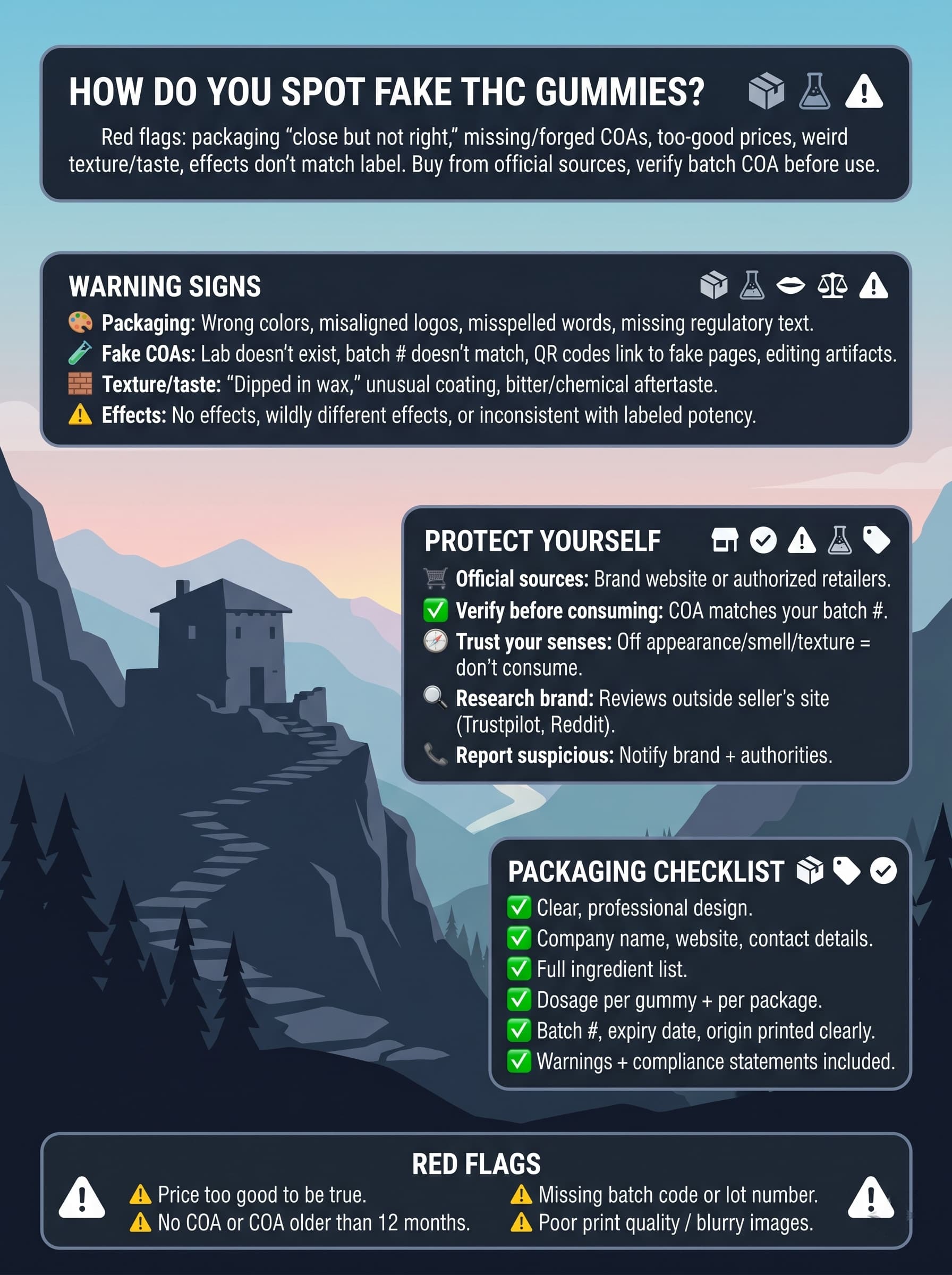
Fake THC gummies often have packaging that mimics popular brands with subtle differences, missing or forged COAs, prices too good to be true, inconsistent texture or taste, effects that don't match expectations, and generic labeling without batch information. Always verify products through official brand channels and purchase from authorized retailers or the brand's own website.
Counterfeit Warning Signs
Packaging discrepancies: Counterfeit products often copy popular brand packaging but with subtle differences: slightly wrong colors, misaligned logos, misspelled words, or missing regulatory text. If something looks "close but not quite right," that's a red flag.
Fake COAs: Some counterfeiters create fake lab reports. Verify by:
- Checking if the lab actually exists
- Contacting the lab to verify the batch number
- Scanning QR codes to ensure they link to legitimate lab pages
- Looking for obvious editing artifacts or inconsistencies
Texture and taste issues: If a gummy feels like it was "dipped in wax" or has an unusual coating, that's a texture red flag. Legitimate gummies have consistent, quality texture and taste.
Effects don't match: If you're experienced with THC and a product produces no effects, wildly different effects, or effects inconsistent with the labeled potency, you may have a fake or mislabeled product.
How to Protect Yourself
- Buy from official sources: Purchase directly from brand websites or authorized retailers
- Verify before consuming: Check the COA matches your batch before use
- Trust your senses: If something seems off about appearance, smell, or texture, don't consume
- Research the brand: Look for reviews outside the seller's website
- Report suspicious products: If you receive a counterfeit, report to the brand and relevant authorities
What Makes a THC Gummy Brand Trustworthy?
Trustworthy THC gummy brands provide batch-specific COAs from ISO-accredited labs, use US-grown hemp, publish comprehensive ingredient lists, maintain professional websites with real contact information, have consistent positive reviews across platforms, offer satisfaction guarantees or return policies, and demonstrate regulatory compliance. The best brands exceed minimum requirements rather than just meeting them.
Trust Indicators Beyond Basics
Hemp sourcing transparency: Quality brands disclose where their hemp is grown. US-grown hemp is subject to state agricultural programs. Brands that won't disclose farm locations or source from overseas may be cutting corners.
Extraction method disclosure: CO2 extraction is the cleanest method. Ethanol extraction works but requires residual solvent testing. Brands that won't disclose their extraction process may be hiding something.
Consistent testing across batches: Reputable brands test every production batch, not just occasionally. Look for COAs with different batch numbers over time, showing ongoing quality control.
Responsive customer service: Try contacting the brand before purchasing. How quickly do they respond? Can they answer questions about sourcing and testing? Accessibility suggests accountability.
Money-back guarantees: Brands confident in their products stand behind them with satisfaction guarantees. This shifts risk from consumer to manufacturer.
What We Do at Enjoy Hemp
At Enjoy Hemp, we prioritize transparency across all products:
- Third-party testing: Every batch is tested by independent, accredited labs
- Accessible COAs: Lab results are easily accessible for all products
- USDA-certified organic hemp: Our products use USDA-certified organic hemp
- Clear labeling: Every package shows THC content per gummy and per package
- Responsive support: Our customer service team answers questions
- Federal compliance: All products contain ≤0.3% Delta-9 THC by dry weight
Explore our gummy collection, from beginner-friendly 5mg options to high-potency formulas.
Which States Can You Ship THC Gummies To?
Hemp-derived THC gummies can ship to approximately 40-47 states under the 2018 Farm Bill, but some states have banned intoxicating hemp products or imposed restrictions that prevent delivery. States with restrictions include Idaho, Kansas, and others that have enacted specific hemp THC bans. Always check a brand's shipping page to confirm your state is eligible before ordering.
Why Some States Restrict Hemp THC
Some states with legal cannabis programs view hemp-derived THC products as competition that avoids cannabis taxes and licensing. Others have concerns about age verification and access. The result is a patchwork where identical products are legal in some states but prohibited in others.
Checking State Eligibility
Before ordering:
- Check the brand's shipping restrictions page
- Verify current state laws (they change frequently)
- Confirm the brand won't ship to restricted states (this shows compliance awareness)
Reputable brands update their shipping restrictions as laws change and refuse orders to states where products are prohibited.
What Happens When Your Order Arrives?
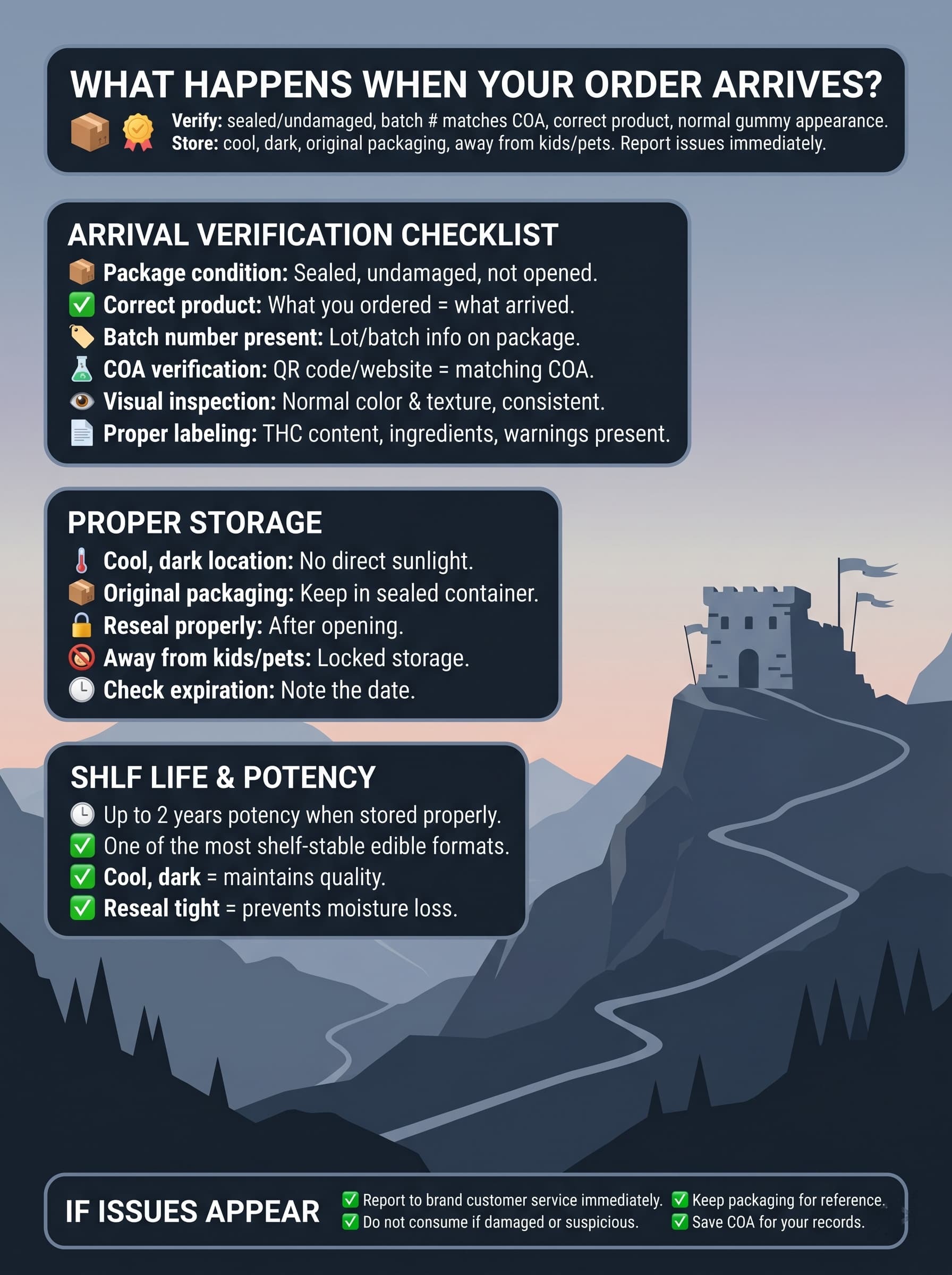
When your THC gummy order arrives, verify the package is sealed and undamaged, check that the batch number matches available COAs, confirm the product matches your order, inspect gummies for normal appearance and texture, and store properly in a cool, dark place away from children and pets. Report any issues to the brand's customer service immediately.
Arrival Verification Checklist
- Package condition: Sealed, undamaged, not obviously opened
- Correct product: What you ordered is what arrived
- Batch number present: Package includes lot/batch information
- COA verification: Scan QR code or check website for matching COA
- Visual inspection: Gummies look normal, consistent color and texture
- Proper labeling: THC content, ingredients, warnings all present
Proper Storage
To maintain potency and quality:
- Store in cool, dark location (not in direct sunlight)
- Keep in original packaging
- Reseal properly after opening
- Keep away from children and pets
- Check expiration dates
Properly stored gummies maintain potency for up to 2 years, making them one of the most shelf-stable edible formats.
Key Takeaways: Buying THC Gummies Online Safely
Safe online THC gummy shopping requires verifying third-party lab testing with batch-specific COAs, confirming ISO 17025 lab accreditation, matching batch numbers between products and COAs, checking for "ND" results on contaminant testing, avoiding suspiciously cheap products, and purchasing from established brands with transparent practices. Taking these steps protects both your health and your investment.
What to remember:
- Always verify COAs before purchasing
- Match batch numbers on products to lab reports
- Look for ISO 17025 accredited testing labs
- Avoid prices significantly below market rate
- Check for pesticide, heavy metal, and solvent testing (not just potency)
- Buy from brand websites or authorized retailers
- Verify company contact information exists
- Trust your senses if something seems off
- Report suspicious products to brands and authorities
- Check state shipping restrictions before ordering
At Enjoy Hemp, transparency is central to everything we do. From our microdose gummies for beginners to our high-potency options for experienced users, every product includes comprehensive third-party testing. Browse our complete gummy collection with confidence.
Frequently Asked Questions
Is it legal to buy THC gummies online?
Yes, hemp-derived THC gummies containing ≤0.3% Delta-9 THC by dry weight are federally legal under the 2018 Farm Bill and can be purchased online in most states. Some states have enacted additional restrictions. Check the seller's shipping page to confirm delivery to your state.
How do I know if a COA is real?
Verify a COA is real by confirming the testing lab exists and is ISO 17025 accredited, matching the batch number to your product, checking the testing date is recent, and looking for comprehensive results including both potency and contaminant testing. You can often contact labs directly to verify results.
What does "ND" mean on a lab report?
"ND" stands for "Not Detected," meaning the lab found no measurable traces of that substance within their testing limits. For contaminants like pesticides and heavy metals, "ND" is the best possible result.
Why are some THC gummies so cheap?
Suspiciously cheap THC gummies may contain less THC than labeled, skip third-party testing, use low-quality ingredients, or contain contaminants. Quality extraction, testing, and packaging costs money. Prices dramatically below market rate should raise concerns.
Can THC gummies be shipped to all states?
No. While hemp-derived THC gummies ship to most states, some states have banned intoxicating hemp products. Reputable brands maintain updated shipping restriction pages and won't ship to prohibited states.
How do I report a fake or mislabeled product?
Report to the brand being counterfeited (they want to know), the platform where you purchased (if marketplace), your state attorney general's consumer protection office, and the FDA if the product made health claims. Keep the product and packaging as evidence.
What's the difference between third-party and in-house testing?
Third-party testing is conducted by independent labs with no financial relationship to the manufacturer. In-house testing is done by the company itself. Third-party testing is far more reliable because independent labs have no incentive to manipulate results.
How fresh should THC gummies be?
THC gummies typically have shelf lives of 1-2 years when properly stored. Check expiration dates and avoid products without them. COAs should be from within the past 12 months to ensure they reflect current production practices.
Should I trust Amazon or eBay for THC gummies?
No. Major marketplaces like Amazon and eBay prohibit THC products. Anything claiming to be THC gummies on these platforms is either mislabeled, counterfeit, or violating platform policies. Buy directly from brand websites or authorized retailers.
What should I do if my order arrives damaged?
Contact the brand's customer service immediately with photos of the damage. Reputable brands will replace damaged products. If the product appears tampered with or unsealed, do not consume it and report the issue to the seller.
About the Author
Sarah Mitchell is a wellness industry veteran with 15 years of experience in functional supplements and hemp-derived products. She previously led product development at two nationally recognized wellness brands and holds certification as a holistic health practitioner. Sarah now advises consumers on quality standards, helping them make informed decisions in the evolving hemp market.
Disclaimer: This content is for informational purposes only and does not constitute legal or medical advice. Hemp-derived THC products are federally legal under the 2018 Farm Bill at ≤0.3% Delta-9 THC by dry weight, but state laws vary. Always verify current laws in your state before purchasing. THC can impair your ability to drive or operate machinery. Do not use if pregnant, nursing, or if you have a medical condition without consulting a healthcare provider. Must be 21+ to purchase.