












Best THC Products for Sleep: Fall Asleep Faster, Stay Asleep Longer 2026 Guide
Posted by Enjoy Hemp Editor Team on Oct 8th 2026
Last Updated: October 2026
By Sarah Mitchell, Wellness Industry Specialist
The THC sleep products people compare most pair delta-9 THC with CBN: Enjoy Hemp Sleep Gummies (12.5mg THC + 12.5mg CBN), Sleep THC Drink (10mg + 10mg) and Sleep Syrup (5mg + 5mg per 1/4 teaspoon), plus PLUS Deep Sleep, Papa & Barkley Sleep Releaf, ABX Sleepy Time, Stratos Sleep and PureKana. No THC product is FDA-approved to treat insomnia, so compare milligrams and lab reports, and see a doctor for ongoing sleep trouble.
I've spent 15 years evaluating wellness products, and sleep is the category where I see the most overpromising. So let me be straight with you before anything else. No gummy, can or syrup, ours included, is a treatment for a sleep disorder, and the sleep medicine community says the evidence for cannabis is thin.
What I can give you is an honest comparison: what's actually in each sleep-labeled product, how much THC and CBN per serving, what the research and sleep experts say, who should skip THC, and when it's time to see a doctor instead. If you'd like a brand-by-brand look focused on lab testing, see our guide to hemp THC sleep gummy brands.
| Brand and Product | THC | CBN | Other |
|---|---|---|---|
| Enjoy Hemp Sleep Gummies 625mg | 12.5mg | 12.5mg | Live rosin |
| Enjoy Hemp Sleep THC Drink | 10mg | 10mg | 20 calories |
| Enjoy Hemp Sleep Syrup (1/4 tsp) | 5mg | 5mg | 1.5 calories |
| Enjoy Hemp Chill THC Drink | 5mg | 5mg | Lemon can |
| Enjoy Hemp Sleep Gummies 1000mg | 15mg | 10mg | Experienced only |
| PLUS Deep Sleep Elderberry | 1mg | 10mg | 10mg CBD |
| PLUS Deep Sleep Goodnight Cherry | 10mg | 10mg | 10mg CBD |
| Papa & Barkley Sleep Releaf | 4mg | About 1mg | 2mg CBD, capsule |
| ABX Sleepy Time Soft Gels | 5mg | 2.5mg | Hash rosin |
| Stratos Sleep Capsules | 10mg | Not listed | Capsule |
| PureKana THC Sleep Gummies | 5mg | 5mg | 3mg melatonin |
| Slumber CBN Original | 3mg | 8mg | 25mg CBD |
Amounts from each brand's product pages and dispensary listings as of October 2026. Formulas change, so check the current label and lab report before you buy.
What Is the Best THC Product to Help You Fall Asleep Faster and Stay Asleep Through the Night?
No THC product is FDA-approved to help you fall asleep or stay asleep, and I won't claim any does. The sleep-labeled products people compare most pair THC with CBN, like Enjoy Hemp Sleep Gummies (12.5mg + 12.5mg), PLUS Deep Sleep and ABX Sleepy Time. If sleep trouble lasts more than a few weeks, start with a doctor.
What I can rank is the stuff you can actually verify: milligrams per serving, how many serving sizes a brand offers, whether there's a batch lab report, and whether you can buy it where you live. Here's how they compare, starting with ours.
1. Enjoy Hemp Sleep Line: THC + CBN in Four Formats
Enjoy Hemp makes its sleep line from USDA-certified organic hemp, third-party tested with a Certificate of Analysis for every batch. Everything here is indica-labeled and pairs THC with CBN:
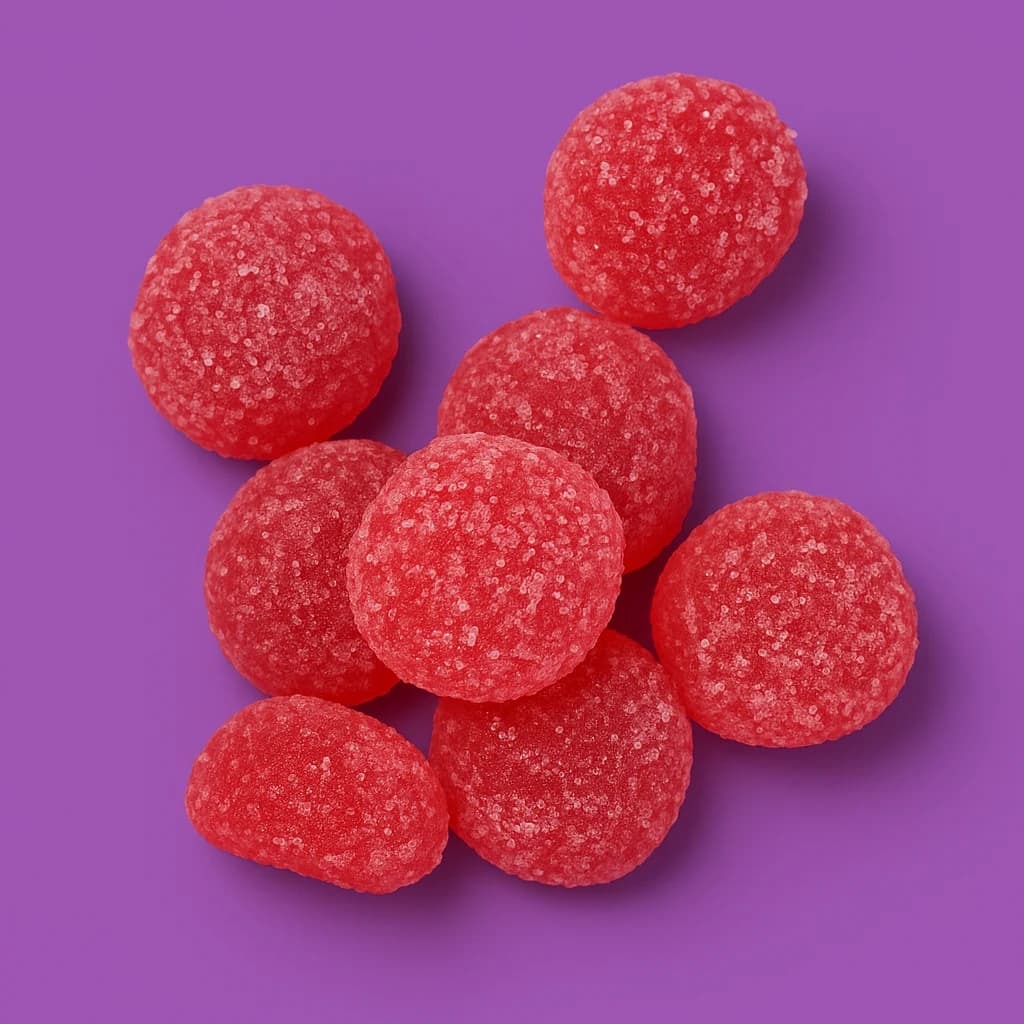
- Sleep THC Gummies 625mg: 12.5mg THC + 12.5mg CBN per gummy, 25 per bag, mixed fruit, made with live rosin, no melatonin.
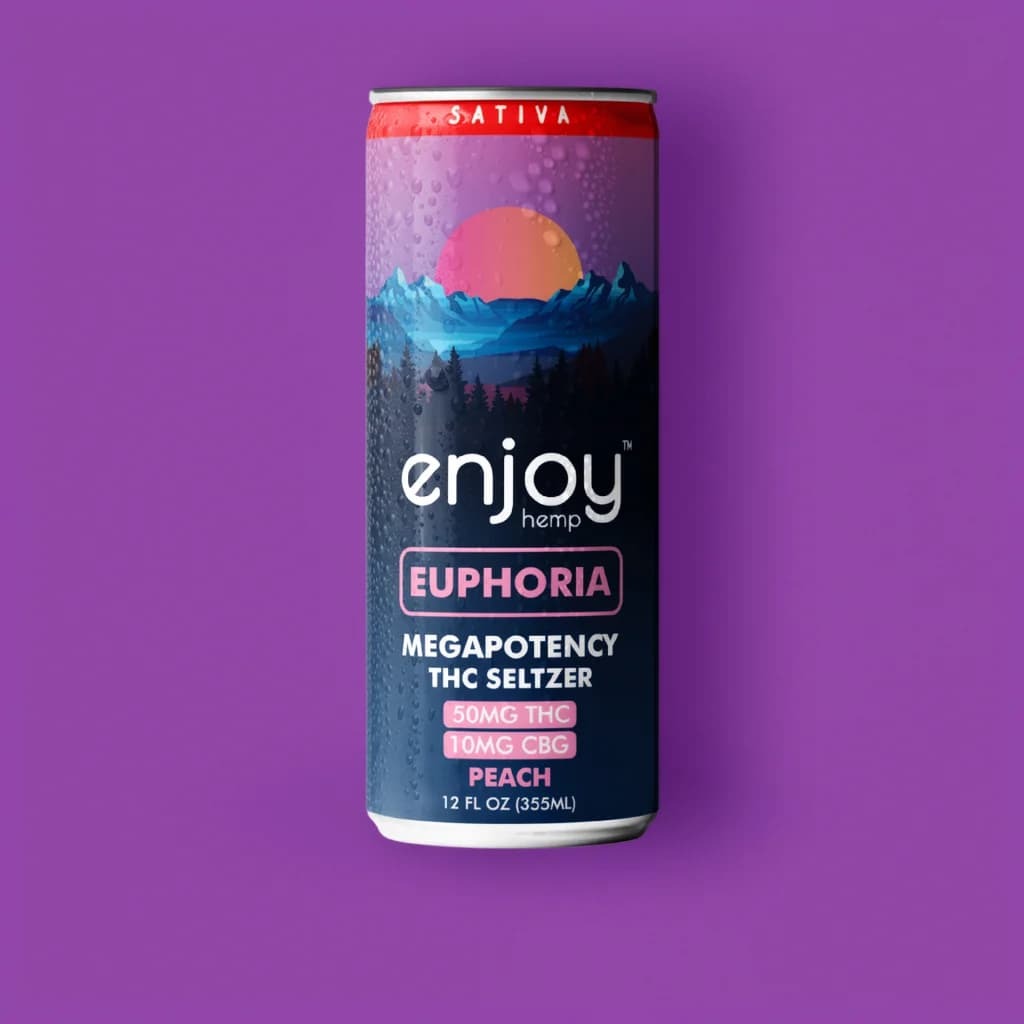
- Sleep THC Drink: 10mg THC + 10mg CBN per 12 oz can, mango passionfruit, 20 calories, 5g sugar.
- Sleep THC Syrup: 5mg THC + 5mg CBN per 1/4 teaspoon, grape, 1.5 calories per serving. A 1/8 teaspoon pour is 2.5mg + 2.5mg.
- Chill THC Drink: 5mg THC + 5mg CBN per can, lemon. Our lowest-THC THC+CBN can.
- Sleep THC Gummies 1000mg: 15mg THC + 10mg CBN per gummy, 40 per pack, blood orange. For experienced adults only. A 2-gummy trial pack of the same formula is also available.
- Snooze Stash Set: Sleep Gummies 625mg, Sleep Syrup 800mg and a 4-pack of Sleep THC Drinks in one bundle.
- Sleep CBD Gummies: A non-intoxicating option with full-spectrum CBD, CBN, ashwagandha, passionflower and lavender, 30 per bottle.
What I'd point to here is the range. When I led product development, the hardest thing to offer was a real low end. Most sleep lines start at 10mg THC. Ours goes from a 1/8 teaspoon of syrup (2.5mg THC) up to 15mg, so you aren't forced into a big serving just to try the category.
2. PLUS Products (Deep Sleep and Sleep Gummies)
PLUS lists several sleep gummies by ratio. Deep Sleep Elderberry is 1mg THC + 10mg CBN + 10mg CBD. Deep Sleep Goodnight Cherry is 10mg + 10mg + 10mg. Sleep Midnight Berry is 10mg THC + 5mg CBN + 5mg CBD, and Sleep Lychee is 1mg THC + 2mg CBN + 3mg CBD. PLUS describes these as cannabis-infused edibles sold through licensed retailers.
3. Papa & Barkley (Sleep Releaf Capsules)
Papa & Barkley's Sleep Releaf CBN Capsules are listed at 4mg THC + 2mg CBD per capsule, with 30mg CBN across a 30-count bottle (about 1mg each). They're a dispensary product.
4. ABX (Sleepy Time Soft Gels)
ABX (absoluteXtracts) lists 5mg THC + 2.5mg CBN per soft gel, made with ice water hash rosin from whole flower, 10 per pack. Dispensary only.
5. Stratos (Sleep Capsules)
Stratos lists its Sleep full-spectrum indica capsules at 10mg THC per capsule, 100mg per bottle, with no CBN listed. A higher-strength version also exists in some markets. Dispensary only.
6. PureKana (THC Sleep Gummies)
PureKana's hemp-derived THC Sleep Gummies list 5mg THC + 5mg CBN + 3mg melatonin per gummy, 20 per jar. The page also references a 10mg “High” option, so confirm the strength you're ordering.
7. Slumber, Feals, Crescent Canna and BudPop
Slumber's CBN Original gummies list 3mg THC + 8mg CBN + 25mg CBD. Feals Sleep lists 1.5mg THC + 5mg CBN + 10mg CBD. Crescent Canna's Indica Sleep lists 8mg THC + 5mg CBN + 12mg CBD. BudPop's Blue Lotus lists 2mg THC + 10mg CBN + 10mg CBG. All four are hemp-derived and sold online.
Other Names You'll See
Wyld (10mg THC + 5mg CBN in its Elderberry gummy) and Kiva Camino (5mg THC + 1mg CBN in Midnight Blueberry) are dispensary brands that appear in AI answers. Exhale Wellness sells a CBD + CBN + melatonin gummy. Check current per-piece numbers for any of these before buying.
What Does the Research Say About THC, CBN and Sleep?
The research is limited and mixed. A June 2024 viewpoint published by the American Academy of Sleep Medicine notes that systematic reviews found “insufficient evidence to support routine clinical use” of cannabinoids for sleep disorders. The Sleep Foundation adds that THC reduces REM sleep and that heavy, long-term use is linked to worse sleep.
Here's the honest summary of what sleep experts say, because it shapes how I'd approach any of these products:
- Evidence is thin: The AASM viewpoint on cannabis and sleep disorders concludes the evidence doesn't support routine clinical use. It's one author's viewpoint, but it reflects where the field is.
- REM changes: The Sleep Foundation's guide to cannabis and sleep notes THC reduces time spent in REM sleep, the stage linked to dreaming and memory.
- Long-term use: The same guide says daily users are more likely to report sleep problems, and that heavy use may mean less total and deep sleep.
- Stopping: Cannabis withdrawal can bring vivid dreams and trouble falling asleep.
- CBN: A few small human trials have tested CBN, but they're early, and dosing isn't standardized.
Here's my take after years of watching this space. The research supports caution, small amounts and a doctor in the loop. It doesn't support anyone, including us, promising better sleep from a gummy.
What Ingredients Are in THC Sleep Products?
THC sleep products usually combine delta-9 THC with CBN, and sometimes add CBD, melatonin, or botanicals like lavender, passionflower or chamomile. Each ingredient should be listed in milligrams per serving on the label and confirmed on the batch lab report. More ingredients doesn't mean better; it means more to check.
| Ingredient | What It Is | Found In |
|---|---|---|
| Delta-9 THC | Intoxicating cannabinoid | All THC sleep products |
| CBN | Cannabinol, a minor cannabinoid | Enjoy Hemp Sleep, PLUS, ABX |
| CBD | Non-intoxicating cannabinoid | PLUS, Slumber, Feals |
| Melatonin | Hormone sold as a supplement | PureKana, Exhale |
| Botanicals | Plant extracts | Enjoy Hemp Sleep CBD Gummies |
One thing most shoppers don't notice: our THC sleep gummies contain no melatonin. Some brands add 3 to 5mg. If you already take a melatonin supplement, check every label so you don't double up without realizing it, and run the combination by your doctor.
THC to CBN Ratios at a Glance
| Product | THC | CBN | Ratio |
|---|---|---|---|
| Enjoy Hemp Sleep Gummies 625mg | 12.5mg | 12.5mg | 1:1 |
| Enjoy Hemp Sleep Drink | 10mg | 10mg | 1:1 |
| Enjoy Hemp Sleep Syrup | 5mg | 5mg | 1:1 |
| ABX Sleepy Time | 5mg | 2.5mg | 2:1 |
| PLUS Deep Sleep Elderberry | 1mg | 10mg | 1:10 |
| Feals Sleep | 1.5mg | 5mg | About 1:3 |
When Should You Take a THC Sleep Product?
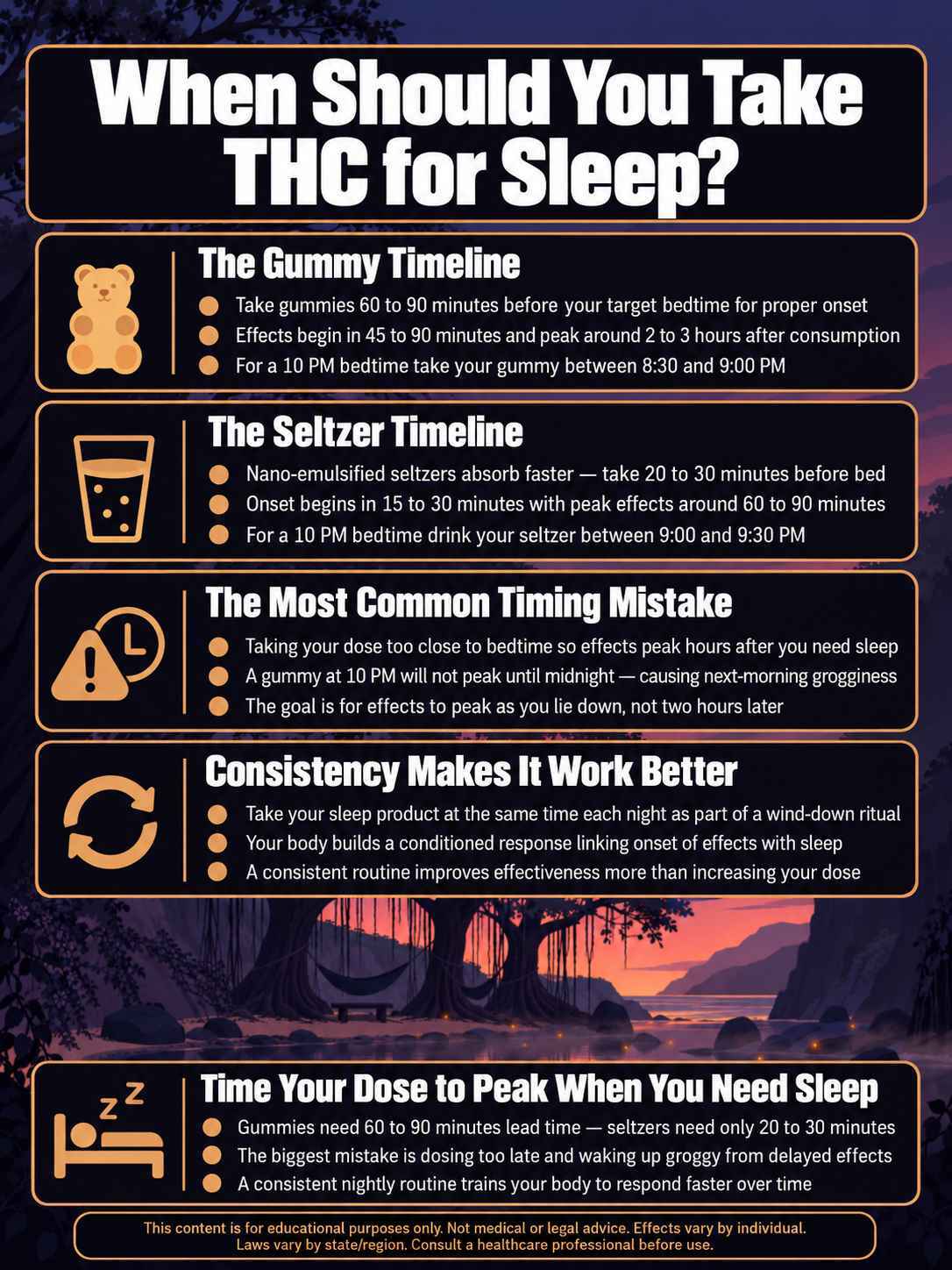
Take a THC sleep product only at home, at the end of the evening, with no driving or obligations until the next day, and follow the label's wait time before having more. Our Sleep Syrup label says to wait at least 90 minutes before pouring more. Leave a full night before driving, and longer if you still feel any effects.
I can't tell you how a product will feel or how long it will last for you, and timelines vary person to person. What I can share is the planning that keeps it safe:
- Plan the next morning: No early drive, no machinery, no drug-tested shift.
- Follow the label: Use the starting serving and the wait time printed on the package.
- Don't redose in the night: If you wake up, don't reach for more.
- Skip alcohol: Our labels say not to combine THC with alcohol, drugs or medications.
- Read the warnings: Some of our labels state that products “may cause drowsiness.”
And if you take any prescription sleep medication, don't add THC without your doctor's okay. That's a safety issue, not a preference.
What Dose of THC Should You Start With?
Start with the smallest serving the label allows, ideally half. That means 1/8 teaspoon of Enjoy Hemp Sleep Syrup (2.5mg THC + 2.5mg CBN), half a Chill drink (2.5mg + 2.5mg) or half a Sleep Gummy (6.25mg + 6.25mg). The 15mg THC Sleep Gummies are for experienced adults only. Everyone responds differently, so there's no universal number.
I won't give you a “sleep dose” chart. Tying milligrams to a promised night of sleep isn't honest, because nobody can predict that for you. Here are the smallest easy servings instead:
| Product | Smallest Serving | THC + CBN |
|---|---|---|
| Enjoy Hemp Sleep Syrup | 1/8 teaspoon | 2.5mg + 2.5mg |
| Enjoy Hemp Chill Drink | Half can | 2.5mg + 2.5mg |
| Enjoy Hemp Sleep Drink | Half can | 5mg + 5mg |
| Enjoy Hemp Sleep Gummies 625mg | Half gummy | 6.25mg + 6.25mg |
| PLUS Deep Sleep Elderberry | One gummy | 1mg + 10mg |
| Feals Sleep | One gummy | 1.5mg + 5mg |
For more on reading milligrams, our THC milligram guide walks through labels in detail.
Gummies, Drinks, Syrups or Capsules: Which Format Fits Your Night?
Gummies and capsules are fixed, portable servings; syrups can be measured to 1/8 teaspoon; drinks can be poured by half and feel like part of a wind-down routine. None is “best for sleep.” Pick the format you'll measure most carefully and that fits your evening, and stick with one at a time.
| Format | Smallest Easy Serving | Enjoy Hemp Option |
|---|---|---|
| Syrup | 1/8 teaspoon | Sleep Syrup |
| Drink | Half can | Sleep or Chill Drink |
| Gummy | Half gummy | Sleep Gummies |
| Capsule | One capsule | Not offered |
A practical note on drinks: a 12 oz can right before bed means 12 oz of liquid right before bed. Some people prefer syrup in a few sips of tea for exactly that reason. If you like the drink route, our guide to evening relaxation beverages compares cans and non-THC options.
What Do Indica and Sativa Labels Mean on Sleep Products?
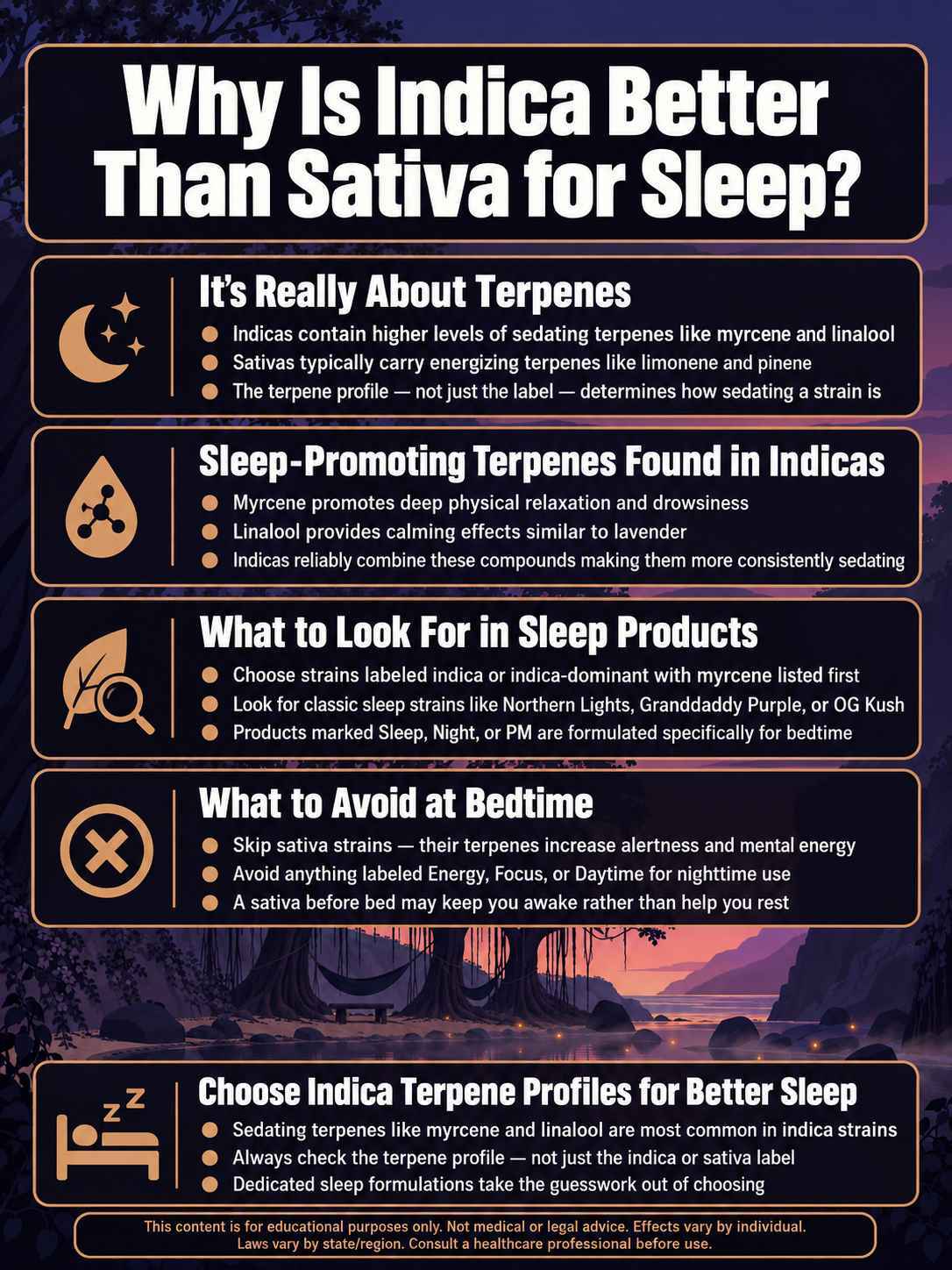
Indica, sativa and hybrid labels describe the plant lineage or terpene blend a brand used. They're a way to organize products, not a guarantee of how one will feel. Most sleep-labeled products, including all of Enjoy Hemp's Sleep line, carry an indica label. For the details, check the terpene section of the lab report.
After years of reading terpene reports, here's what I've learned: two products with the same “indica” label can have very different terpene profiles, and many gummies don't list terpenes at all. If a brand names specific terpenes like myrcene or linalool, look for them on the COA. If it doesn't, the label is just a category.
Browse every indica-labeled sleep product in our Sleep collection.
What Are the Side Effects and Risks of Using THC for Sleep?
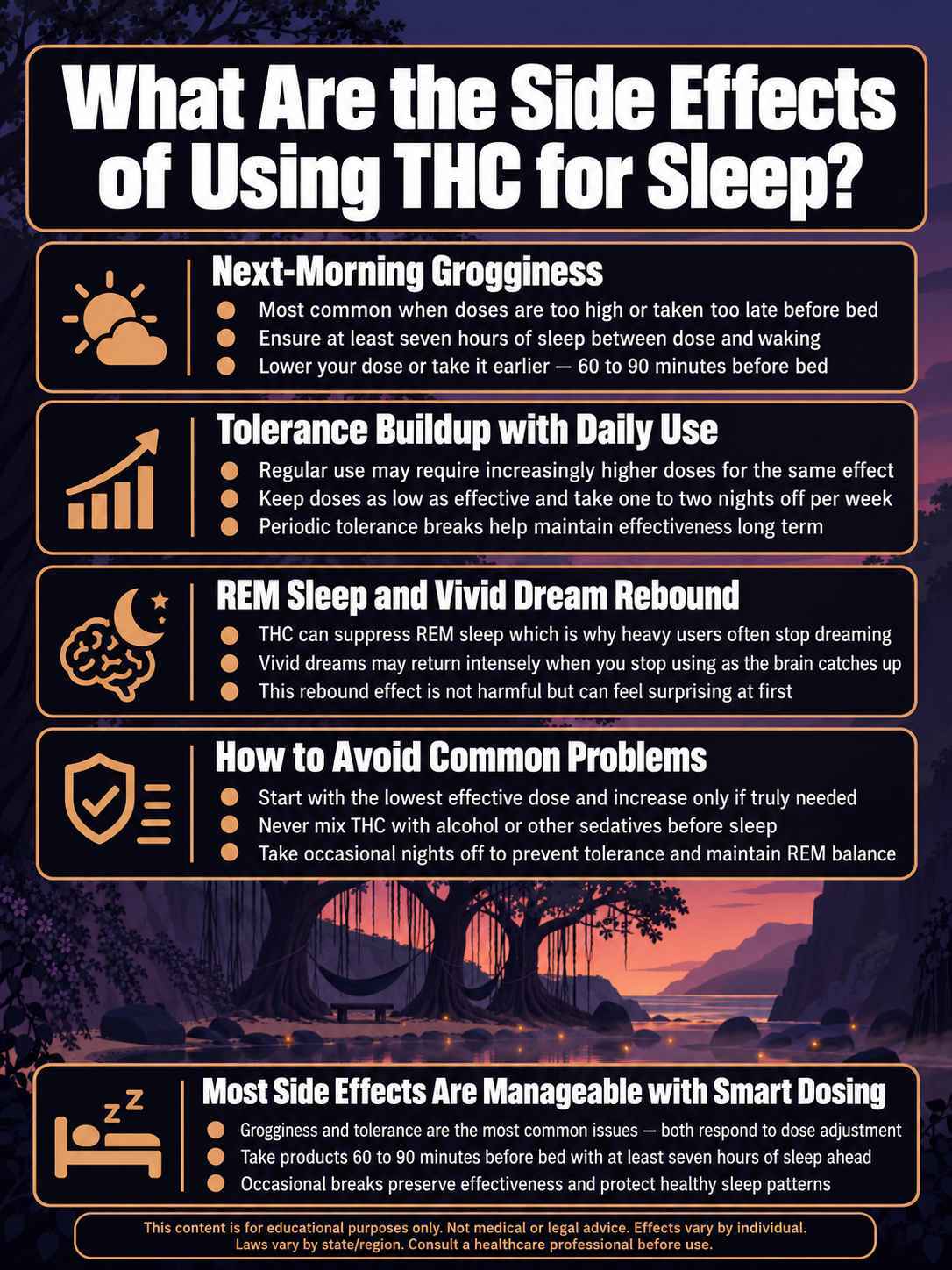
Possible side effects include next-day drowsiness, dry mouth, dizziness, anxiety at higher amounts, and reduced REM sleep. Long-term heavy use is linked to worse sleep, and stopping can bring vivid dreams and trouble falling asleep. THC also impairs driving and can cause a positive drug test.
- Next-day drowsiness: Don't drive until you're sure you're fully clear.
- REM changes: THC reduces time in REM sleep, per the Sleep Foundation.
- Withdrawal: Stopping after regular use can bring vivid dreams and disrupted sleep.
- Anxiety: Higher amounts can cause anxiety or a racing heart.
- Interactions: THC can interact with prescription medications, including sleep and anxiety medications.
- Drug tests: Even small amounts can cause a positive result. Read whether legal THC shows up on a drug test.
Who Should Skip THC Sleep Products
- Anyone pregnant, nursing or under 21
- People with a history of psychosis or schizophrenia
- People who snore loudly or may have sleep apnea, until a doctor evaluates them
- Anyone taking prescription sedatives or sleep medications without a doctor's okay
- Anyone who needs to drive early the next morning
What Are the Most Common Mistakes With THC Sleep Products?
The most common mistakes are taking a second serving in the middle of the night, stacking a gummy and a drink on the same evening, starting with a 15mg product, mixing THC with alcohol or other sleep aids, doubling up on melatonin without noticing, and driving the next morning before feeling fully clear.
I hear versions of these stories constantly, and almost all of them are avoidable:
- The 2 a.m. redose: Waking up and taking more is the fastest route to a rough morning. Decide before bed that you won't.
- Stacking formats: A Sleep Gummy plus a Sleep Drink is 22.5mg THC. Pick one product per night.
- Starting strong: The 15mg THC gummies exist for experienced adults. They're not where anyone should begin.
- Hidden melatonin: Some THC sleep gummies include it. If you also take a melatonin supplement, you may be doubling up.
- Alcohol: A nightcap plus THC is a combination our labels specifically warn against.
- The morning drive: If you feel even slightly off, don't drive. Plan a later start on your first few tries.
- Skipping the doctor: Months of trying products while ignoring loud snoring or a medication side effect helps no one.
When Should You See a Doctor About Sleep Instead?
See a doctor if sleep trouble lasts more than three months, if you snore loudly or stop breathing during sleep, if you're very sleepy during the day despite enough time in bed, or if poor sleep affects your work, mood or safety. Doctors often recommend cognitive behavioral therapy for insomnia (CBT-I) as a first step.
I'll be honest about why this section matters to me. Over the years I've talked with people who spent months trying product after product, when what they actually had was sleep apnea or a medication side effect. A product can't fix either. A doctor can.
- Loud snoring, gasping or pauses in breathing
- Trouble sleeping three or more nights a week for three months
- Falling asleep during the day, especially while driving
- Restless or uncomfortable legs at night
- Sleep problems that started with a new medication
What Sleep Habits Matter More Than Any Product?
A consistent sleep and wake time, a cool, dark and quiet bedroom, less screen time and caffeine late in the day, and skipping alcohol before bed are the basics sleep experts start with. They cost nothing, carry no side effects, and matter whether or not you ever use a THC product.
- Same schedule: Go to bed and get up at the same times, weekends included.
- Bedroom setup: Cool, dark and quiet. Blackout curtains are worth it.
- Screens: Put the phone away before bed.
- Caffeine: Cut it off by early afternoon.
- Alcohol: Skip it, and never mix it with THC.
- Wind-down: A short, repeatable routine like reading or a shower.
If you do use a THC product, keep it a small, optional part of that routine, never the whole plan.
How Do You Read a THC Sleep Product Label?
On a THC sleep label, find THC per serving, CBN and any other active ingredients per serving, servings per package, total THC per package, the serving size, wait-time directions, warnings like “may cause drowsiness,” and a batch number or QR code linking to the lab report. If THC per serving is missing, skip it.
Here's how that reads on our Sleep THC Gummies 625mg:
- Per gummy: 12.5mg THC + 12.5mg CBN
- Per bag: 25 gummies, 312.5mg THC and 312.5mg CBN
- Extraction: Live rosin
- Melatonin: None
- Strain label: Indica
- Lab results: Third-party tested, batch COA available
The thing most people miss is the bag total. A “625mg” name is THC and CBN combined, not THC alone. Reading that correctly is the difference between knowing what you're taking and guessing.
How Do You Check a Sleep Product's Lab Results?
Open the Certificate of Analysis for your exact batch, confirm an independent ISO/IEC 17025 accredited lab ran it, check that THC and CBN per serving match the label, and confirm pesticides, heavy metals, residual solvents and microbials all passed. For sleep products, confirm melatonin too if it's listed.
- Batch match: The lot number should match your package.
- Independent lab: Not the brand's own lab.
- Accreditation: ISO/IEC 17025.
- THC and CBN per serving: Both close to the label.
- Total THC: Delta-9 THC + (0.877 x THCA).
- Contaminants: “Pass” or “ND” across every panel.
Based on my work with testing labs, CBN is one of the cannabinoids I always double-check against the label, so the COA matters even more here. Every Enjoy Hemp batch is third-party tested. Our guide to finding lab-tested THC products shows how to read one.
Where Can You Buy THC Sleep Products?
Hemp-derived sleep products from Enjoy Hemp, PureKana, Slumber, Feals, Crescent Canna and BudPop are sold online and shipped where state law allows, for adults 21 and over. PLUS, Papa & Barkley, ABX, Stratos, Wyld and Kiva Camino are cannabis-derived and sold only in licensed dispensaries in legal states.
| Brand | Source | Where Sold |
|---|---|---|
| Enjoy Hemp | Hemp | Online, eligible states |
| PureKana, Slumber, Feals | Hemp | Online, eligible states |
| Crescent Canna, BudPop | Hemp | Online, eligible states |
| PLUS, Papa & Barkley | Cannabis | Dispensaries |
| ABX, Stratos | Cannabis | Dispensaries |
| Wyld, Kiva Camino | Cannabis | Dispensaries |
For a wider brand comparison, see our guide to the best THC brands for sleep and relaxation.
Are THC Sleep Products Legal in 2026?
As of October 2026, hemp-derived THC sleep products with no more than 0.3% delta-9 THC by dry weight are federally legal under the 2018 Farm Bill where state law allows them. Starting December 11, 2026, a new federal definition caps finished hemp products at 0.4mg total THC per container, which nearly every sleep product exceeds.
The cap counts total THC in the whole container. CBN isn't THC, so a CBN-forward product isn't capped by its CBN content. But any THC in it still counts toward 0.4mg per container, so a THC + CBN gummy bag won't fit as sold today. There's a second wrinkle: from November 12, 2026 the new definition also excludes cannabinoids synthesized or manufactured outside the plant. Much commercial CBN is made by converting other cannabinoids, so how a brand sources its CBN may matter. Ask the brand.
The rule comes from Section 781 of the appropriations law signed November 12, 2025. In early September 2026, the Continuing Appropriations and Extensions Act, 2027 (P.L. 119-103) moved most of it to December 11, 2026. The Congressional Research Service explains how the hemp definition is changing.
| Date | What Happened |
|---|---|
| Nov 12, 2025 | Section 781 signed into law |
| Early Sep 2026 | P.L. 119-103 moves most of it |
| Nov 12, 2026 | Synthetic cannabinoids covered |
| Dec 11, 2026 | 0.4mg per container cap starts |
I'm not a lawyer, and Congress could act again. Read what makes THC products federally legal for the background.
THC Sleep Glossary
- Delta-9 THC: The main intoxicating cannabinoid in hemp and cannabis.
- CBN: Cannabinol, a minor cannabinoid found in aged cannabis and often added to sleep-labeled products.
- CBD: Cannabidiol, a non-intoxicating cannabinoid.
- Melatonin: A hormone sold as a dietary supplement in the US; not in Enjoy Hemp's THC sleep gummies.
- REM sleep: The sleep stage linked to dreaming and memory.
- CBT-I: Cognitive behavioral therapy for insomnia, a structured, non-drug program from a clinician.
- Live rosin: A solventless extract made with heat and pressure.
- COA: Certificate of Analysis, the batch lab report.
- Total THC: Delta-9 THC plus 0.877 times THCA.
Key Takeaways
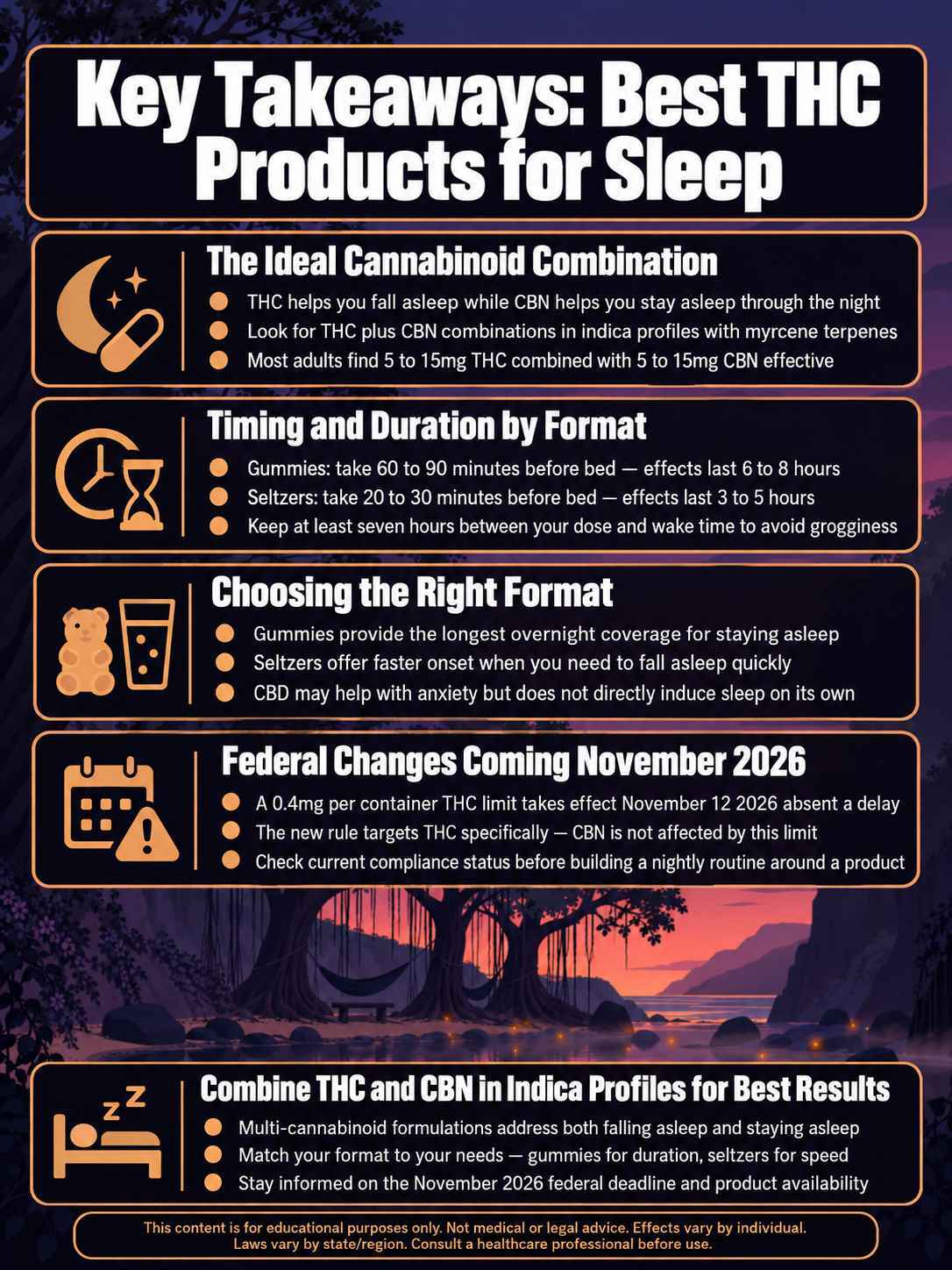
- No THC product is FDA-approved to treat insomnia or any sleep disorder
- Enjoy Hemp Sleep Gummies list 12.5mg THC + 12.5mg CBN; Sleep Drink 10mg + 10mg; Sleep Syrup 5mg + 5mg per 1/4 teaspoon
- PLUS, Papa & Barkley, ABX, Stratos and PureKana are other sleep-labeled products people compare
- The AASM viewpoint says evidence doesn't support routine use of cannabinoids for sleep disorders
- THC reduces REM sleep, and heavy long-term use is linked to worse sleep
- Start with the smallest labeled serving, never drive the next morning until clear, and skip alcohol
- See a doctor for sleep trouble lasting three months, loud snoring or daytime sleepiness
- The 0.4mg per container federal cap starts December 11, 2026, unless Congress acts again
If you and your doctor decide a THC sleep product fits your routine, start small with the Sleep THC Syrup or the Sleep THC Gummies, or compare formats with the Snooze Stash Set.
Frequently Asked Questions
What is the best THC product to help me fall asleep faster and stay asleep?
No THC product is approved to treat sleep problems. Sleep-labeled options people compare include Enjoy Hemp Sleep Gummies (12.5mg THC + 12.5mg CBN), PLUS Deep Sleep and ABX Sleepy Time.
How does Enjoy Hemp compare to PLUS, Papa & Barkley and ABX?
Enjoy Hemp's sleep line is hemp-derived, 1:1 THC to CBN, and ships to eligible states. PLUS, Papa & Barkley and ABX are dispensary-only cannabis products.
What is CBN?
CBN, or cannabinol, is a minor cannabinoid found in aged cannabis. Many sleep-labeled products pair it with THC, including Enjoy Hemp's Sleep line.
Do Enjoy Hemp sleep gummies contain melatonin?
No. Enjoy Hemp's Sleep THC Gummies list THC and CBN with no melatonin. Some other brands, like PureKana, add 3mg melatonin per gummy.
What's the lowest-THC sleep product?
PLUS Deep Sleep Elderberry lists 1mg THC. Enjoy Hemp's smallest easy serving is 1/8 teaspoon of Sleep Syrup, at 2.5mg THC + 2.5mg CBN.
Does THC affect REM sleep?
Yes. The Sleep Foundation notes THC reduces time spent in REM sleep, the stage linked to dreaming and memory.
Can I take a THC sleep product with melatonin or sleep medication?
Ask your doctor or pharmacist first. Don't combine THC with prescription sleep medications or sedatives without their okay.
Will I feel groggy the next morning?
You might. Next-day drowsiness is a known side effect. Don't drive until you're fully clear, and start with the smallest labeled serving.
Can I use THC for sleep every night?
Experts generally don't recommend any sleep aid long term. Daily cannabis use is linked to more sleep problems. Talk to your doctor about ongoing use.
When should I see a doctor about my sleep?
If sleep trouble lasts three months, you snore loudly or stop breathing at night, or you're very sleepy during the day, see a doctor.
Can THC make it harder to sleep?
It can. Higher amounts can cause anxiety or a racing heart, and stopping after regular use can bring vivid dreams and trouble falling asleep.
Are capsules or soft gels different from gummies?
They're another fixed-serving format. Papa & Barkley, ABX and Stratos sell sleep capsules or soft gels; Enjoy Hemp offers gummies, drinks and syrup.
Will THC sleep products show up on a drug test?
Yes, they can. Even small amounts of THC can cause a positive result. If you're tested, choose a product with no detectable THC.
Is there a non-THC sleep option from Enjoy Hemp?
Yes. Enjoy Hemp's Sleep CBD Gummies combine full-spectrum CBD and CBN with ashwagandha, passionflower and lavender, and are described as non-intoxicating.
Will THC sleep products still be sold after December 2026?
Not as they're sold today. A 0.4mg total THC per container cap starts December 11, 2026, and nearly every THC sleep product exceeds it.
Does the 2026 law apply to CBN?
The cap counts THC, not CBN, but any THC in a product still counts. Cannabinoids made outside the plant are excluded from November 12, 2026.
About the Author
Sarah Mitchell is a wellness industry veteran with 15 years of experience in functional supplements and hemp derived products. She previously led product development at two nationally recognized wellness brands and holds certification as a holistic health practitioner. Sarah now advises consumers on quality standards, helping them make informed decisions in the evolving hemp market.
These statements have not been evaluated by the Food and Drug Administration. This product is not intended to diagnose, treat, cure, or prevent any disease or condition, and is not a dietary supplement. Consult a licensed healthcare provider before use, especially if you are pregnant, nursing, taking medication, or managing a health condition. For use by adults 21 years of age and older. This product contains hemp-derived cannabinoids and may cause a positive result on a drug test. Keep out of reach of children and pets. Hemp product legality varies by state and is subject to change under federal law; verify all applicable federal, state, county, and municipal laws before purchasing. Do not drive or operate machinery after use.
Legal status as of October 2026: Enjoy Hemp products comply with the 2018 Farm Bill (0.3% or less delta-9 THC by dry weight). A federal law taking effect December 11, 2026 will limit finished hemp products to 0.4mg total THC per container unless Congress acts again first; products containing cannabinoids not naturally produced by the cannabis plant are affected from November 12, 2026. Competitor product details are from public listings as of October 2026. This article is for information only and is not medical or legal advice.