






THC Carts Online: Legal Status and Shipping Rules
Posted by Enjoy Hemp Editor Team on Feb 19th 2026
Last Updated: February 2026
The legality of buying THC carts online depends on multiple factors: the type of THC, where the cannabinoids are derived from, your state's specific regulations, and significant federal shipping restrictions that make vape delivery more complicated than other hemp products. Understanding these distinctions helps you navigate what can be a confusing legal landscape. For consumers looking for convenient dosing options, thc syrup for sale offers precise measurements and versatile consumption methods.
In my 15 years evaluating wellness products, I have watched the vape cartridge market evolve dramatically. You can discover the different types of thc drinks, including seltzers, by following this guide. While many hemp-derived THC products ship easily to consumers, vape cartridges face unique regulatory hurdles that affect availability, shipping options, and legal compliance. For those seeking alternatives to vaping, where to buy CBD syrup with balanced cannabinoids offers a different consumption method without shipping restrictions. While vape shipping faces restrictions, liquid hemp syrup products typically ship more easily as they avoid the PACT Act limitations that affect vape cartridges. Check out our 600mg thc gummies selection to explore delicious and effective options for your needs. If you're interested in beverages, check out our selection of 10mg thc drinks available for purchase online.
| Cart Type | Federal Status | Can Ship Online? | State Restrictions |
|---|---|---|---|
| Hemp-Derived Delta-9 (≤0.3%) | Legal under 2018 Farm Bill | Limited; PACT Act restricts shipping | Some states ban THC vapes specifically |
| Delta-8 THC Carts | Legal gray area; contested | Very limited; most carriers refuse | Banned in 15+ states |
| THCA Carts | Legal if ≤0.3% delta-9 THC | Very limited; shipping restrictions apply | Several states restrict or ban |
| Marijuana-Derived Carts | Federally illegal (Schedule I) | No; cannot cross state lines | Dispensary only in legal states |
Is It Legal to Buy THC Vape Cartridges Online?
Hemp-derived THC vape cartridges containing less than 0.3% delta-9 THC are federally legal under the 2018 Farm Bill, but significant shipping restrictions make online purchasing more complicated than other hemp products. The PACT Act prohibits USPS from shipping vaping devices to consumers, and major carriers like FedEx, UPS, and DHL have implemented similar bans, severely limiting direct-to-consumer delivery options.
When I led product development at wellness brands, vape products always presented unique compliance challenges. The legal framework for hemp-derived vapes involves two separate regulatory systems: cannabinoid laws and tobacco/vaping regulations.
The 2018 Farm Bill legalized hemp and hemp-derived cannabinoids, including THC products meeting the 0.3% delta-9 THC threshold. This created a pathway for hemp-derived delta-9 carts, delta-8 carts, THCA carts, and other cannabinoid vape products.
However, the PACT Act (Prevent All Cigarette Trafficking Act), expanded in 2021, created a separate barrier. The law defines Electronic Nicotine Delivery Systems (ENDS) broadly to include "any electronic device that, through an aerosolized solution, delivers nicotine, flavor, or any other substance to the user inhaling from the device." This definition captures hemp and THC vapes, even those containing no nicotine.
According to the Congressional Research Service, the regulatory landscape for hemp-derived products continues evolving, with new federal restrictions taking effect in November 2026 that will further affect vape products.
How Does the PACT Act Affect Online THC Cart Purchases?
The PACT Act effectively prohibits shipping THC vape cartridges directly to consumers through USPS, FedEx, UPS, and DHL. The law requires vape product sellers to register with the ATF and state tax authorities, verify customer age, use adult signature delivery, maintain detailed records, and file monthly reports. These requirements, combined with carrier bans, have eliminated most direct-to-consumer online vape shipping options.
Based on my experience working with hemp brands, the PACT Act created the single largest barrier to online vape sales. While hemp-derived gummies and tinctures ship relatively easily, vape cartridges face a fundamentally different regulatory environment.
PACT Act Requirements for Vape Sellers:
- ATF Registration: Online sellers must register with the Bureau of Alcohol, Tobacco, Firearms, and Explosives
- State Registration: Registration required with every state where products are shipped
- Age Verification: Rigorous verification at both purchase and delivery
- Monthly Reporting: Detailed shipment reports to each state's tax administrator
- Adult Signature: Every delivery must include adult signature confirmation
Carrier Restrictions:
- USPS: Complete ban on shipping ENDS products to consumers
- FedEx: Prohibits consumer vape shipments
- UPS: Prohibits consumer vape shipments
- DHL: Prohibits consumer vape shipments
These restrictions mean most legitimate online retailers cannot ship THC vape cartridges directly to your home using standard carriers. Some businesses work with specialized regional carriers, but coverage is limited and costs are higher.
Which Types of THC Carts Are Federally Legal?
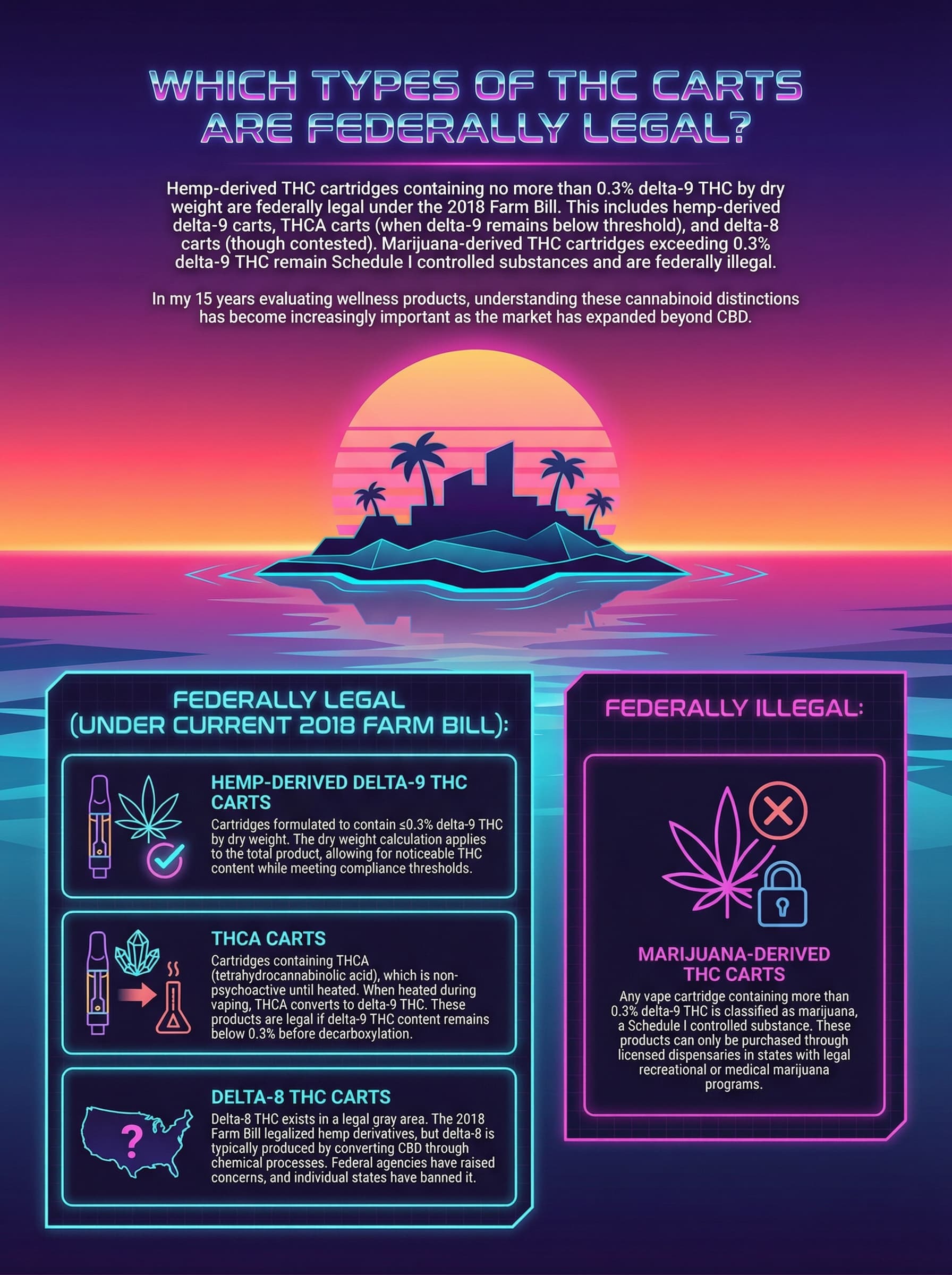
Hemp-derived THC cartridges containing no more than 0.3% delta-9 THC by dry weight are federally legal under the 2018 Farm Bill. This includes hemp-derived delta-9 carts, THCA carts (when delta-9 remains below threshold), and delta-8 carts (though contested). Marijuana-derived THC cartridges exceeding 0.3% delta-9 THC remain Schedule I controlled substances and are federally illegal.
In my 15 years evaluating wellness products, understanding these cannabinoid distinctions has become increasingly important as the market has expanded beyond CBD.
Federally Legal (Under Current 2018 Farm Bill):
Hemp-Derived Delta-9 THC Carts: Cartridges formulated to contain ≤0.3% delta-9 THC by dry weight. The dry weight calculation applies to the total product, allowing for noticeable THC content while meeting compliance thresholds.
THCA Carts: Cartridges containing THCA (tetrahydrocannabinolic acid), which is non-psychoactive until heated. When heated during vaping, THCA converts to delta-9 THC. These products are legal if delta-9 THC content remains below 0.3% before decarboxylation.
Delta-8 THC Carts: Delta-8 THC exists in a legal gray area. The 2018 Farm Bill legalized hemp derivatives, but delta-8 is typically produced by converting CBD through chemical processes. Federal agencies have raised concerns, and individual states have banned it.
Federally Illegal:
Marijuana-Derived THC Carts: Any vape cartridge containing more than 0.3% delta-9 THC is classified as marijuana, a Schedule I controlled substance. These products can only be purchased through licensed dispensaries in states with legal recreational or medical marijuana programs.
Which States Allow Hemp THC Vape Carts?
States where hemp-derived THC vape cartridges are generally legal include Florida, Texas, Georgia, Missouri, Pennsylvania, Wisconsin, Indiana, North Carolina, South Carolina, Tennessee, Kentucky, Kansas, Nebraska, and Oklahoma. However, some states have specifically banned THC vapes while allowing edibles, and others require purchases through licensed dispensaries only.
From my conversations with industry compliance experts, vape regulations often differ from edible regulations even within the same state. Several states that permit hemp-derived THC gummies have specifically banned smokable or inhalable products.
States Where Hemp THC Vapes Are Generally Permitted:
- Florida, Texas, Georgia, Missouri, Pennsylvania
- Wisconsin, Indiana, North Carolina, South Carolina
- Tennessee, Kentucky, Kansas, Nebraska, Oklahoma
States with Specific Vape/Smokable Bans:
- Alabama: Specifically bans THC vapes while allowing edibles with potency limits
- Louisiana: Bans smokable hemp products
- Hawaii: Prohibits edible and inhalable hemp products through administrative rules
- Texas: As of September 2025, banned all THC vape products (edibles still permitted)
States Where Delta-8/THC Vapes Are Banned:
- Alaska, Arizona, Arkansas, Colorado, Delaware
- Idaho, Iowa, Montana, New York, North Dakota
- Oregon, Rhode Island, Utah, Vermont, Washington
State laws change frequently. Always verify current regulations before attempting to purchase or possess THC vape cartridges in your state.
Why Can Some Retailers Ship THC Gummies but Not THC Carts?
THC gummies and other edibles are not covered by the PACT Act's vaping restrictions, allowing them to ship through standard carriers like USPS, FedEx, and UPS. Vape cartridges, however, fall under the ENDS definition regardless of what substance they contain, triggering strict shipping prohibitions that don't apply to non-inhalable products. This creates a situation where the same cannabinoid may ship easily in gummy form but face severe restrictions in vape form.
Based on my experience working with hemp brands, this regulatory distinction frustrates many consumers who assume all hemp products face the same shipping rules.
The PACT Act was designed to regulate nicotine and tobacco products, but its expanded 2021 definition captured all vaping devices regardless of their active ingredients. A hemp-derived delta-9 THC gummy containing 10mg of THC can ship through USPS to most states. The same 10mg of THC in a vape cartridge cannot.
This explains why many online hemp retailers offer extensive gummy, tincture, and edible selections while offering limited or no vape products. The compliance burden and shipping restrictions make vape cartridges impractical for many online businesses.
Companies like Enjoy Hemp focus on products that can ship legally and reliably, offering THC gummies and THC-infused drinks that deliver the effects consumers seek without the shipping complications of vape products.
What Are the Risks of Buying THC Carts Online?
Risks of buying THC carts online include receiving counterfeit or untested products, potential legal issues in states where products are banned, packages being seized during shipping, exposure to unsafe additives or contaminants in unregulated products, and difficulty obtaining refunds if orders never arrive. The lack of shipping infrastructure for vape products has created opportunities for non-compliant sellers.
In my 15 years evaluating wellness products, vape cartridges have presented the most significant safety concerns in the hemp market. Unlike gummies or tinctures, vape products can contain harmful additives that create serious health risks when inhaled.
Product Safety Risks:
- Untested Products: Some sellers skip third-party testing, meaning you don't know what's actually in the cartridge
- Harmful Additives: Cutting agents, flavoring chemicals, or thickeners may pose inhalation risks
- Metal Contamination: Low-quality hardware can leach metals into vapor at high temperatures
- Inaccurate Potency: Products may contain more or less THC than labeled
Legal Risks:
- State Bans: Ordering to states where products are illegal could result in seizure or legal consequences
- Shipping Violations: Non-compliant sellers may ship through unauthorized means, risking interception
- No Recourse: If packages are seized, you likely cannot recover funds or products
Red Flags to Avoid:
- No Certificate of Analysis (COA) available
- Claims to ship everywhere without restrictions
- Prices dramatically below market average
- No age verification at checkout
- Anonymous or unverifiable business information
What Alternatives Exist to Buying THC Carts Online?
Alternatives to online THC cart purchases include buying from local smoke shops or dispensaries (where legal), purchasing THC edibles or tinctures that ship more easily, visiting states where products are legal, or using non-THC hemp products. For consumers primarily seeking THC effects, gummies and tinctures offer reliable delivery without the shipping complications of vape products.
From my experience consulting for wellness publications, many consumers who initially sought THC vapes have found other product formats equally satisfying, particularly when shipping became problematic.
Local Purchase Options:
- Smoke Shops: In states where hemp-derived THC vapes are legal, local retailers may carry compliant products
- CBD/Hemp Stores: Specialty retailers often stock a wider selection than general smoke shops
- Licensed Dispensaries: In legal recreational or medical marijuana states, dispensaries offer tested, regulated products
Alternative Product Formats:
THC Gummies: Ship legally through standard carriers, offer precise dosing, and provide longer-lasting effects. Enjoy Hemp's gummy collection includes options for various moods and potency levels.
THC Drinks: THC-infused beverages offer faster onset than traditional edibles while avoiding shipping restrictions. Seltzers and tonics provide a social, sessionable experience, and consumers can explore the cleanest delta seltzer options available online.
Tinctures: Sublingual THC oils offer fast absorption and flexible dosing without inhalation or shipping restrictions.
Non-THC Options:
CBD vapes, CBG products, and other non-intoxicating cannabinoids face fewer restrictions and may provide wellness benefits without psychoactive effects.
What Changes Are Coming to THC Vape Legality?
Federal legislation signed in November 2025 (H.R. 5371) will dramatically restrict all hemp-derived THC products, including vape cartridges, starting November 12, 2026. The new law limits final products to 0.4mg total THC per container, bans synthetic or converted cannabinoids like delta-8, and redefines hemp using total THC rather than delta-9 alone. These changes will effectively eliminate most intoxicating hemp vapes from the legal market.
In my 15 years evaluating wellness products, this represents the most significant regulatory shift since the 2018 Farm Bill legalized hemp. Vape products will be among the most affected categories.
Key Changes Taking Effect November 2026:
- 0.4mg Per Container Limit: Final products cannot contain more than 0.4mg total THC per container, effectively banning all intoxicating vape cartridges
- Total THC Standard: Measurements will include all THC forms (including THCA), not just delta-9
- Synthetic Ban: Cannabinoids manufactured or converted outside the plant (like most delta-8) are excluded from hemp definition
- THCA Restriction: THCA will count toward total THC, making high-THCA carts non-compliant
According to industry legal analysis, vape cartridges will be particularly affected because concentrated products cannot meet the new threshold. The 0.4mg per-container limit is designed for products like full-spectrum CBD with trace THC, not intoxicating vapes.
Until November 2026: Products meeting current 2018 Farm Bill standards remain federally legal, though PACT Act shipping restrictions continue to apply.
Frequently Asked Questions
Can You Fly with THC Vape Cartridges?
Flying with THC vape cartridges is legally risky regardless of federal hemp compliance. The TSA screens for security threats, not drugs, but can refer prohibited items to local law enforcement. If your destination state bans THC vapes, possession upon arrival could result in legal consequences. Most travel experts advise against flying with any THC products.
Will THC Carts Show Up on a Drug Test?
Yes. All THC vape cartridges, including hemp-derived delta-9, delta-8, and THCA (when heated), will produce metabolites that trigger positive drug test results. Drug tests cannot distinguish between THC sources. If you face drug testing for employment or legal matters, avoid all THC products regardless of their legal status.
Are Disposable THC Vapes Legal?
Disposable THC vapes face the same regulations as cartridges. Hemp-derived disposables containing ≤0.3% delta-9 THC are federally legal under the 2018 Farm Bill but subject to PACT Act shipping restrictions and state-level bans on delta-8 or THC vapes. Marijuana-derived disposables exceeding 0.3% delta-9 THC are federally illegal and available only through licensed dispensaries in legal states.
How Can You Verify a THC Cart Is Safe?
Verify THC cart safety by checking for a batch-specific Certificate of Analysis (COA) from an ISO 17025 accredited laboratory. The COA should confirm cannabinoid potency, verify delta-9 THC remains below 0.3%, and show passed tests for pesticides, heavy metals, residual solvents, and microbial contaminants. Avoid products without accessible lab testing documentation.
Why Are Some THC Carts So Cheap Online?
Extremely low-priced THC carts often indicate untested products, non-compliant cannabinoid sources, low-quality hardware, or potentially unsafe additives. The cost of proper extraction, third-party testing, compliant packaging, and quality hardware creates a floor price for legitimate products. Prices dramatically below market average should raise immediate concerns about product safety and legality.
How long do THC vape cartridges last before going bad?
THC vape cartridges typically maintain peak quality for 6–12 months when stored properly, though potency and flavor begin degrading after this period due to natural cannabinoid breakdown. Storage conditions significantly affect shelf life, with cartridges kept upright in a cool, dark location at consistent temperatures between 60–70°F lasting the longest. Heat, sunlight, and humidity can accelerate degradation, causing the oil to thin out, darken, or develop off flavors. Once opened, cartridges should ideally be used within 3–6 months for the best vaping experience, though properly stored carts remain functional for longer periods.
Can I refill or reuse THC vape cartridges?
Most pre-filled THC vape cartridges are designed for single use and shouldn't be refilled because the heating coil degrades with use and the ceramic absorbs flavor and residue from the original oil. Attempting to refill disposable cartridges can result in leaking, burnt taste, or hardware failure, while also voiding any warranty or quality guarantees. Refillable vape cartridges and tanks are designed specifically for this purpose with replaceable coils and higher-quality materials. If you want to use your own THC oil, purchase a dedicated refillable vape system rather than trying to repurpose disposable cartridges.
What's the difference between 510-thread and proprietary THC vape cartridges?
510-thread cartridges use a universal connection system that works with most standard vape batteries, giving consumers flexibility to use different batteries with various cartridges from multiple brands. Proprietary cartridges are designed to work only with specific brand batteries, locking you into a single ecosystem but often featuring optimized airflow, heating, and design for that specific brand. 510-thread is the industry standard for most hemp-derived THC carts, making it easier to replace batteries or switch between products without buying new hardware. Proprietary systems may offer better performance and quality control but limit consumer choice and require purchasing matched components from the same brand.
Making Informed Decisions About THC Vapes
The legality of buying THC carts online involves more complexity than most hemp products. While hemp-derived cartridges may be federally legal under the 2018 Farm Bill, the PACT Act creates substantial shipping barriers, individual states have imposed their own restrictions, and upcoming 2026 federal changes will further limit what products qualify as legal hemp.
For consumers seeking THC effects, alternative product formats may offer better accessibility. THC gummies, THC drinks, and tinctures ship through standard carriers to most states without the complications vape products face. These options deliver comparable effects while avoiding the regulatory hurdles specific to inhalable products.
If you do seek THC vape cartridges, local purchase from reputable retailers in states where products are legal may be your most reliable option. Verify lab testing, confirm compliance with state regulations, and understand that online shipping options remain severely limited by federal law.
The regulatory landscape continues evolving rapidly. Monitor changes at both federal and state levels to ensure your purchases remain legal and your products meet safety standards.
By Sarah Mitchell, Wellness Industry Specialist
Sarah Mitchell is a wellness industry veteran with 15 years of experience in functional supplements and hemp-derived products. She previously led product development at two nationally recognized wellness brands and holds certification as a holistic health practitioner. Sarah now advises consumers on quality standards, helping them make informed decisions in the evolving hemp market.
Disclaimer: This article is for educational purposes only and does not constitute legal advice. Hemp, THC, and vaping regulations vary by jurisdiction and change frequently. Verify current federal and state laws before purchasing any THC or vape products. Consult with a legal professional for advice specific to your situation.