





THC Dosage for Sleep: How Many Milligrams Do You Need? (2026)
Posted by Enjoy Hemp Editor Team on Feb 24th 2026
Last Updated: February 2026
Finding the right THC dosage for sleep depends on your experience level, body weight, and desired effects. Most sleep experts and cannabis physicians recommend starting with 2.5 to 5mg of THC for beginners, with experienced users typically finding their sweet spot between 5 and 15mg. Research suggests that lower doses of THC may actually produce better sleep outcomes than higher doses, which can interfere with sleep architecture and cause next-day grogginess. Taking your dose 60 to 90 minutes before bedtime allows edibles to reach peak effect when you are ready to sleep.
After 15 years evaluating wellness products and working with formulators on cannabinoid dosing, I have found that the biggest mistake people make with THC for sleep is assuming more is better. The science actually points in the opposite direction: strategic, low-dose THC often produces more restorative sleep than high doses that leave you groggy the next morning.
| Experience Level | Recommended THC Dose | Expected Effects | Timing Before Bed | Product Example |
|---|---|---|---|---|
| First-Time Users | 1 to 2.5mg THC | Mild relaxation; subtle calming; minimal psychoactivity | 90 minutes to 2 hours | Microdose gummies |
| Beginners | 2.5 to 5mg THC | Noticeable relaxation; easier sleep onset; mild euphoria | 60 to 90 minutes | Enjoy Hemp Sleep Gummies |
| Moderate Experience | 5 to 10mg THC | Strong relaxation; faster sleep onset; deeper initial sleep | 60 to 90 minutes | Enjoy Hemp Chill Gummies |
| Experienced Users | 10 to 20mg THC | Significant sedation; reduced sleep latency; may affect REM | 60 to 90 minutes | Deep Sleep THC+CBN Gummies |
| High Tolerance | 20 to 30mg+ THC | Strong sedation; potential next-day grogginess; tolerance-dependent | 60 to 90 minutes | High-potency formulas |
How Many Milligrams of THC Should You Take for Sleep?
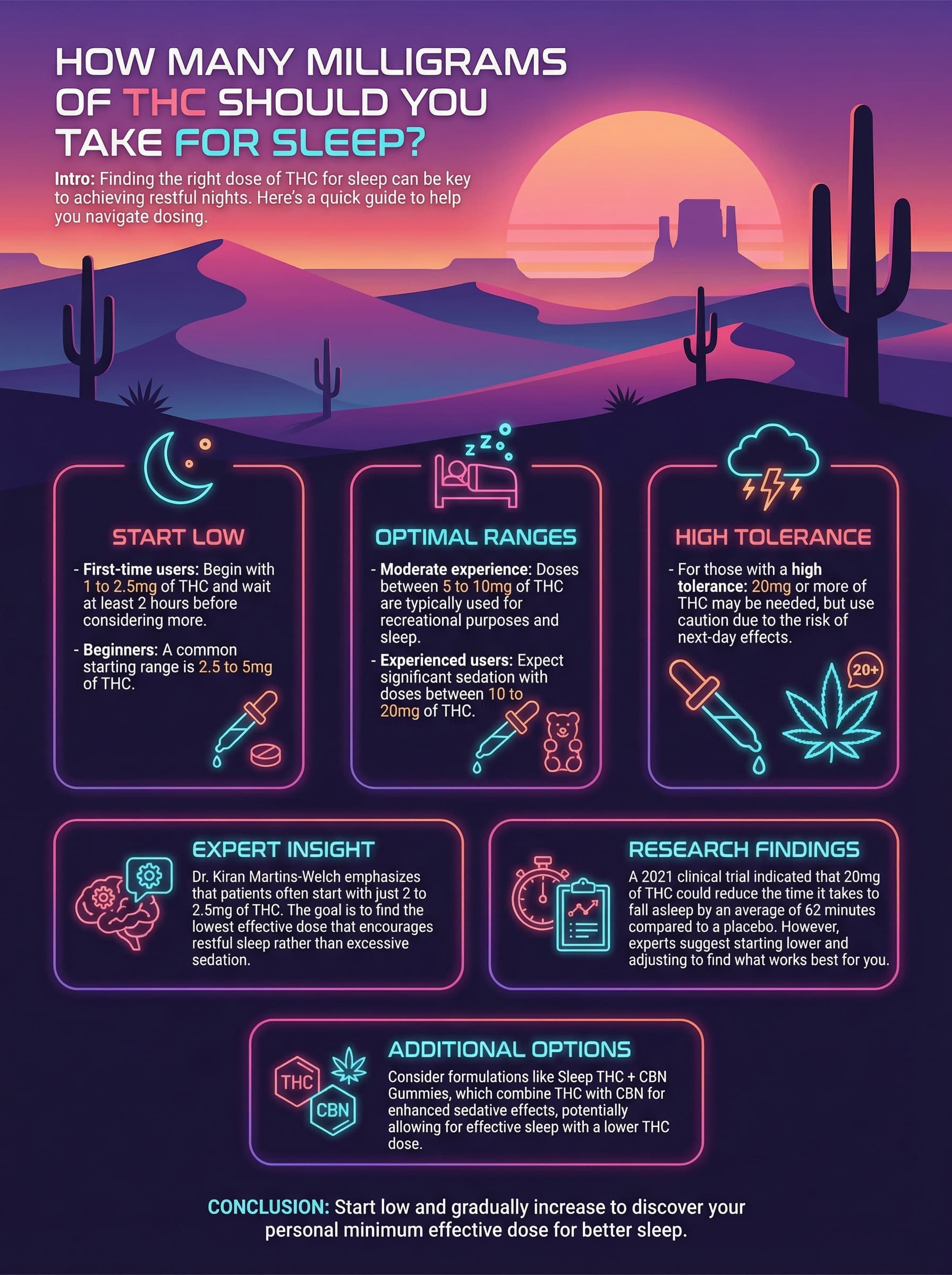
For sleep, most experts recommend starting with 2.5 to 5mg of THC if you are new to cannabinoids, with experienced users typically finding optimal results between 5 and 15mg. Research suggests lower doses may actually produce better sleep outcomes than higher doses. A 2021 clinical trial found that 20mg THC reduced time to fall asleep by an average of 62 minutes compared to placebo, but cannabis physicians generally recommend starting lower and titrating up gradually to find your personal minimum effective dose.
According to Dr. Kiran Martins-Welch, a cannabis medicine specialist at Northwell Health, most patients do well starting at just 2 to 2.5mg of THC. "The goal isn't to knock someone out," she explains. "It's to find the lowest effective dose that gently nudges the body into rest."
Enjoy Hemp offers sleep-focused formulations like their Sleep THC + CBN Gummies that combine THC with CBN (cannabinol) for enhanced sedative effects. This approach allows users to achieve restful sleep with lower THC doses than they might need from THC alone.
General dosing guidelines:
- First-time users: 1 to 2.5mg THC; wait at least 2 hours before considering more
- Beginners: 2.5 to 5mg THC; most common starting range
- Moderate experience: 5 to 10mg THC; standard recreational and sleep dose
- Experienced users: 10 to 20mg THC; significant sedation expected
- High tolerance: 20mg+ THC; use with caution; higher risk of next-day effects
Why Do Lower THC Doses Often Work Better for Sleep?
Lower THC doses (2.5 to 10mg) often produce better sleep quality than higher doses because they support the body's natural sleep architecture without suppressing REM sleep or causing next-day grogginess. Research published in the journal Sleep Medicine Reviews found that high doses of THC (50 to 210mg) decreased both REM sleep and slow-wave (deep) sleep, while low doses (4 to 20mg) produced milder effects with less disruption to sleep stages. The key is finding the minimum effective dose for your body.
Sleep consists of multiple stages that cycle throughout the night: light sleep (stages 1 and 2), deep slow-wave sleep (stage 3), and REM sleep. Each stage serves essential functions, from physical restoration during deep sleep to memory consolidation and emotional processing during REM.
According to research published in Current Sleep Medicine Reports, acute THC exposure may increase slow-wave sleep while decreasing REM sleep. While reduced REM might sound beneficial for nightmare sufferers, it can affect memory, learning, and emotional regulation over time.
How different THC doses affect sleep stages:
- Low doses (2.5 to 10mg): May reduce sleep onset latency; minimal REM suppression; less next-day impairment
- Moderate doses (10 to 20mg): Stronger sedation; more pronounced REM reduction; potential grogginess
- High doses (20mg+): Significant REM suppression; may reduce deep sleep with chronic use; higher risk of tolerance development
When Should You Take THC Before Bed for Best Results?
Take THC edibles 60 to 90 minutes before your intended bedtime for optimal results. Edibles must be digested and metabolized through the liver before taking effect, which typically requires 45 to 120 minutes depending on your metabolism, recent food intake, and the specific product. Taking your dose during your wind-down routine, rather than once you are already in bed, allows effects to build gradually and peak around the time you want to fall asleep.
Timing is critical with edibles because taking them too late means effects peak after you have already fallen asleep (potentially disrupting rest), while taking them too early can leave you drowsy before you intended. The 60 to 90 minute window works well for most people using standard gummies or capsules.
Timing recommendations by product type:
- Standard gummies: 60 to 90 minutes before bed
- Capsules: 60 to 90 minutes before bed (similar to gummies)
- THC drinks/beverages: 30 to 60 minutes before bed (faster absorption)
- Sublingual tinctures: 15 to 45 minutes before bed (absorbed under tongue)
- Nano-emulsified products: 15 to 30 minutes before bed (enhanced bioavailability)
Enjoy Hemp THC Drinks offer faster onset than traditional gummies, making them a good option if you prefer a shorter lead time before bed.
Does Adding CBN to THC Improve Sleep?
Adding CBN (cannabinol) to THC may improve sleep outcomes, particularly for staying asleep through the night. A 2023 double-blind, placebo-controlled study published in Experimental and Clinical Psychopharmacology found that 20mg of CBN significantly reduced nighttime awakenings and overall sleep disturbance compared to placebo. CBN has shown potential sedative effects in preclinical research, and many users report that THC + CBN combinations produce more restful sleep than THC alone.
The 2023 clinical trial tested 293 participants with self-reported poor sleep quality over seven consecutive nights. Researchers found that CBN "demonstrated reduced nighttime awakenings and overall sleep disturbance relative to placebo, with no impact on daytime fatigue." Interestingly, adding CBD to CBN did not further improve outcomes.
A 2024 study published in Neuropsychopharmacology examined CBN effects on sleep architecture in rats and found that CBN increased total sleep time, including both non-REM and REM sleep. The researchers identified CBN's primary metabolite (11-OH-CBN) as potentially responsible for these sedative effects.
Enjoy Hemp Deep Sleep THC + CBN Gummies combine THC with CBN specifically for sleep support, allowing users to benefit from the synergy between these cannabinoids.
Cannabinoids and their roles in sleep:
- THC: Reduces sleep onset latency; may increase deep sleep acutely; can suppress REM
- CBN: May reduce nighttime awakenings; emerging evidence for sedative effects
- CBD: May reduce anxiety-related sleep issues; does not appear sedating at typical doses
- CBG: Limited sleep research; may support relaxation
What Are the Signs You Took Too Much THC for Sleep?
Signs of taking too much THC for sleep include racing thoughts or anxiety, increased heart rate, difficulty falling asleep despite feeling tired, vivid or unsettling dreams, waking up still feeling "high," significant next-morning grogginess, dry mouth, and impaired coordination the following day. If you experience these effects, reduce your dose by 2.5mg increments on subsequent nights until you find a dose that promotes sleep without unwanted side effects.
Taking too much THC is rarely dangerous, but it can be extremely uncomfortable and counterproductive for sleep. High doses may actually increase anxiety and make it harder to fall asleep, defeating the purpose entirely.
Common signs of overconsumption:
- Racing thoughts: Mind feels active rather than calm
- Anxiety or paranoia: More common at higher THC doses
- Increased heart rate: THC can temporarily elevate heart rate
- Next-day grogginess: "Edible hangover" feeling in the morning
- Difficulty waking up: Feeling sedated or impaired after adequate sleep time
- Impaired coordination: Lingering effects the next morning
What to do if you took too much:
- Stay calm; effects are temporary and will subside
- Hydrate with water (avoid caffeine or alcohol)
- Try to sleep if possible; sleeping off an edible is often the best approach
- CBD may help counteract some THC effects (research is mixed)
- Black pepper (sniffing or chewing) is a folk remedy some find helpful
- Reduce your dose on subsequent nights
How Does THC Affect Sleep Quality Over Time?
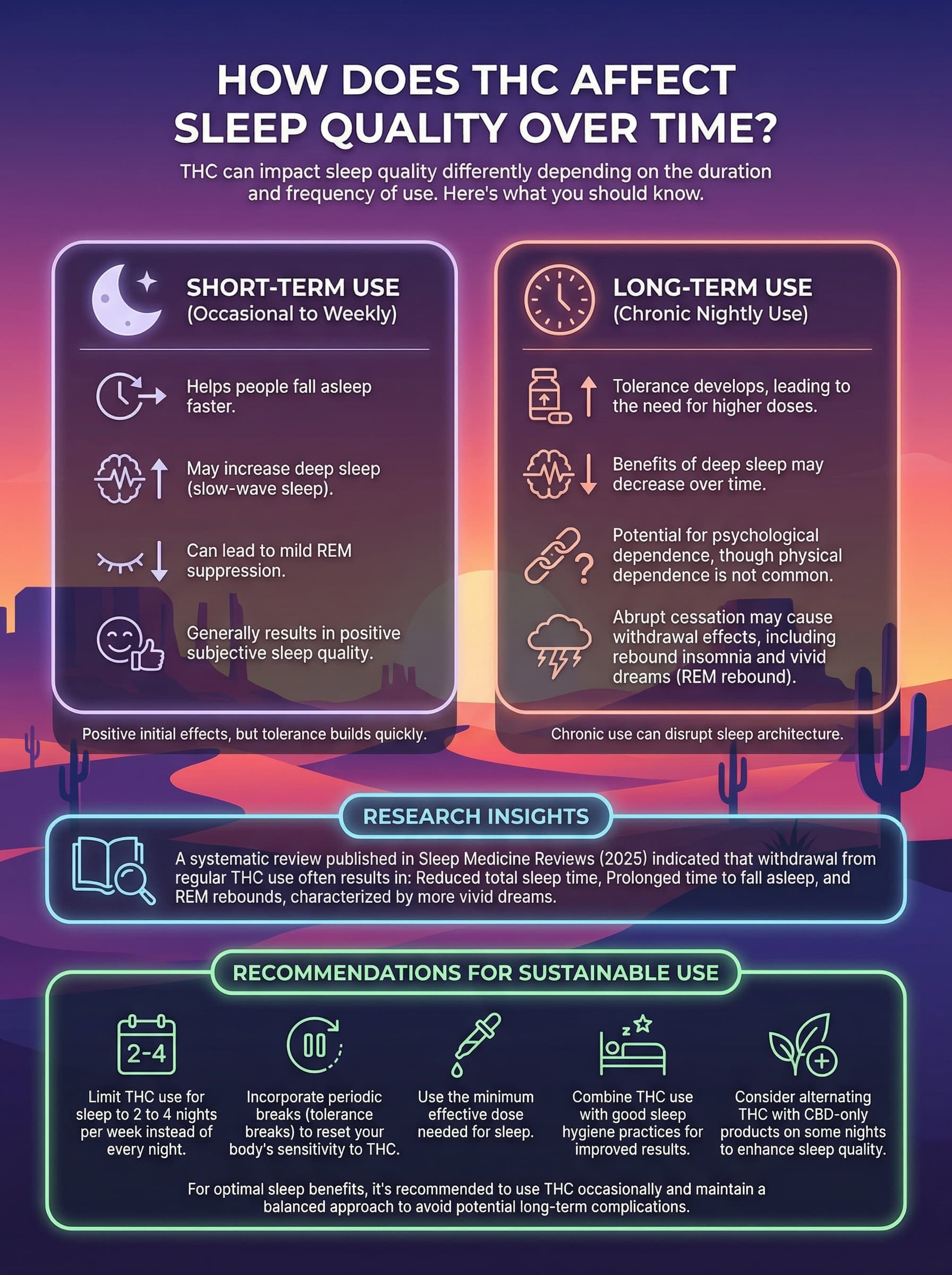
Short-term THC use (occasional to weekly) generally helps people fall asleep faster and may increase deep sleep, but chronic nightly use can lead to tolerance, diminished effects, and potential sleep disturbances when use is stopped. Research shows that withdrawal from regular THC use is associated with rebound insomnia, reduced total sleep time, prolonged sleep onset, and vivid dreams (REM rebound). For best results, many experts recommend using THC for sleep on an occasional rather than nightly basis.
A systematic review published in Sleep Medicine Reviews (2025) found that "withdrawal from active cannabis use was consistently associated with sleep disturbances, including reduced total sleeping times and prolonged sleep onset latency, as well as REM rebounds."
Short-term use (occasional):
- May reduce time to fall asleep
- May increase slow-wave (deep) sleep
- Mild REM suppression
- Generally positive subjective sleep quality
Long-term nightly use:
- Tolerance develops, requiring higher doses
- Deep sleep benefits may diminish
- Potential dependence (psychological, not physical)
- Withdrawal effects if stopped abruptly
Strategies for sustainable use:
- Use THC for sleep 2 to 4 nights per week rather than nightly
- Take periodic breaks (tolerance breaks) to reset sensitivity
- Use the minimum effective dose
- Combine with good sleep hygiene practices
- Consider alternating with CBD-only products on some nights
What Makes Enjoy Hemp Sleep Products Effective?
Enjoy Hemp sleep products combine strategic cannabinoid ratios (THC, CBN, CBD) with clean, USDA-certified organic ingredients and third-party testing to deliver consistent, effective results. Their "Pick Your Feeling" approach includes sleep-specific formulations like Sleep THC + CBN Gummies and Deep Sleep Gummies designed for different intensity levels. Every product contains ≤0.3% THC by dry weight, ensuring federal compliance while delivering functional effects.
In my experience evaluating hemp products, Enjoy Hemp stands out for their mood-specific formulation approach. Rather than offering generic "relaxation" products, they have developed distinct sleep formulas targeting different needs:
Enjoy Hemp Sleep Product Options:
- Sleep THC + CBN Gummies: Combines THC with CBN for enhanced sedation and reduced nighttime awakenings
- Deep Sleep THC + CBN Gummies: Higher-potency formula for experienced users or persistent sleep issues
- Chill THC Gummies (Indica): THC-forward formula for relaxation and winding down
- Sleep THC + CBN Seltzer: Fast-acting drink format for quicker onset
- Sleep THC + CBN Syrup: Customizable dosing in liquid form
Quality indicators that matter for sleep products:
- USDA-certified organic hemp: No synthetic pesticides or herbicides
- Third-party testing: Independent verification of potency and purity
- Batch-specific COAs: Lab results matching your specific product
- Clear cannabinoid labeling: Precise THC, CBN, and CBD content per serving
- Indica-based formulations: Terpene profiles associated with sedation
Should You Take THC with Food for Better Sleep?
Taking THC with a light snack containing fat can improve absorption and produce more consistent effects for sleep. Cannabis compounds are fat-soluble, meaning they absorb better when consumed with dietary fat. However, eating too much before bed can interfere with sleep quality independently of THC. A small snack like a handful of nuts, toast with peanut butter, or cheese and crackers 30 to 60 minutes before your THC dose can optimize absorption without overloading your digestive system.
Research shows that consuming cannabinoids with high-fat meals can increase bioavailability significantly. However, for sleep purposes, balance is key: you want enhanced absorption without the digestive burden of a heavy meal.
Optimal eating strategy for THC sleep aids:
- Eat dinner 2 to 3 hours before bed (normal timing)
- Have a small fatty snack 30 to 60 minutes before taking your THC dose
- Good options: handful of almonds, cheese, avocado toast, peanut butter
- Avoid: heavy meals, spicy foods, excessive sugar close to bedtime
- Stay hydrated, but reduce fluid intake close to bedtime to avoid waking up
Frequently Asked Questions
Is 10mg of THC Too Much for Sleep?
For most beginners, 10mg of THC is too much for sleep and may cause anxiety, racing thoughts, or next-morning grogginess. Most cannabis physicians recommend starting at 2.5 to 5mg and increasing gradually. However, 10mg may be appropriate for users with moderate cannabinoid experience. The standard recreational dose is 5 to 10mg, but sleep benefits often occur at lower doses than recreational effects. If 10mg leaves you groggy the next morning, reduce to 5mg or consider adding CBN instead of increasing THC.
Can You Build a Tolerance to THC for Sleep?
Yes, regular THC use leads to tolerance, meaning you may need higher doses over time to achieve the same sleep effects. This tolerance develops because CB1 receptors in the brain downregulate with chronic cannabinoid exposure. To minimize tolerance, use THC for sleep 2 to 4 nights per week rather than nightly, take periodic "tolerance breaks" of 1 to 2 weeks, and always use the minimum effective dose. Enjoy Hemp Sleep Gummies combine THC with CBN, which may help maintain effectiveness at lower THC doses.
What Happens If You Take THC Every Night for Sleep?
Taking THC every night for sleep may initially improve sleep quality, but chronic use typically leads to tolerance (diminished effects), potential dependence, and withdrawal symptoms if stopped abruptly. Withdrawal effects include rebound insomnia, vivid dreams, reduced total sleep time, and increased time to fall asleep. These effects usually resolve within 1 to 2 weeks of stopping. For sustainable use, consider alternating THC nights with CBD-only nights or using THC 2 to 4 times per week rather than nightly.
Are THC Drinks or Gummies Better for Sleep?
THC drinks typically work faster than gummies (30 to 60 minutes versus 60 to 90 minutes) but may not last as long. THC gummies provide longer-lasting effects (6 to 8 hours) that may better support staying asleep through the night. For most people, gummies are preferred for sleep because their extended duration matches the typical sleep cycle. However, if you prefer a shorter lead time before bed or need help falling asleep more than staying asleep, drinks can be effective. Both formats work well when dosed appropriately.
Will THC for Sleep Show Up on a Drug Test?
Yes, THC from hemp-derived sleep products will show up on standard drug tests. Drug tests detect THC metabolites regardless of whether the THC came from hemp (≤0.3% THC) or marijuana. A single dose of THC can be detectable for 3 to 10 days in occasional users and 30+ days in daily users. If you are subject to drug testing, consider CBD-only sleep products or discuss alternatives with your healthcare provider. There is no way to use THC, even in federally legal hemp products, without risk of a positive drug test.
Finding Your Optimal THC Sleep Dose
Discovering the right THC dosage for sleep is a personal process that requires patience and attention to how your body responds. The research consistently supports starting low (2.5 to 5mg for beginners) and increasing gradually by 2.5mg increments until you find your minimum effective dose. Taking your dose 60 to 90 minutes before bed allows edibles to reach peak effect when you want to sleep.
Enjoy Hemp offers a range of sleep-focused products combining THC with CBN for enhanced sedative effects without requiring higher THC doses. Their Sleep THC + CBN Gummies provide a consistent, third-party tested option for those seeking natural sleep support.
Remember that THC affects everyone differently based on body weight, metabolism, tolerance, and individual endocannabinoid system function. What works for one person may be too much or too little for another. Keep a sleep journal tracking your dose, timing, and sleep quality to identify patterns and optimize your approach over time.
By Sarah Mitchell, Wellness Industry Specialist
Sarah Mitchell is a wellness industry veteran with 15 years of experience in functional supplements and hemp-derived products. She previously led product development at two nationally recognized wellness brands and holds certification as a holistic health practitioner. Sarah now advises consumers on quality standards, helping them make informed decisions in the evolving hemp market.
Disclaimer: This article is for educational purposes only and does not constitute medical advice. Hemp-derived THC products are not FDA-approved for treating insomnia, sleep disorders, or any medical condition. Individual responses to cannabinoids vary significantly. Consult with a healthcare provider before using THC products for sleep, especially if you take medications, have underlying health conditions, or experience chronic sleep issues. These statements have not been evaluated by the Food and Drug Administration.