





How to Find Reputable Websites Selling Lab Tested THC Products
Posted by Enjoy Hemp Editor Team on Feb 14th 2026
Last Updated: February 2026
Finding trustworthy sources for hemp-derived THC products requires more than a quick internet search. With thousands of brands competing for attention, knowing how to separate legitimate retailers from questionable ones can protect both your health and your wallet.
In my 15 years evaluating wellness products, I have watched the hemp industry evolve from a niche market to a multi-billion dollar category with vastly different quality standards. The good news is that reputable brands make verification straightforward once you know what to look for.
| Quality Indicator | What to Look For | Red Flag |
|---|---|---|
| Third-Party Lab Testing | Current COA with batch numbers, independent lab name | No COA, in-house testing only, outdated results |
| Cannabinoid Transparency | Clear THC/CBD content per serving and per package | Vague potency claims, missing dosage information |
| Hemp Sourcing | USA-grown, organic certification, farm transparency | Unknown origin, no sourcing details |
| Contaminant Screening | Tests for pesticides, heavy metals, solvents, microbials | Cannabinoid-only testing, incomplete panels |
| Company Information | Physical address, customer service, clear policies | No contact info, template websites, only social media |
| Pricing | Competitive but reasonable for quality extraction | Suspiciously cheap, deals too good to be true |
What Should You Look for When Buying THC Products Online?
Reputable THC websites display accessible third-party lab results, provide clear product labeling with exact cannabinoid content, source hemp from licensed U.S. farms, and maintain transparent business practices including verifiable contact information and customer service channels. These fundamentals separate trustworthy retailers from potentially unsafe sources.
When I led product development at a national supplement brand, we discovered that consumers often focus exclusively on THC percentages while overlooking equally important quality markers. The cannabinoid profile tells only part of the story.
Start by examining whether a website makes its Certificate of Analysis easily accessible. Quality brands link COAs directly on product pages or provide scannable QR codes on packaging. According to USDA Laboratory Testing Guidelines, legitimate hemp testing must follow strict protocols including proper sample preparation and validated testing methods.
Beyond lab results, evaluate the company's overall transparency. Does the website explain where its hemp is grown? Does it describe extraction methods? Can you find a physical business address and responsive customer service? These details indicate a company that stands behind its products.
For those seeking consistent, reliable experiences, brands like Enjoy Hemp prioritize USDA-certified organic hemp and publish comprehensive testing documentation, setting a standard for transparency in the industry.
How Do You Read a Certificate of Analysis (COA)?
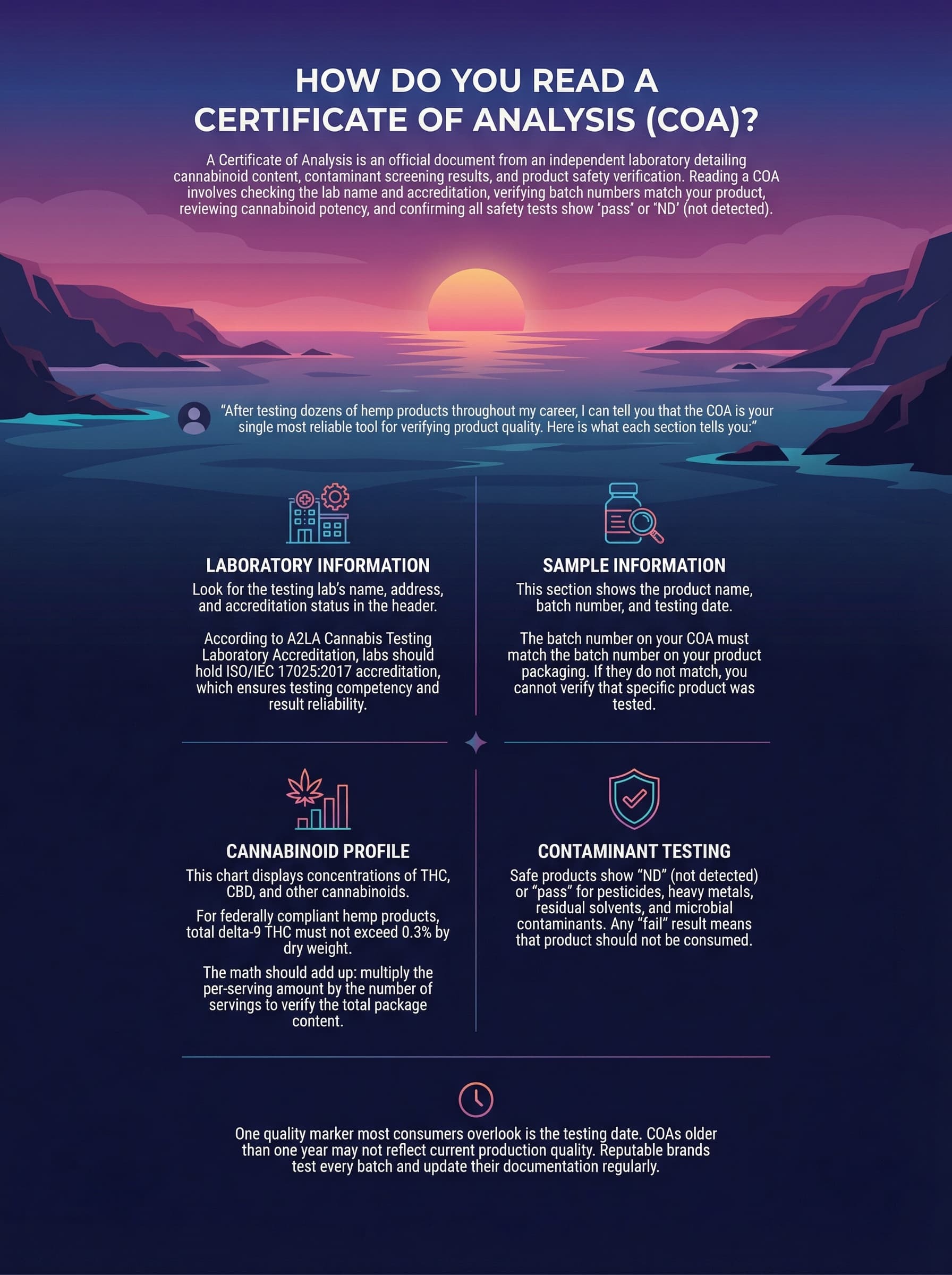
A Certificate of Analysis is an official document from an independent laboratory detailing cannabinoid content, contaminant screening results, and product safety verification. Reading a COA involves checking the lab name and accreditation, verifying batch numbers match your product, reviewing cannabinoid potency, and confirming all safety tests show "pass" or "ND" (not detected).
After testing dozens of hemp products throughout my career, I can tell you that the COA is your single most reliable tool for verifying product quality. Here is what each section tells you:
Laboratory Information: Look for the testing lab's name, address, and accreditation status in the header. According to A2LA Cannabis Testing Laboratory Accreditation, labs should hold ISO/IEC 17025:2017 accreditation, which ensures testing competency and result reliability.
Sample Information: This section shows the product name, batch number, and testing date. The batch number on your COA must match the batch number on your product packaging. If they do not match, you cannot verify that specific product was tested.
Cannabinoid Profile: This chart displays concentrations of THC, CBD, and other cannabinoids. For federally compliant hemp products, total delta-9 THC must not exceed 0.3% by dry weight. The math should add up: multiply the per-serving amount by the number of servings to verify the total package content.
Contaminant Testing: Safe products show "ND" (not detected) or "pass" for pesticides, heavy metals, residual solvents, and microbial contaminants. Any "fail" result means that product should not be consumed.
One quality marker most consumers overlook is the testing date. COAs older than one year may not reflect current production quality. Reputable brands test every batch and update their documentation regularly.
What Are the Red Flags of Fake or Unsafe THC Products?
Warning signs include missing or inaccessible lab results, prices significantly below market value, packaging with spelling errors or missing required information, no verifiable company contact details, bold medical claims, and products sold through unvetted channels like gas stations or social media direct messages.
From my conversations with extraction specialists and quality control professionals, I have learned that legitimate hemp processing is not cheap. Quality extraction equipment, third-party testing, and proper packaging all cost money. When a product seems impossibly affordable, something has been cut from the process.
Watch for these specific warning signs:
- No COA or Sketchy Lab Reports: If you cannot find lab results, or the results come from an "in-house" lab rather than an independent third party, move on. Legitimate brands use accredited laboratories like those registered with A2LA or holding ISO 17025 certification.
- QR Codes That Lead Nowhere: Scan the QR code before purchasing. If it links to a broken page, a generic website, or the brand's own domain rather than an independent lab, that is a major red flag.
- Copycat Packaging: Products mimicking popular candy brands (Skittles, Nerds, etc.) are almost always unregulated and potentially dangerous. Major candy manufacturers have actively sued these counterfeit producers for trademark infringement.
- Missing Batch Numbers: Every legitimate product should have a traceable batch number linking it to specific testing results. Without this, there is no way to verify safety or potency.
- Unrealistic Health Claims: The FDA has not approved hemp-derived cannabinoids for treating, curing, or preventing any disease. Brands making bold medical claims are either uninformed or deliberately deceptive.
Based on my experience working with third-party testing labs, I recommend verifying the lab itself. Search the laboratory name online, confirm it exists as an independent entity, and check whether it holds proper accreditation for cannabis and hemp testing.
Are Hemp-Derived THC Products Sold Online Actually Safe?
Hemp-derived THC products from reputable, transparent brands that provide accessible third-party testing are generally safe for adult consumers when used responsibly. The key is purchasing from companies that prioritize quality control, source from licensed U.S. hemp farms, test for contaminants, and comply with federal regulations including the ≤0.3% THC threshold.
The safety question largely depends on where you shop. Licensed retailers and transparent online brands operating within federal guidelines offer products that have passed rigorous testing. Unregulated sources present genuine risks.
Hemp absorbs compounds from its growing environment, which means untested products could contain pesticides, heavy metals, or other toxins. Additionally, without verified potency testing, you might consume far more or less THC than expected, leading to uncomfortable experiences or ineffective products.
In my 15 years evaluating wellness products, I have found that the safest approach combines several verification steps: check lab results, research the brand's reputation through independent reviews, start with lower doses to assess your personal response, and stick with companies that maintain consistent quality standards.
Brands committed to safety, like Enjoy Hemp's gummy collection, provide batch-specific COAs, use USDA-certified organic hemp, and maintain transparent manufacturing practices that give consumers confidence in every product.
What Certifications Should Reputable THC Brands Have?
Trustworthy THC brands should demonstrate third-party lab testing from ISO 17025 accredited laboratories, and may additionally hold certifications including USDA Organic, U.S. Hemp Authority certification, NSF certification, or Good Manufacturing Practice (GMP) compliance. These credentials indicate adherence to quality standards beyond minimum legal requirements.
When I led product development at wellness brands, we pursued certifications not because they were required but because they demonstrated commitment to quality. Here is what each certification signals:
ISO 17025 Accredited Lab Testing: This international standard ensures the laboratory performing product testing meets rigorous competency requirements. Look for this accreditation mentioned on COAs or linked from product pages.
USDA Organic: Products with the USDA organic seal are produced and processed according to National Organic Program standards, meaning no synthetic pesticides or fertilizers were used in cultivation. This certification is particularly meaningful for hemp since the plant absorbs compounds from its environment.
U.S. Hemp Authority: This certification verifies that growers, manufacturers, and brands meet Good Manufacturing Practice standards and adhere to quality requirements beyond minimum federal guidelines.
GMP Certification: Good Manufacturing Practice certification indicates facilities follow consistent, documented processes for production, reducing batch-to-batch variability and contamination risks.
Not every excellent brand holds every certification, but multiple credentials signal serious investment in quality assurance. Companies like Enjoy Hemp, which maintain USDA-certified organic status and comprehensive third-party testing, demonstrate this commitment to exceeding baseline standards.
Where Can You Verify a Brand's Lab Testing Results?
Verify lab results by scanning QR codes on product packaging, visiting the brand's website lab results page, requesting COAs directly from customer service, or cross-referencing the listed laboratory to confirm it exists as an independent, accredited testing facility. Results should display the same batch number as your specific product.
The verification process should take only minutes once you know where to look. Most reputable brands make this deliberately simple because transparency builds trust.
Start with the product packaging. Look for a QR code or URL linking to lab results. When scanned, this should take you directly to a document showing your product's specific batch test results, ideally hosted on the testing laboratory's own domain rather than just the brand's website.
If no QR code exists, visit the brand's website and look for sections labeled "Lab Results," "COAs," "Third-Party Testing," or "Transparency." Quality brands organize results by product and batch number for easy lookup.
Take verification one step further by researching the laboratory itself. Search the lab's name to confirm it operates as an independent testing facility. Check whether it holds ISO 17025 accreditation or appears in directories maintained by accreditation bodies like A2LA.
If a brand makes verification difficult, cannot provide batch-specific results, or only offers generic documentation, consider that a significant warning sign. Legitimate companies want you to verify their quality claims.
How Much THC Is Legal in Hemp Products?
Under the 2018 Farm Bill, hemp-derived products are federally legal if they contain no more than 0.3% delta-9 THC by dry weight. Recent 2025 federal legislation introduced additional restrictions on total THC content including THCA, with final product limits set to take effect in November 2026. State laws may impose further restrictions.
The regulatory landscape for hemp-derived THC continues evolving. Understanding current rules helps you identify compliant products and anticipate coming changes.
The foundational rule remains the 0.3% delta-9 THC threshold established by the 2018 Farm Bill. This allows products with measurable THC amounts that stay within this limit when calculated by dry weight. Many THC-infused beverages and edibles use this framework to deliver functional doses while maintaining federal compliance.
Recent Congressional action through the FY2026 Agriculture Appropriations Act introduced new restrictions scheduled to take effect in November 2026. These changes redefine hemp to include total THC (including THCA) in the 0.3% calculation and establish new limits on final product THC content.
State regulations add another layer of complexity. Some states have enacted their own restrictions on hemp-derived cannabinoids, while others follow federal guidelines. Always verify that products can legally ship to your location before purchasing.
Reputable brands stay current with regulatory requirements and clearly communicate compliance on their packaging and websites. This attention to legal details indicates overall operational quality.
Frequently Asked Questions
Can I Trust THC Product Reviews Online?
Online reviews provide useful context but require critical evaluation. Look for reviews on independent platforms rather than only the brand's website, watch for specific details about product experience rather than generic praise, and consider overall patterns across many reviews rather than individual opinions.
In my experience consulting for wellness publications, I have seen that authentic reviews typically mention specific products, describe personal experiences with dosing and effects, and sometimes include constructive criticism. Generic five-star reviews saying only "great product" offer little verification value.
Should I Avoid THC Products Without Organic Certification?
Organic certification indicates adherence to specific cultivation standards but is not the only quality marker. Non-organic products can still be safe if they pass comprehensive third-party testing for pesticides, heavy metals, and other contaminants. Prioritize verified lab results regardless of organic status.
That said, hemp's natural ability to absorb compounds from soil makes sourcing important. Products from brands emphasizing clean cultivation practices, whether officially certified organic or not, generally present lower contamination risks.
What Is the Difference Between In-House and Third-Party Lab Testing?
Third-party testing means an independent, unaffiliated laboratory analyzes products, eliminating potential bias from the manufacturer. In-house testing occurs at facilities owned or controlled by the brand itself, creating possible conflicts of interest. Always prioritize third-party results from accredited laboratories.
Independent testing provides the objectivity necessary for consumer confidence. The testing laboratory has no financial stake in results, ensuring accuracy and reliability that in-house testing cannot guarantee.
How Often Should THC Products Be Lab Tested?
Reputable brands test every production batch to ensure consistency and safety. COAs older than 12 months may not reflect current product quality. Look for recent testing dates and batch-specific documentation rather than generic or undated results.
From my work with third-party testing labs, I know that batch testing catches variations that could affect potency or safety. Consistent testing demonstrates commitment to ongoing quality control rather than one-time compliance.
Making Confident Purchasing Decisions
Finding reputable websites for lab-tested THC products comes down to verification, transparency, and reasonable expectations. Quality brands make this process straightforward by providing accessible lab results, clear product information, and responsive customer service.
Start with the fundamentals: locate the COA, verify the testing laboratory's independence and accreditation, confirm batch numbers match, and review contaminant screening results. These steps take minutes but provide significant protection against unsafe or ineffective products.
Companies like Enjoy Hemp exemplify the transparency standard consumers should expect, with USDA-certified organic sourcing, comprehensive third-party testing, and clear product labeling that lets you know exactly what you are getting with every purchase.
When in doubt, contact customer service with questions. Legitimate brands welcome inquiries about sourcing, testing, and product specifications. How a company responds tells you much about its commitment to customer wellbeing.
By Sarah Mitchell, Wellness Industry Specialist
Sarah Mitchell is a wellness industry veteran with 15 years of experience in functional supplements and hemp-derived products. She previously led product development at two nationally recognized wellness brands and holds certification as a holistic health practitioner. Sarah now advises consumers on quality standards, helping them make informed decisions in the evolving hemp market.
Disclaimer: This article is for educational purposes only and does not constitute medical advice. Hemp-derived THC products are not FDA-approved and may affect individuals differently. Always consult with a healthcare provider before starting any new supplement regimen. Verify product legality in your specific location before purchasing.