






What Makes THC Products Federally Legal? 2018 Farm Bill Explained
Posted by Enjoy Hemp Editor Team on Feb 24th 2026
Last Updated: February 2026
The 2018 Farm Bill made THC products federally legal by creating a distinction between hemp and marijuana based solely on delta-9 THC concentration. Under this law, the cannabis plant and all its derivatives, extracts, and cannabinoids are classified as "hemp" and removed from the Controlled Substances Act if they contain no more than 0.3% delta-9 THC on a dry weight basis. This single threshold created the legal framework for hemp-derived THC gummies, beverages, tinctures, and other products now sold nationwide.
In my 15 years evaluating wellness products, I have watched this legislation transform the hemp industry from a niche agricultural sector into a multi-billion dollar consumer market. Understanding the Farm Bill's specific language is essential for anyone purchasing or selling hemp-derived THC products, especially as significant federal changes take effect in November 2026.
| Legal Element | 2018 Farm Bill (Current Until Nov 2026) | H.R. 5371 (Effective November 12, 2026) |
|---|---|---|
| THC Threshold | ≤0.3% delta-9 THC only on dry weight basis | ≤0.3% total THC (including THCA, delta-8, all THC variants) on dry weight basis |
| Final Product Limit | No per-container cap; dry weight percentage calculation allows 5mg, 10mg, 25mg+ products | ≤0.4 milligrams total THC per container (innermost packaging) |
| Delta-8 THC | Federally legal if hemp-derived and under 0.3% delta-9 (Ninth Circuit ruling) | Excluded; synthetic/converted cannabinoids not protected as hemp |
| THCA Flower | Legal; only delta-9 THC measured, not THCA (which converts when heated) | Effectively illegal; total THC includes THCA in calculation |
| Hemp-Derived Gummies | Legal at 5mg, 10mg, 25mg+ per gummy (dry weight calculation) | Cannot exceed 0.4mg total THC per package |
| Industrial Hemp | Included in hemp definition | Explicitly protected (fiber, seed oil, microgreens) |
What Does the 2018 Farm Bill Say About Hemp and THC?
The 2018 Farm Bill (Agriculture Improvement Act of 2018) defines hemp as "the plant Cannabis sativa L. and any part of that plant, including the seeds thereof and all derivatives, extracts, cannabinoids, isomers, acids, salts, and salts of isomers, whether growing or not, with a delta-9 tetrahydrocannabinol concentration of not more than 0.3 percent on a dry weight basis." This definition removed hemp from the Controlled Substances Act's Schedule I classification, making it legal to cultivate, possess, sell, and transport across state lines.
The critical distinction Congress created was between hemp and marijuana based entirely on one measurement: delta-9 THC concentration. Cannabis containing more than 0.3% delta-9 THC remains classified as marijuana under the Controlled Substances Act (CSA) and is federally illegal. Cannabis at or below that threshold is hemp and is not a controlled substance.
According to the Congressional Research Service, the 2018 Farm Bill's definition explicitly includes "all derivatives, extracts, cannabinoids, isomers, acids, salts, and salts of isomers" derived from hemp. This broad language became the legal foundation for the entire hemp-derived cannabinoid industry, including products containing delta-8 THC, delta-10 THC, HHC, THCP, and notably, delta-9 THC itself when present at compliant levels.
In my experience working with product development teams, this definition's impact cannot be overstated. It transformed hemp from an agricultural commodity primarily used for fiber and seeds into the source material for a diverse range of consumer products including gummies, beverages, tinctures, topicals, and smokable flower.
How Does the 0.3% THC Threshold Work in Practice?
The 0.3% delta-9 THC threshold is measured on a "dry weight basis," meaning the THC concentration is calculated after removing all water content from the product. For finished consumer products like gummies, this creates a mathematical relationship where heavier products can contain more milligrams of THC while remaining compliant. A 3.5-gram gummy can legally contain up to 10.5 milligrams of delta-9 THC because that amount represents only 0.3% of the product's total dry weight.
This dry weight calculation is the mechanism that allows hemp-derived THC products to deliver meaningful doses while remaining federally legal. The math is straightforward: multiply the product's weight in milligrams by 0.003 (0.3%) to find the maximum allowable THC content.
Examples of compliant product formulations:
- 3.5-gram gummy: 3,500mg × 0.003 = 10.5mg maximum delta-9 THC
- 5-gram gummy: 5,000mg × 0.003 = 15mg maximum delta-9 THC
- 12-ounce beverage: 340,000mg × 0.003 = 1,020mg theoretical maximum (though beverages typically contain 5-50mg)
- 30mL tincture: Approximately 30,000mg × 0.003 = 90mg maximum per bottle
Research published in the Journal of Cannabis Research analyzed 53 hemp-derived delta-9 THC products and found that 96.2% fell within the legal limit for delta-9 THC. The study noted that the dry weight calculation allows manufacturers to create products with meaningful THC doses while remaining technically compliant with federal law.
From my conversations with extraction specialists, this formula approach has allowed the industry to develop products that deliver consistent, predictable experiences. The key is understanding that the law measures concentration (percentage) rather than absolute amount (milligrams), which is why heavier products can contain more THC.
Why Did Congress Create the 0.3% THC Threshold?
The 0.3% THC threshold originated from Canadian researcher Ernest Small's 1976 taxonomic work attempting to distinguish hemp from marijuana varieties of cannabis. Small chose this arbitrary threshold based on typical THC levels in fiber and seed hemp versus drug-type cannabis, not pharmacological data. The threshold was later adopted into international treaties and eventually codified into U.S. law, despite Small himself later acknowledging it was not scientifically rigorous.
Congress adopted this threshold in the 2014 Farm Bill for research purposes and expanded it in the 2018 Farm Bill for commercial production. The intent was to legalize "industrial hemp" for agricultural purposes, including fiber, seed, and non-intoxicating CBD products. Lawmakers did not anticipate that the definition would enable a market for intoxicating products.
According to Congressional Research Service analysis, the legislative history shows lawmakers using the term "industrial hemp" during debates, suggesting they intended to legalize hemp for traditional agricultural and industrial uses rather than psychoactive consumer products. However, the final statutory text dropped the word "industrial" and used the broader term "hemp," creating what many observers call the "Farm Bill loophole."
The 2018 Farm Bill also delegated significant authority to states and Native American tribes to regulate hemp production and sales within their borders. This created a patchwork of state laws, with some states embracing hemp-derived THC products and others restricting or banning them entirely.
Are Delta-8 THC and Other Cannabinoids Legal Under the Farm Bill?
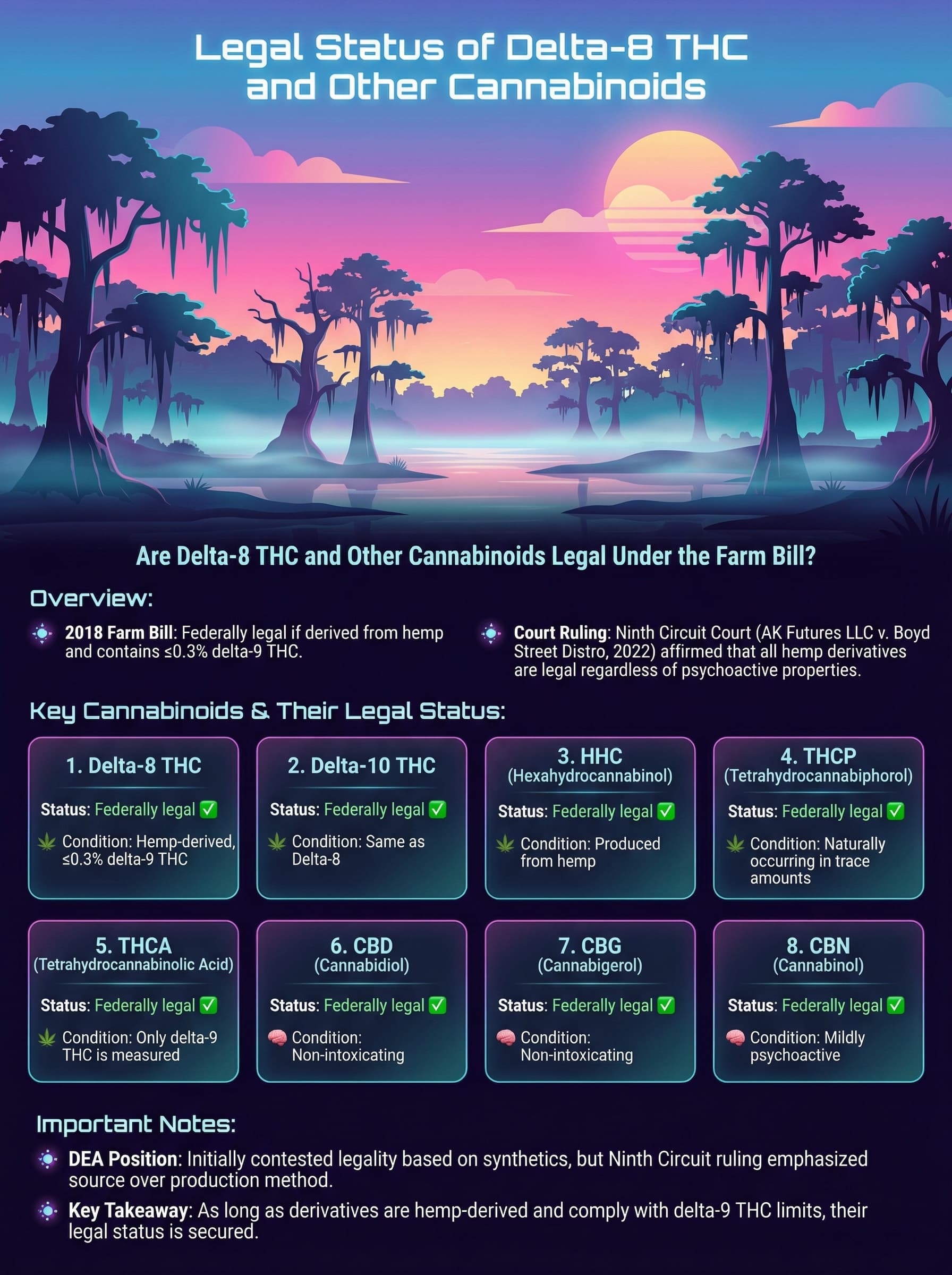
Delta-8 THC and other minor cannabinoids are currently federally legal under the 2018 Farm Bill if they are derived from hemp and the final product contains no more than 0.3% delta-9 THC. The Ninth Circuit Court of Appeals ruled in AK Futures LLC v. Boyd Street Distro (2022) that the "plain and unambiguous text" of the Farm Bill includes all hemp derivatives and cannabinoids, regardless of their psychoactive properties or manufacturing method, as long as they meet the delta-9 THC threshold.
The legal status of delta-8 THC had been contested since the DEA released an interim final rule in August 2020 stating that "all synthetically derived tetrahydrocannabinols remain Schedule I controlled substances." The DEA further opined in a 2021 letter to the Alabama Board of Pharmacy that delta-8 THC produced through chemical conversion from CBD would be considered synthetic THC.
However, the Ninth Circuit rejected these arguments, finding that the Farm Bill's definition of hemp "does not limit its application according to the manner by which derivatives, extracts, and cannabinoids are produced." The court stated that "the source of the product, not the method of manufacture, is the dispositive factor for ascertaining whether a product is synthetic."
Key cannabinoids and their current federal status:
- Delta-8 THC: Federally legal when hemp-derived and under 0.3% delta-9 THC (Ninth Circuit ruling)
- Delta-10 THC: Same legal framework as delta-8
- HHC (Hexahydrocannabinol): Legal under current interpretation; produced from hemp
- THCP (Tetrahydrocannabiphorol): Legal under current interpretation; naturally occurring in trace amounts
- THCA (Tetrahydrocannabinolic Acid): Currently legal; only delta-9 THC is measured, not THCA
- CBD (Cannabidiol): Legal; non-intoxicating cannabinoid
- CBG (Cannabigerol): Legal; non-intoxicating cannabinoid
- CBN (Cannabinol): Legal; mildly psychoactive cannabinoid
In my 15 years evaluating wellness products, I have observed this legal framework enable rapid product innovation. Manufacturers developed products featuring cannabinoids that were virtually unknown to consumers before the 2018 Farm Bill, each offering different effect profiles while remaining federally compliant.
How Do Hemp-Derived THC Gummies Remain Federally Legal?
Hemp-derived THC gummies remain federally legal by formulating products where the delta-9 THC content does not exceed 0.3% of the product's total dry weight. Manufacturers achieve this by creating heavier gummies, typically weighing 3 to 5 grams, which allows for 10 to 15 milligrams of THC per piece while staying within the legal threshold. The THC must be derived from hemp plants that themselves contain no more than 0.3% delta-9 THC.
The manufacturing process typically involves one of two approaches. First, some manufacturers extract naturally occurring delta-9 THC directly from hemp biomass during the distillation process. While hemp contains low concentrations of delta-9 THC, industrial extraction can concentrate these cannabinoids for use in finished products.
Second, some manufacturers use isomerization to convert CBD (which hemp produces in abundance) into delta-9 THC. CBD and delta-9 THC share similar molecular structures, and chemical processes can rearrange CBD molecules into delta-9 THC. The resulting delta-9 THC is molecularly identical to naturally occurring delta-9 THC.
What makes a hemp-derived gummy federally compliant:
- Source material: Hemp plant containing ≤0.3% delta-9 THC
- Final product concentration: ≤0.3% delta-9 THC by dry weight
- Calculation: THC milligrams ÷ product weight in milligrams ≤ 0.003
- Example: 10mg THC ÷ 3,500mg gummy = 0.00286 (0.286%) = Compliant
Quality brands like Enjoy Hemp formulate their THC gummies to meet these exact specifications, with third-party lab testing verifying both the THC content and the product weight to ensure federal compliance on every batch.
What Is the Difference Between Hemp and Marijuana Under Federal Law?
Under federal law, the only difference between hemp and marijuana is the delta-9 THC concentration. Hemp is cannabis containing 0.3% or less delta-9 THC on a dry weight basis and is not a controlled substance. Marijuana is cannabis containing more than 0.3% delta-9 THC and remains a Schedule I controlled substance under the Controlled Substances Act. Both plants are botanically the same species (Cannabis sativa L.) and can produce identical cannabinoids.
This legal distinction is entirely arbitrary from a botanical and chemical standpoint. The same cannabis plant could theoretically be classified as hemp one day and marijuana the next if environmental conditions caused its THC levels to fluctuate across the 0.3% threshold.
The USDA's hemp regulations establish testing protocols to determine compliance, including the concept of "measurement of uncertainty" that allows for some variance in testing results. If a sample tests at 0.35% but the measurement uncertainty is ±0.06%, the sample may still be considered compliant because 0.3% falls within the possible range.
Key legal distinctions:
Hemp (Federally Legal):
- Contains ≤0.3% delta-9 THC on dry weight basis
- Removed from Controlled Substances Act
- Can be shipped across state lines
- Regulated by USDA and FDA
- Banking and payment processing available
- Products sold in retail stores and online nationwide
Marijuana (Federally Illegal):
- Contains more than 0.3% delta-9 THC
- Schedule I controlled substance
- Interstate transport is a federal crime
- Legal in 24 states for recreational use
- Banking restrictions (limited to cash or state-chartered institutions)
- Products sold only through licensed dispensaries within legal states
What Federal Changes Are Coming in November 2026?
H.R. 5371, signed into law on November 12, 2025, fundamentally changes the federal definition of hemp effective November 12, 2026. The new law replaces the delta-9 THC only threshold with a "total THC" standard including THCA and all THC variants, caps final consumer products at 0.4 milligrams of total THC per container, and excludes synthetic or converted cannabinoids from hemp protections. These changes will effectively eliminate most currently marketed intoxicating hemp products.
According to legal analysis from Perkins Coie, the new definition will push many currently marketed products back into Schedule I status under the Controlled Substances Act once the changes take effect.
Key changes under H.R. 5371:
Total THC Standard:
- Hemp must contain ≤0.3% total THC (not just delta-9)
- Total THC includes THCA, delta-8, delta-10, and all THC variants
- THCA is calculated into total THC using the decarboxylation formula: Total THC = (0.877 × THCA) + delta-9 THC
Per-Container Cap:
- Final consumer products limited to ≤0.4 milligrams total THC per container
- "Container" means the innermost packaging in direct contact with the product
- This cap makes current gummies (5mg, 10mg, 25mg) non-compliant
Synthetic/Converted Cannabinoid Exclusion:
- Cannabinoids "synthesized or manufactured outside the plant" are not hemp
- Delta-8 THC (converted from CBD) loses federal protection
- HHC, THCP, and other converted cannabinoids are excluded
What Remains Protected:
- Industrial hemp (fiber, stalks, grain/seed oil, microgreens)
- Research programs at institutions of higher education
- Non-intoxicating CBD products meeting the new thresholds
The FDA is required to publish guidance within 90 days of enactment (by February 2026) including lists of naturally occurring cannabinoids, THC-class cannabinoids, and cannabinoids with "similar effects" to THC. These publications will significantly impact compliance requirements.
Frequently Asked Questions
Is It Legal to Buy THC Gummies Online?
Yes, it is currently legal to buy hemp-derived THC gummies online if they contain no more than 0.3% delta-9 THC by dry weight and ship to a state that allows hemp-derived THC products. The 2018 Farm Bill legalized interstate commerce of hemp and hemp-derived products, enabling nationwide online sales. However, individual states may restrict or prohibit these products, so buyers should verify their state's laws before purchasing.
What Is the Difference Between Hemp-Derived THC and Marijuana THC?
There is no chemical difference between hemp-derived THC and marijuana THC. Delta-9 THC has the same molecular structure regardless of which cannabis plant it comes from. The distinction is purely legal: THC from plants containing ≤0.3% delta-9 THC is classified as hemp-derived and federally legal, while THC from plants exceeding that threshold is marijuana-derived and federally illegal.
Will Hemp-Derived THC Products Still Be Legal After November 2026?
Most currently marketed intoxicating hemp-derived THC products will become federally illegal after November 12, 2026, when H.R. 5371 takes effect. Products exceeding 0.4 milligrams total THC per container or containing converted cannabinoids like delta-8 THC will no longer qualify as hemp. However, non-intoxicating hemp products, industrial hemp applications, and very low-dose THC products may remain compliant depending on FDA guidance.
Can Hemp-Derived THC Get You High?
Yes, hemp-derived THC can produce psychoactive effects identical to marijuana-derived THC because the delta-9 THC molecule is chemically identical regardless of source. The dry weight calculation in the 2018 Farm Bill allows products to contain meaningful doses (5mg, 10mg, 25mg or more) of THC while remaining under 0.3% concentration. These doses are comparable to or stronger than typical marijuana edibles.
Why Do Some States Ban Hemp-Derived THC Even Though It Is Federally Legal?
The 2018 Farm Bill delegated authority to states and tribes to regulate hemp within their borders, including the power to impose stricter requirements than federal law. States like Idaho, Oregon, Colorado, and New York have banned or heavily restricted certain hemp-derived THC products due to concerns about youth access, intoxication, and the lack of regulatory oversight compared to licensed marijuana programs.
Understanding Federal Hemp Law in 2026
The 2018 Farm Bill created a legal framework that enabled an estimated $28 billion hemp-derived cannabinoid industry by focusing solely on delta-9 THC concentration. For consumers, this means products like THC gummies and THC beverages from reputable brands like Enjoy Hemp are currently federally legal when they meet the 0.3% threshold.
However, the legal landscape is changing dramatically. H.R. 5371's amendments to the hemp definition will take effect in November 2026, fundamentally altering what products qualify for federal protection. Consumers should stay informed about these changes and understand that products legal today may not be legal after the transition date.
In my 15 years evaluating wellness products, I have seen regulatory frameworks evolve repeatedly. The key for consumers is purchasing from transparent brands that provide third-party lab testing, clearly label their products, and demonstrate commitment to compliance with current and evolving regulations. Quality brands invest in proper testing and formulation because they prioritize both legal compliance and consumer safety.
By Sarah Mitchell, Wellness Industry Specialist
Sarah Mitchell is a wellness industry veteran with 15 years of experience in functional supplements and hemp-derived products. She previously led product development at two nationally recognized wellness brands and holds certification as a holistic health practitioner. Sarah now advises consumers on quality standards, helping them make informed decisions in the evolving hemp market.
Disclaimer: This article is for educational purposes only and does not constitute legal advice. Cannabis laws are complex and change frequently. The legal status of hemp-derived THC products varies by state and is subject to ongoing federal legislative changes. Consult applicable laws in your jurisdiction and consider seeking legal counsel for specific compliance questions.