






How to Spot a Quality THC Brand: Lab Testing and Red Flags
Posted by Enjoy Hemp Editor Team on Feb 24th 2026
Last Updated: February 2026
Spotting a quality THC brand requires knowing how to verify lab testing and recognize warning signs of unsafe or dishonest products. Studies show that 60% of cannabis products have inaccurate potency labels, 86% of tested dispensary products contained pesticides, and countless unregulated hemp products contain contaminants never disclosed to consumers. The Certificate of Analysis (COA) from an ISO 17025 accredited third-party laboratory is your only reliable verification tool, but you need to know what to look for and what red flags should send you elsewhere.
In my 15 years evaluating wellness products, I have seen the hemp-derived THC market grow from a handful of CBD brands to thousands of companies selling everything from gummies to flower to vapes. This explosive growth has attracted both legitimate manufacturers committed to quality and opportunistic sellers who cut every corner possible. Learning to tell the difference protects both your health and your wallet.
| Quality Indicator | What to Look For | Red Flags to Avoid |
|---|---|---|
| Lab Testing (COA) | Batch-specific COA from ISO 17025 accredited third-party lab; easily accessible via QR code or website | No COA available; COA older than 12 months; batch numbers do not match; in-house testing only |
| Potency Accuracy | COA potency matches label within 10%; realistic percentages for product type | Suspiciously round numbers (exactly 25.0%); flower claiming 40%+ THCA; label and COA mismatch |
| Contaminant Testing | Full panel: pesticides, heavy metals, residual solvents, microbials; all show "ND" or "Pass" | Potency-only testing; missing contaminant panels; blank sections; any "Fail" results |
| Pricing | Competitive with established brands; reflects quality ingredients and testing costs | Dramatically below market average; "too good to be true" deals; suspiciously cheap bulk pricing |
| Transparency | Clear company information; disclosed hemp sourcing; stated extraction methods; responsive customer service | Anonymous ownership; vague sourcing; no contact information; unresponsive to questions |
| Claims and Marketing | Appropriate disclaimers; "may support" language; no medical claims | "Cures" or "treats" claims; fake celebrity endorsements; child-appealing packaging |
What Is a Certificate of Analysis and Why Does It Matter?
A Certificate of Analysis (COA) is an official laboratory report documenting the exact chemical composition and safety testing results of a cannabis or hemp product. It verifies cannabinoid potency (THC, CBD, and other compounds), confirms federal compliance (delta-9 THC at or below 0.3% for hemp), and screens for dangerous contaminants like pesticides, heavy metals, residual solvents, and microbial pathogens. Without a COA from an accredited third-party lab, you have no way to verify what is actually in a product.
When I led product development at wellness brands, we considered third-party testing non-negotiable. The COA is the only data-driven verification that exists in an industry with minimal federal oversight. According to research published in the Journal of Cannabis Research, 60% of cannabis products had inaccurate potency labels (overlabeled), while 25% were underlabeled, creating both efficacy and safety concerns.
What a complete COA should include:
- Laboratory information: Name, address, phone number, ISO 17025 accreditation number
- Product identification: Product name, batch/lot number matching your package
- Test date: Within the past 6 to 12 months
- Cannabinoid potency panel: THC, THCA, CBD, CBG, CBN, and other cannabinoids
- Contaminant testing: Pesticides, heavy metals, residual solvents, microbial screening
- Pass/Fail status: Clear indication for each testing category
- Terpene profile: Optional but indicates higher quality testing
How Do You Read a THC Product Lab Report?
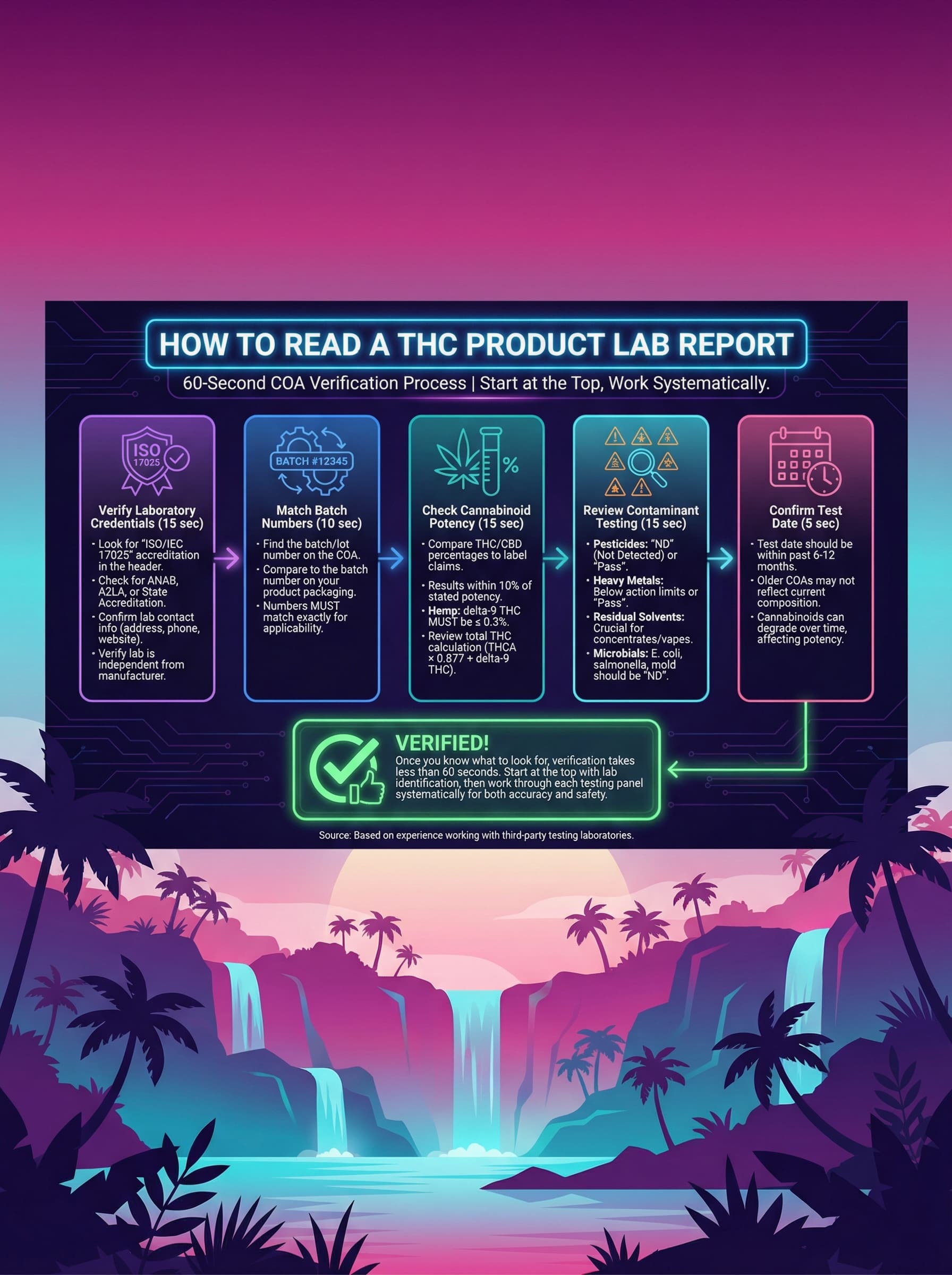
Reading a THC lab report requires checking five key areas: laboratory credentials (ISO 17025 accreditation), batch number verification (matches your product), cannabinoid potency (THC/THCA percentages match label claims within 10%), contaminant results (all show "ND" for Not Detected or "Pass"), and test date (within 12 months). Start at the top with lab identification, then work through each testing panel systematically to verify both accuracy and safety.
From my experience working with third-party testing laboratories, most consumers feel overwhelmed when first viewing a COA. The document contains scientific terminology and numerical data that seems impenetrable. However, once you know what to look for, verification takes less than 60 seconds.
Step-by-step COA verification process:
Step 1: Verify Laboratory Credentials (15 seconds)
- Look for "ISO/IEC 17025" accreditation in the header
- Check for accreditation from ANAB, A2LA, or state-specific bodies
- Confirm lab contact information is provided (address, phone, website)
- Verify lab is independent from the product manufacturer
Step 2: Match Batch Numbers (10 seconds)
- Find the batch or lot number on the COA
- Compare to the batch number on your product packaging
- Numbers must match exactly for the COA to apply to your product
Step 3: Check Cannabinoid Potency (15 seconds)
- Compare THC/CBD percentages to label claims
- Results should be within 10% of stated potency
- For hemp products, delta-9 THC must be at or below 0.3%
- Look for total THC calculation (THCA × 0.877 + delta-9 THC)
Step 4: Review Contaminant Testing (15 seconds)
- Pesticides: Should show "ND" (Not Detected) or "Pass"
- Heavy metals: All metals below action limits or "Pass"
- Residual solvents: Especially important for concentrates and vapes
- Microbials: E. coli, salmonella, mold should all be "ND"
Step 5: Confirm Test Date (5 seconds)
- Test date should be within past 6 to 12 months
- Older COAs may not reflect current product composition
- Cannabinoids can degrade over time, affecting potency
What Are the Biggest Red Flags When Evaluating THC Brands?
The biggest red flags include: no COA available or refusal to share testing, missing contaminant panels (potency-only testing), outdated test results older than 12 months, batch numbers that do not match your product, suspiciously low prices far below market average, medical claims like "cures" or "treats," packaging designed to appeal to children, unverifiable laboratory credentials, and anonymous company ownership with no contact information.
In my 15 years evaluating wellness products, these warning signs have consistently indicated products that are mislabeled, contaminated, or outright fraudulent. The hemp-derived THC market remains largely unregulated at the federal level, creating opportunities for bad actors.
Critical red flags to avoid:
Testing Red Flags:
- No COA available: If a brand cannot provide a COA, do not purchase
- In-house testing only: Testing must be from independent third-party lab
- Potency-only testing: Contaminant screening is essential for safety
- Outdated results: COAs older than 12 months may not reflect current batches
- Batch mismatch: COA batch number must match product packaging exactly
- Missing lab credentials: No ISO 17025 accreditation or contact information
- Suspiciously perfect numbers: Exactly round percentages suggest fabrication
Marketing Red Flags:
- Medical claims: "Cures anxiety," "treats pain," "eliminates insomnia"
- Fake celebrity endorsements: Unauthorized use of famous names or images
- Child-appealing packaging: Mimics popular candy or snack brands
- Claims to ship everywhere: Ignores state-specific restrictions
- "Free trial" traps: Recurring charges hidden in fine print
Business Red Flags:
- Dramatically low prices: Quality extraction and testing cost money
- No company information: Anonymous ownership, no physical address
- Unresponsive customer service: No reply to questions about testing or sourcing
- No return policy: Legitimate brands stand behind their products
- Only available through unverified marketplaces: Sold exclusively on Amazon or through social media ads
What Contaminants Should Lab Testing Screen For?
Comprehensive lab testing should screen for pesticides (agricultural chemicals that can accumulate with regular use), heavy metals (lead, arsenic, cadmium, and mercury from soil or equipment), residual solvents (butane, ethanol, and other extraction chemicals), microbial contaminants (E. coli, salmonella, mold, and yeast), and mycotoxins (toxic compounds produced by certain molds). Each category requires specific testing methods, and all results should show "ND" (Not Detected) or fall below established safety thresholds.
Based on my experience working with product safety teams, contaminant testing is where many brands cut corners to save money. Potency testing alone costs less than comprehensive safety panels, but potency-only COAs provide false confidence while leaving consumers exposed to real health risks.
Contaminant categories explained:
Pesticides:
- Why it matters: Cannabis can absorb pesticides from soil and retain them through processing
- Research finding: 86% of regulated dispensary products in one Washington State study contained pesticides
- What to look for: Full pesticide panel with all results showing "ND" or "Pass"
- Common concerns: Myclobutanil, bifenazate, imidacloprid
Heavy Metals:
- Why it matters: Cannabis is a bioaccumulator that pulls heavy metals from soil
- Key metals tested: Lead, arsenic, cadmium, mercury
- What to look for: All metals below action limits (typically in parts per million)
- Particular concern for: Vape cartridges (hardware can leach metals)
Residual Solvents:
- Why it matters: Extraction processes often use solvents that can remain in final products
- Common solvents: Butane, propane, ethanol, hexane, isopropyl alcohol
- What to look for: All solvents below Class 1, 2, or 3 limits
- Most important for: Concentrates, distillates, vape oils
Microbial Contaminants:
- Why it matters: Mold, bacteria, and pathogens can cause illness, especially in immunocompromised users
- Key tests: Total yeast and mold, E. coli, salmonella, aspergillus
- What to look for: "ND" (Not Detected) for all pathogenic organisms
- Most important for: Flower, edibles, anything consumed orally or inhaled
Mycotoxins:
- Why it matters: Toxic compounds produced by certain molds, even after mold is killed
- Key mycotoxins: Aflatoxins, ochratoxin A
- What to look for: Results below established action limits or "ND"
- Special concern: Products that may have been remediated after initial mold detection
What Makes a Testing Laboratory Trustworthy?
A trustworthy testing laboratory holds ISO/IEC 17025 accreditation from a recognized accrediting body like ANAB or A2LA, operates independently from the brands it tests, uses validated testing methods with documented procedures, participates in proficiency testing programs, and provides verifiable contact information. The laboratory should display accreditation credentials on COAs and allow direct verification of results through their own systems rather than only through the brand's website.
When I worked with extraction specialists on compliance issues, laboratory selection was a critical quality control decision. Not all labs deliver the same accuracy, and some brands engage in "lab shopping," testing with multiple labs until they get favorable results.
Key laboratory quality indicators:
ISO/IEC 17025 Accreditation:
- International gold standard for testing laboratory competence
- Requires documented quality management systems
- Labs undergo regular third-party audits and proficiency testing
- Accreditation bodies: ANAB, A2LA, PJLA, state-specific programs
Independence:
- Laboratory must have no financial relationship with brands it tests
- Lab address should be different from product manufacturer
- In-house testing creates obvious conflicts of interest
Verifiability:
- Contact information provided on COA (phone, address, website)
- Results can be confirmed directly with lab using batch/sample ID
- Many labs offer online verification portals
- QR codes should link to lab's database, not just brand's website
Consistency:
- Quality brands use the same accredited lab consistently
- Frequent lab changes may indicate "shopping" for favorable results
- Established lab relationships suggest commitment to quality
How Can You Verify a THC Brand's Reputation?
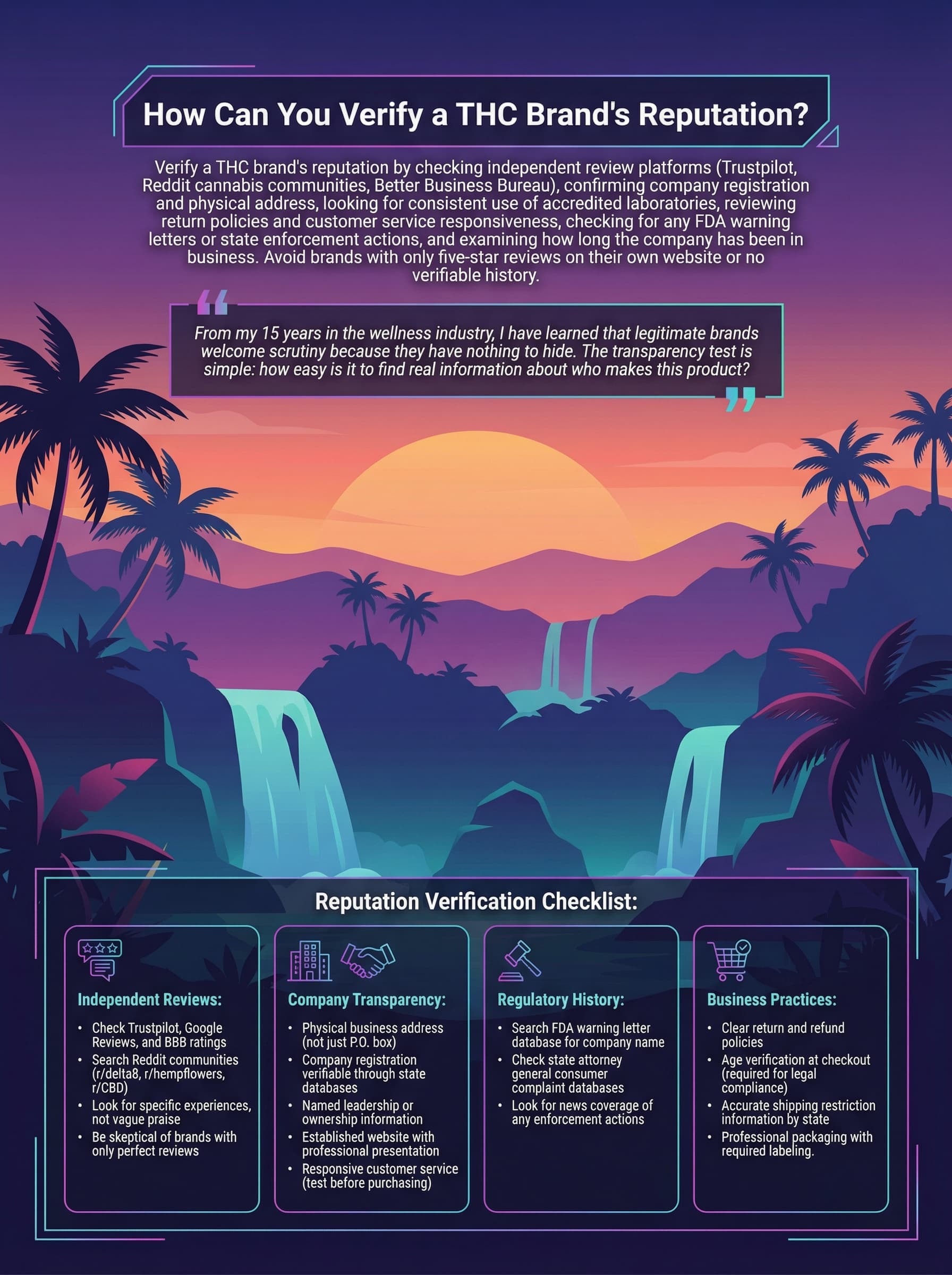
Verify a THC brand's reputation by checking independent review platforms (Trustpilot, Reddit cannabis communities, Better Business Bureau), confirming company registration and physical address, looking for consistent use of accredited laboratories, reviewing return policies and customer service responsiveness, checking for any FDA warning letters or state enforcement actions, and examining how long the company has been in business. Avoid brands with only five-star reviews on their own website or no verifiable history.
From my 15 years in the wellness industry, I have learned that legitimate brands welcome scrutiny because they have nothing to hide. The transparency test is simple: how easy is it to find real information about who makes this product?
Reputation verification checklist:
Independent Reviews:
- Check Trustpilot, Google Reviews, and BBB ratings
- Search Reddit communities (r/delta8, r/hempflowers, r/CBD)
- Look for specific experiences, not vague praise
- Be skeptical of brands with only perfect reviews
Company Transparency:
- Physical business address (not just P.O. box)
- Company registration verifiable through state databases
- Named leadership or ownership information
- Established website with professional presentation
- Responsive customer service (test before purchasing)
Regulatory History:
- Search FDA warning letter database for company name
- Check state attorney general consumer complaint databases
- Look for news coverage of any enforcement actions
Business Practices:
- Clear return and refund policies
- Age verification at checkout (required for legal compliance)
- Accurate shipping restriction information by state
- Professional packaging with required labeling
What Should Quality THC Product Packaging Include?
Quality THC product packaging should include clear cannabinoid content (THC/CBD in milligrams per serving and per package), batch or lot number matching COA, QR code linking to lab results, complete ingredient list, manufacturer name and contact information, appropriate warnings and disclaimers, child-resistant closure, and net weight in both metric and U.S. units. Professional packaging signals regulatory compliance and brand accountability.
Based on my experience evaluating hundreds of hemp products, packaging quality often reflects overall product quality. Brands investing in compliant, professional packaging typically invest equally in product safety and testing.
Required and recommended packaging elements:
Cannabinoid Information:
- Total THC per package in milligrams
- THC per serving/unit in milligrams
- Total servings per package
- CBD content if applicable
Traceability:
- Batch or lot number for COA matching
- Manufacturing or packaging date
- Expiration or best-by date
- QR code linking to batch-specific lab results
Company Information:
- Manufacturer or distributor name
- Contact information (website, phone, or address)
- State of manufacture/production
Safety and Compliance:
- Child-resistant packaging (required in most states)
- "Keep out of reach of children" warning
- Impairment warning (do not drive or operate machinery)
- 21+ age restriction notice
- Hemp-derived product statement for federal compliance
Packaging red flags:
- Mimics popular candy, cereal, or snack brands
- Uses cartoon characters or child-appealing imagery
- Missing batch number or COA access
- No manufacturer identification
- Vague or missing potency information
- Easy-open packaging (not child-resistant)
Frequently Asked Questions
Can I Trust COAs Posted on a Brand's Website?
COAs on a brand's website are a starting point but require verification. Confirm that the batch number matches your product, check that the laboratory is ISO 17025 accredited and independent from the manufacturer, and ideally verify results directly with the testing laboratory using their contact information or online verification portal. Some brands post outdated or fabricated COAs, so independent verification provides additional assurance.
What Does "ND" Mean on a Lab Report?
"ND" stands for "Not Detected," meaning the laboratory's instruments could not detect measurable levels of that compound within their testing sensitivity (also called Limit of Detection or LOD). For contaminants like pesticides, heavy metals, and pathogens, "ND" is the ideal result indicating none were found. For minor cannabinoids, "ND" simply means they are not present at detectable levels.
How Often Should a Brand Update Their Lab Testing?
Quality brands should test every production batch, not just periodically. Each COA should be batch-specific with a unique lot number corresponding to that specific manufacturing run. COAs older than 6 to 12 months may not accurately represent current products due to cannabinoid degradation over time. If a brand only has one generic COA for all products or all batches, this indicates inadequate testing practices.
Are More Expensive THC Products Always Higher Quality?
Higher price does not automatically guarantee higher quality, but extremely low prices are a reliable warning sign. Quality hemp extraction, comprehensive lab testing, and compliant packaging all cost money. Brands selling products at dramatically below market prices are likely cutting corners somewhere, whether through inadequate testing, lower-quality ingredients, or inaccurate labeling. Compare prices among established, reputable brands to understand reasonable market ranges.
What Is the Difference Between Full-Panel and Potency-Only Testing?
Potency-only testing measures cannabinoid content (THC, CBD, etc.) but does not screen for contaminants. Full-panel testing includes potency plus comprehensive safety screening for pesticides, heavy metals, residual solvents, and microbial contaminants. Potency-only testing is cheaper but leaves consumers without safety verification. Quality brands always provide full-panel testing regardless of cost because consumer safety is non-negotiable.
Choosing Quality THC Brands in an Unregulated Market
The hemp-derived THC market offers remarkable product diversity, but the lack of federal regulation means consumers must become their own quality control inspectors. The COA from an ISO 17025 accredited third-party laboratory is your essential verification tool, but only if you know how to read it and what red flags to avoid.
In my 15 years evaluating wellness products, I have consistently found that transparent brands welcome questions about their testing and sourcing. Companies that make their COAs easily accessible, use consistent accredited laboratories, provide clear company information, and stand behind their products with reasonable return policies demonstrate the commitment to quality that consumers deserve.
Brands like Enjoy Hemp exemplify these quality standards with USDA-certified organic products, comprehensive third-party testing, and transparent lab result access. Their commitment to quality is evident across their THC gummies, THC drinks, and other product lines, with batch-specific COAs available for verification.
Before purchasing any THC product, take 60 seconds to verify lab testing, check for red flags, and confirm you are buying from a brand that prioritizes your safety. That small investment of time protects both your health and ensures you receive the quality product you are paying for.
By Sarah Mitchell, Wellness Industry Specialist
Sarah Mitchell is a wellness industry veteran with 15 years of experience in functional supplements and hemp-derived products. She previously led product development at two nationally recognized wellness brands and holds certification as a holistic health practitioner. Sarah now advises consumers on quality standards, helping them make informed decisions in the evolving hemp market.
Disclaimer: This article is for educational purposes only and does not constitute product endorsement or safety guarantees. Cannabis and hemp product quality can vary significantly between brands and batches. Always verify lab testing independently before purchasing. Individual state regulations regarding hemp-derived THC products vary. Consult applicable laws in your jurisdiction before making any purchase.